

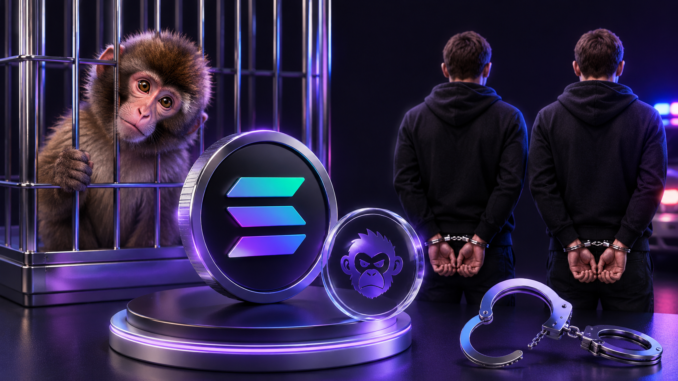

Two American men were arrested in Japan after one allegedly entered the enclosure of Punch, the viral baby macaque at Ichikawa City Zoo, during a stunt tied to a Solana meme coin promotion.
The incident took place on May 17 at the zoo in Ichikawa, east of Tokyo. Reid Jahnai Dayson, 24, allegedly climbed over a fence and entered the monkey enclosure, while Neal Jabahri Duan, 27, allegedly filmed him. Footage shared online showed a person in an emoji-style costume inside the enclosure area as the monkeys moved away.

The men were arrested on suspicion of forcible obstruction of business. They denied the charge, and the case remains a police matter. Zoo staff quickly intervened, and the monkeys were not reported to have been harmed.
The crypto angle surfaced after the stunt was tied to promotion of a Solana meme coin. The incident drew millions of views online, turning a zoo security breach into another example of meme-coin marketing colliding with real-world consequences.
Punch’s Viral Fame Made The Stunt More Sensitive
Punch became an internet favorite earlier this year after images of the young macaque holding a stuffed orangutan spread across social platforms. The monkey had been rejected by his mother and later became known for bonding with the plush toy while being cared for at Ichikawa City Zoo.
That viral attention brought more visitors to the zoo and made Punch a recognizable online figure. It also made the enclosure a target for a stunt designed to capture attention quickly. In meme-coin markets, visibility can be treated as liquidity fuel, but this case shows how quickly that incentive can cross into legal and safety risk.
Ichikawa City Zoo moved to tighten security after the breach. The zoo restricted viewing access to the enclosure area, added intrusion-prevention nets and increased patrols. The facility also said no abnormalities had been observed among the animals after the incident.
Meme Coin Promotion Faces A Harder Line
The Punch incident is not a normal marketing campaign. It is now tied to arrests, a zoo security response and allegations that a viral animal was used as a backdrop for token promotion.
Meme coins often trade on attention, speed and social shock value. That model can create short bursts of liquidity when traders rush into a narrative, but it also encourages increasingly aggressive stunts when teams or promoters chase visibility. Recent meme coin coverage around real-world headline catalysts has already shown how fast attention can move into speculative tokens without changing the underlying asset’s fundamentals.
The legal risk is now the main story. A meme coin can use online culture, animals, celebrities or political moments as branding, but physical trespass, public disturbance and animal-safety concerns move the campaign into a different category. The zoo’s response also limits any claim that the stunt was harmless simply because the monkeys were not injured.
The next developments will come from Japanese authorities and the zoo’s security response. For crypto traders, the case is a reminder that attention-driven token marketing can become a liability when promotion leaves social media and enters public spaces, especially when animals, tourists, local laws and police involvement are part of the outcome.


Be the first to comment