



Ethereum price remained under pressure on Tuesday as worsening technical structure, aggressive ETF outflows, and accelerating whale distribution pushed traders to closely monitor whether the key $2,000 psychological support level could soon fail.
Summary
- Ethereum price slipped below the lower boundary of a bullish ascending channel as ETF outflows exceeded $255 million.
- Around 60 Ethereum whale addresses holding at least 10,000 ETH have exited or consolidated positions over the past two months.
- CoinGlass data showed dense liquidation clusters near the $2,050–$2,000 region, raising the risk of accelerated long liquidations if ETH loses current support levels.
According to data from crypto.news, Ethereum (ETH) traded around $2,120 at press time on May 20 after slipping below the lower boundary of a bullish ascending channel visible on the daily chart. The asset has now erased much of its rebound from April lows after repeatedly failing to reclaim the $2,300 resistance region during recent recovery attempts.

The latest breakdown has strengthened bearish sentiment because ascending channels are generally viewed as bullish continuation formations. When price decisively loses the lower support trendline, it often signals weakening buyer momentum and the potential start of a deeper correction phase.
Ethereum’s broader trend structure also remains unfavorable. The daily chart shows ETH continuing to trade below the Supertrend resistance indicator near $2,338, indicating that sellers still maintain control over the dominant trend.
Momentum indicators have similarly deteriorated in recent sessions. The Relative Strength Index has dropped toward the mid-30 region, reflecting weakening bullish momentum without yet reaching deeply oversold conditions. That distinction remains important because crypto assets often experience stronger relief rallies only after signs of seller exhaustion become more visible.
At the same time, institutional demand for Ethereum exposure has continued to deteriorate.
U.S.-listed spot Ethereum ETFs recently recorded more than $148 million in net outflows so far this week, while cumulative withdrawals over the past several sessions crossed $255 million. The persistent outflow streak has significantly reduced immediate buy-side liquidity during a period of elevated macro uncertainty across financial markets.
Per data from SoSoValue, BlackRock’s ETHA and Fidelity’s FETH continued accounting for a large share of recent withdrawals as institutional investors reduced exposure to risk assets.
The sustained ETF weakness comes as several large financial firms have recently turned more cautious on crypto flows.
JPMorgan analysts recently noted that Ethereum ETF demand has remained weaker than many market participants initially expected following launch enthusiasm earlier this year. The bank reportedly pointed to lower institutional participation, limited staking integration, and growing competition from Bitcoin ETFs as factors constraining sustained inflows into Ethereum investment products.
The bank additionally suggested that macroeconomic uncertainty and elevated Treasury yields were contributing to a weaker appetite for high-beta digital assets.
Meanwhile, crypto market maker Wintermute recently noted that Ethereum ETF flows have remained considerably weaker than many institutional participants initially expected following launch enthusiasm earlier in the cycle.
The firm suggested that short-term institutional positioning had become increasingly defensive amid deteriorating macroeconomic conditions and reduced speculative appetite across crypto markets.
Broader de-risking trends have also intensified following persistent inflation concerns and rising bond yields. U.S. 10-year Treasury yields recently climbed toward multi-month highs, increasing the opportunity cost of holding non-yielding assets such as Ethereum.
Energy markets have additionally contributed to weaker sentiment across risk assets. Brent crude oil recently remained elevated amid ongoing geopolitical tensions involving the United States and Iran, further pressuring broader crypto market appetite.
At the same time, traders are becoming increasingly concerned about large-holder activity on the Ethereum network.
Why are Ethereum whales reducing exposure?
Recent on-chain data suggests that major Ethereum holders have been aggressively scaling back positions over the past several weeks.
Crypto analyst Ali Martinez recently highlighted a sharp decline in the number of large Ethereum whale addresses.
“Over the past two months, approximately 60 whale addresses holding 10,000 ETH or more have completely emptied or consolidated their balances,” Martinez wrote in a May 20 X post.
Martinez warned that such large-scale exits frequently signal institutional profit-taking and declining mid-term confidence among major market participants.
“When distinct entities with multi-million dollar positions exit the network in such a short window, it typically signals institutional profit-taking and asset relocation,” he said.
The analyst additionally noted that the reduction in whale participation coincided with heavy exchange inflows, often interpreted by traders as a sign that large holders may be preparing to sell.
The whale distribution trend has emerged alongside rising concerns about weakening market liquidity.
Several major wallets, including addresses associated with early Ethereum participants and treasury firms, have recently transferred significant amounts of ETH toward centralized exchanges. While exchange transfers do not always indicate immediate selling intent, traders frequently view such activity as a bearish signal during already fragile market conditions.
Ethereum’s market dominance has also continued slipping during recent weeks as capital rotates toward stablecoins and defensive positioning.
At the same time, broader participation across Ethereum derivatives markets has weakened substantially.
Open interest across Ethereum futures markets has declined following repeated failed breakout attempts above the $2,200 and $2,300 resistance zones. Reduced speculative participation often limits the strength of recovery rallies because fewer traders remain willing to aggressively increase bullish exposure.
The broader leverage structure has also become increasingly unstable.
More than $600 million in leveraged crypto long positions were recently liquidated after Ethereum faced another rejection near the $2,400 region. The liquidation cascade significantly weakened trader confidence and triggered further deleveraging across altcoin markets.
Polymarket prediction pools now assign roughly a 56% probability that Ethereum could fall below $2,000 before the end of May, reflecting increasingly bearish market expectations.
Could a liquidation cascade accelerate ETH’s drop below $2,000?
Ethereum’s current technical structure suggests the market may be approaching a highly sensitive volatility zone.
On the daily chart, ETH recently broke the lower boundary of its ascending channel after spending several weeks consolidating within the formation. Failed bullish continuation patterns often trap late long-position traders, increasing the risk of accelerated downside movement once support gives way.
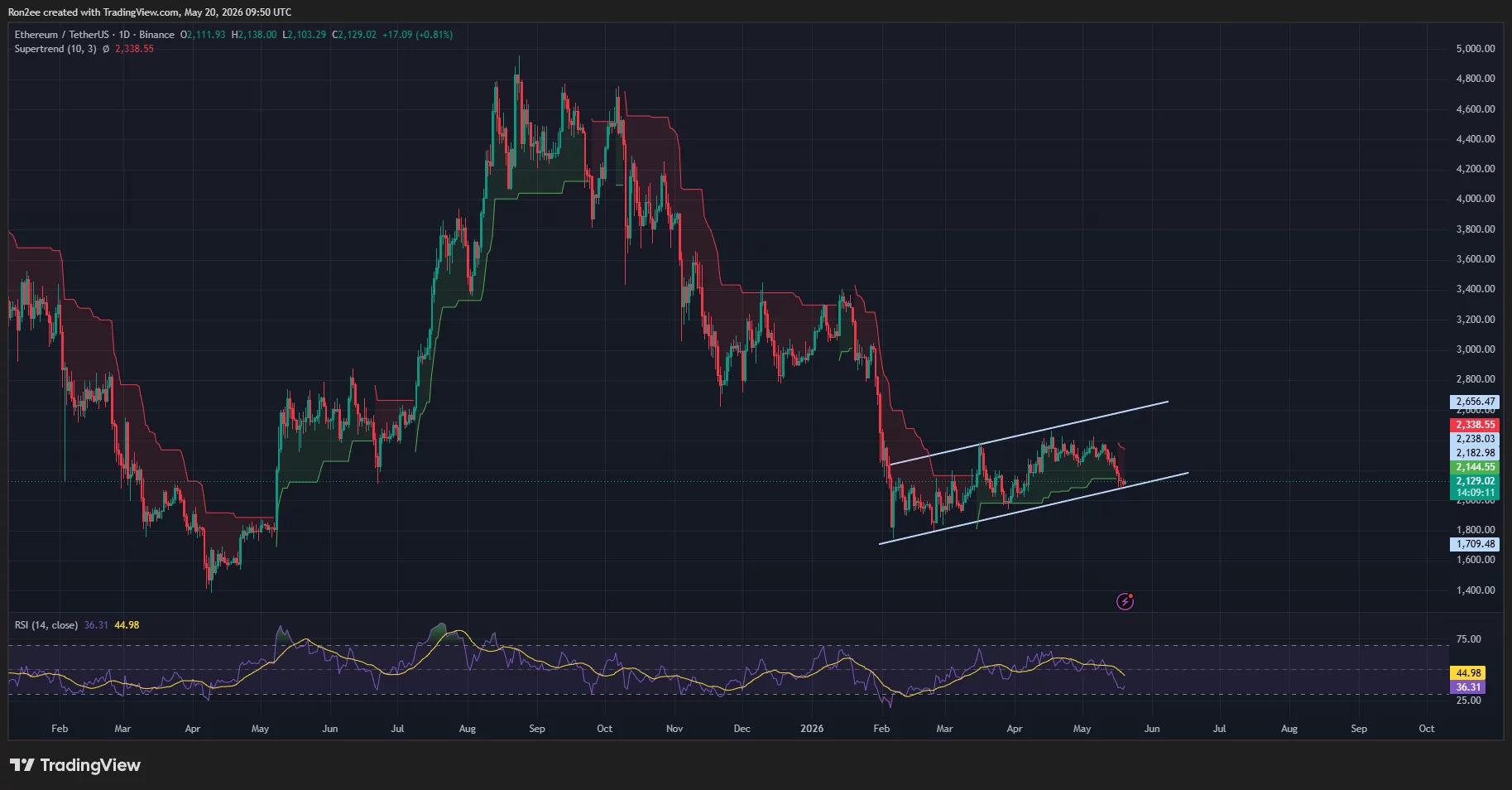
The breakdown becomes especially important because Ethereum had already failed multiple times to reclaim the $2,300 resistance region before losing channel support.
That repeated rejection reinforced the broader lower-high structure that has dominated Ethereum’s trend throughout recent months.
CoinGlass liquidation heatmap data additionally shows dense leverage clusters sitting near both the $2,150 resistance area and the lower $2,050–$2,000 support region.
Those liquidity pockets remain important because heavily leveraged positions frequently attract short-term volatility due to concentrated stop-loss orders and forced liquidation triggers.
If Ethereum successfully reclaims the $2,150 region, short liquidations could potentially fuel a temporary relief rally toward higher liquidity zones.
However, the downside liquidity structure currently appears more vulnerable.
A decisive breakdown below $2,050 could trigger a fresh wave of forced long liquidations as overleveraged traders begin exiting positions simultaneously. That dynamic becomes particularly dangerous in crypto markets because perpetual futures traders often use significantly higher leverage compared to traditional financial markets.
If liquidation pressure accelerates below $2,000, Ethereum could rapidly revisit lower support zones near $1,850 or even the broader structural support region around $1,700.
The psychological significance of the $2,000 level further increases the probability of heightened volatility. Round-number support zones often attract concentrated trader positioning, automated stop-loss activity, and liquidation clusters.
Broader sentiment across altcoins has also weakened as investors continue rotating toward safer assets amid rising macroeconomic uncertainty.
Still, some longer-term Ethereum fundamentals remain relatively stable despite the current correction. Institutional experimentation involving tokenization, stablecoins, and Ethereum-based financial infrastructure continues expanding gradually even as short-term market sentiment deteriorates.
Disclosure: This article does not represent investment advice. The content and materials featured on this page are for educational purposes only.



Be the first to comment