

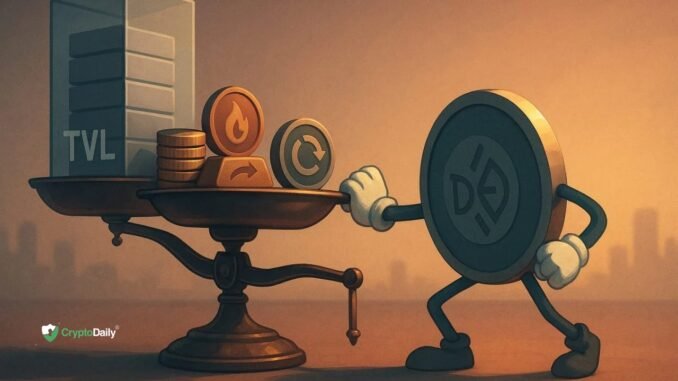

Many DeFi dashboards spotlight total value locked (TVL) as the headline number. But TVL is a balance-sheet figure, not a profit-and-loss statement. If you’re trying to value revenue tokens, you need to follow the cash flows—where fees originate, how they route, and whether buybacks or burns actually accrue value to holders.
This explainer outlines why fees, burns, and buybacks can matter more than TVL, and how to evaluate DeFi tokens with a simple, repeatable framework. It includes model comparisons, quick metrics you can compute, and pitfalls to avoid. It’s educational only—not financial advice.
Where possible, consult primary sources: protocol docs, on-chain analytics, and community governance forums. Third-party aggregators can help, but always verify what portion of “protocol revenue” reaches token holders.

| Point | Details |
|---|---|
| TVL ≠ cash flow | High TVL may indicate utility or leverage, but says little about fee capture or tokenholder accrual. |
| Fees are the engine | Trading, lending, staking, and liquidation fees power sustainable revenue—if tokenholders actually receive a cut. |
| Burns and buybacks | Burns reduce supply; buybacks add demand. They matter only if they’re funded and outpace emissions/unlocks. |
| Route of accrual | Revenue can go to LPs, validators, treasuries, or stakers. Map the path before valuing a token. |
| Quality over quantity | Organic usage and sticky volumes generally beat mercenary incentives bloating TVL. |
| Risk lives in the details | Discretionary treasury policies, token unlocks, and governance changes can alter accrual overnight. |
TVL is not revenue: why the headline number misleads
TVL aggregates the value of assets deposited in a protocol. It can indicate traction, but it’s not income. A lending market with oversized liquidity but little borrowing may report large TVL while earning limited interest spread. Conversely, a derivatives venue with modest collateral can generate substantial trading fees and funding payments.
Common ways TVL misleads:
- Leverage loops: The same stablecoin may be rehypothecated across money markets, inflating aggregate TVL without adding users or revenue.
- Mercenary incentives: High inflationary rewards can attract deposits temporarily; when incentives drop, TVL can evaporate.
- Idle capital: Some strategies maximize TVL optics rather than fee-generating activity; idle collateral rarely pays tokenholders.
- Non-token accrual: Even when a protocol earns, the token may not capture it (fees go to LPs or treasury only).
Think of TVL as an input. The outputs that matter to a token are fees, buybacks, and burns—net of emissions.
Where token value actually comes from
Revenue tokens attempt to link protocol success to tokenholder outcomes. The linkage can be direct or indirect:
- Direct share of fees: A specified cut of protocol fees is distributed to stakers or locked tokenholders.
- Buyback-and-burn: The protocol uses fees to purchase tokens on the market and burn them, reducing supply.
- Buyback-and-make: Fees fund open-market purchases, then redistribute to stakers or treasury (no burn).
- Fee discounts/utility: Holding or locking the token reduces fees or boosts yields (indirect value via demand for utility).
- Governance leverage: Tokens control parameters that attract “bribes” or incentives (common in veToken models), indirectly benefiting lockers.
Each pathway has different sustainability profiles. Direct fee sharing and transparent buybacks tend to be easier to model than purely speculative utility or governance-only designs.
Fees, burns and buybacks: the three pipes that matter
1) Fees: who earns them, in what asset, and how often?
Fees can include trading commissions, borrowing costs, liquidation penalties, funding, and staking commissions. Key questions:
- Distribution: Do fees go to LPs/validators only, or also to token stakers/lockers?
- Asset and cadence: Are fees paid in a blue-chip asset (e.g., ETH or stablecoins) or the native token? Are they claimable continuously or batch-settled?
- Sensitivity: How cyclical are fees to market volatility, volumes, and interest rates?
Why it matters: A token that never touches fees is, by design, a governance or utility token—not a revenue token. That’s fine, but value drivers differ.
2) Burns: permanent supply reduction—or just optics?
Burns destroy tokens, usually funded by fees or a portion of emissions.
- Source of burn: Are burns paid by real revenue, or via newly minted tokens (which is circular)?
- Predictability: Are burns programmatic (transparent) or ad hoc (discretionary)?
- Net effect: Do burns outpace emissions and unlocks? If not, circulating supply can still grow.
Why it matters: Net supply change, not the existence of a burn mechanism, drives scarcity. A token can “burn” regularly and still inflate if emissions are larger.
3) Buybacks: demand creation—if funded and well-designed
Buybacks add organic bid pressure when the protocol uses fees to purchase tokens on the open market.
- Programmatic vs. discretionary: Transparent rules reduce governance risk and front-running.
- Timing: Continuous micro-buybacks minimize signaling risk; sporadic large buybacks can be front-run.
- Destination: Are repurchased tokens burned, re-locked for governance, or used for future incentives?
Buybacks work best when they’re fee-funded, rules-based, and paired with moderate emissions that don’t overwhelm the sink.
Pro tip: Track not just the existence of these mechanisms, but their throughput. A narrow pipe won’t move valuation.
Practical metrics to track beyond TVL
Protocol revenue vs. tokenholder revenue
Start by separating gross protocol revenue from what actually accrues to tokenholders. Aggregators like DeFiLlama’s Fees/Revenue dashboards can provide a baseline for many protocols, but always verify tokenholder splits in official docs and governance posts.
DefiLlama Fees & Revenue aggregates on-chain activity for supported protocols. Cross-check figures with protocol disclosures.
On-chain “price-to-sales” heuristics
Some analysts approximate a P/S ratio using fully diluted valuation (FDV) or market cap divided by annualized protocol revenue. More conservative: divide by tokenholder revenue only.
On-chain P/S ≈ Market Cap ÷ Annualized Tokenholder Revenue
Use this as a relative, not absolute, comparator—revenue cyclicality and risk profiles differ widely.
Buyback/burn yield
Estimate how much demand or supply reduction the protocol creates versus the token’s value.
BB/Burn Yield ≈ Annual Spend on Buybacks/Burns ÷ Market Cap
If emissions or unlocks exceed this yield, net supply may still rise.
Emission offset ratio
How much of new token issuance is neutralized by fee-funded sinks?
Offset Ratio ≈ (Buybacks + Burns) ÷ New Emissions
Values above 1 imply net deflation; below 1 implies ongoing inflation.
Real yield to stakers
For tokens that distribute fees to stakers/lockers, compute yield in non-native assets (e.g., ETH, stablecoins) to avoid circularity.
Staker Real Yield ≈ Annual Fee Distributions (non-native) ÷ Value Staked
Watch for dilution: if incentives are paid in the native token, APY can be high but not necessarily sustainable.
Take rate and unit economics
Exchanges and money markets have an effective take rate (fees as a percentage of volume or outstanding loans). Rising take rates paired with stable volumes can improve revenue quality, but extreme hikes may repel users.
User quality and retention
Concentration risk matters. A few whales driving most of the fees can leave revenue vulnerable. Look for diversified flows, sticky market share, and multi-cycle survival.

Model comparisons in practice
Here are snapshots of common models. Always consult official documentation for current mechanisms.
AMMs where LPs capture most fees (e.g., Uniswap)
Automated market makers typically direct swap fees to liquidity providers. Uniswap governance has the ability to enable a protocol fee on certain pools per documentation, but historically UNI holders have not received routine fee distributions. See Uniswap docs for fee architecture; evaluate any governance changes before assuming accrual.
Buyback-and-burn from stability fees (e.g., MakerDAO)
MakerDAO collects stability fees and liquidation penalties that can accrue to a surplus. Historically, the protocol has used surplus auctions to buy and burn MKR under certain thresholds and risk parameters. Review MakerDAO documentation and governance for current surplus handling.
Perps/derivatives sharing trading fees (e.g., GMX, dYdX Chain)
Some derivatives protocols share a portion of trading fees and funding with stakers or validators.
- GMX has documented “real yield” distributions to stakers in non-native assets; verify split and cadence in the GMX docs.
- dYdX’s v4 (dYdX Chain) documentation indicates protocol fees are distributed at the chain level to validators and stakers; see the dYdX Chain docs for specifics.
These models can be volume-driven and cyclical; yields may expand during volatile markets and compress during quiet periods.
DEXs with buyback-and-burn plus emissions (e.g., PancakeSwap)
Some exchanges combine emissions to incentivize liquidity with fee-funded buybacks and regular token burns. The net effect depends on the balance between ongoing emissions and the burn program. Consult PancakeSwap docs for current tokenomics.
Vote-escrow models sharing admin fees and attracting incentives (e.g., Curve)
Vote-escrow designs (veTokens) lock governance tokens to direct emissions and vote on pool weights. Lockers may receive a portion of admin fees and can attract external incentives competing for votes. The path to accrual is indirect but can be meaningful. See the Curve resources hub for veCRV mechanics.
Key takeaway: The same TVL can support very different accrual outcomes depending on whether LPs, token lockers, validators, or the treasury receive the cash flows.
A 60-minute workflow to diligence a revenue token
- Map cash flows: Read the tokenomics and docs. Identify every fee type and enumerate recipients: LPs, validators, stakers, treasury, or burn address.
- Check on-chain and forum history: Look for governance votes that modified fee splits or buyback policies. Assess how stable the rules are.
- Quantify throughput: Pull recent fee volumes from an aggregator or subgraph. If possible, annualize conservatively across market cycles.
- Compute quick ratios: On-chain P/S, BB/Burn Yield, and Emission Offset. Favor non-native revenue for “real yield.”
- Stress test cyclicality: Ask how revenues behave in low-volatility or low-incentive regimes. If activity stalls, does accrual vanish?
- Inspect emissions, unlocks, and treasury runway: A promising sink can be neutralized by heavy unlocks. Review vesting schedules and inflation paths.
- Assess counterparty and technical risk: Smart contracts, oracles, bridges, and validator sets. External shocks can disrupt revenue.
- Model scenarios, not price targets: Build bear/base/bull cases using fee sensitivity and supply changes. Avoid point estimates you can’t justify.
Pro tip: Screenshots of tokenomics are often outdated. Rely on live docs, recent governance posts, and contracts you can verify.
Tokenomics pitfalls and hidden risks to watch
- Revenue ≠ tokenholder accrual: Protocols may earn handsomely while tokens capture nothing. Always trace the route.
- Discretionary policy risk: A treasury can pause buybacks or redirect fees after a governance vote. Rule-of-code beats rule-of-man.
- Emission overhang: High future unlocks can override burns and buybacks. Monitor vesting cliffs and liquidity mining schedules.
- Reflexivity and leverage: In perps and lending, market stress can compress volumes or widen losses, impairing revenue temporarily.
- Oracle and liquidation dynamics: Bad prices can cause cascades that impact fee quality and risk reserves.
- Cross-chain complexity: Multi-chain deployments fragment liquidity and fee routing; bridges add risk.
- Regulatory exposure: Some jurisdictions may view certain fee-sharing as securities-like. Protocols can change distribution methods in response.
- Front-running buybacks: Predictable, chunky buybacks invite frontrunners. Programmatic and continuous approaches help.
Using revenue tokens in a portfolio
Revenue tokens can complement a crypto portfolio, but position sizing and time horizon matter. Consider the following approaches:
- Cyclical exposure: Derivatives venues can benefit from volatility spikes that lift trading fees. Expect drawdowns when activity cools.
- Defensive yield: Protocols distributing fees in stablecoins or ETH can be more defensive than inflationary rewards—if volumes persist.
- Governance as a strategy: In veToken systems, lockers can optimize bribe capture or direct emissions. Operational complexity is higher.
- Blend models: Mix direct fee sharers with buyback-and-burn protocols to diversify accrual risks.
- Monitor upgrades: Token accrual paths can change quickly after governance votes, forks, or migrations.
Maintain a watchlist of fee, burn, and buyback activity across cycles. Update assumptions when market structure or protocol rules change.
If you enjoy deep dives like this, Crypto Daily regularly covers tokenomics and on-chain trends with a practical tilt. Explore more at Crypto Daily.
Frequently Asked Questions
Does a high TVL guarantee a DeFi token will appreciate?
No. TVL measures deposits, not profits or tokenholder accrual. A token can stagnate despite high TVL if fees route to LPs or the treasury instead of holders.
Which matters more: burns or buybacks?
Both can create value if funded by real fees. Burns permanently cut supply; buybacks create demand and can be redistributed. The net effect depends on throughput and emissions.
How do I know if fees actually reach tokenholders?
Check official docs, tokenomics pages, and governance posts. Look for explicit splits, staking/locking requirements, and distribution assets (e.g., ETH or stablecoins). Verify with on-chain data where possible.
Are “real yield” tokens safer?
Not inherently. They can be more modelable because they pay in non-native assets, but they still carry market, smart-contract, oracle, and governance risks.
What’s a quick red flag when evaluating a revenue token?
A large emissions schedule or unlock cliff that dwarfs fee-funded buybacks/burns. If net supply grows faster than demand, price pressure can persist.
Do governance tokens without fee share have no value?
They can still be valuable for control, discounts, or directing emissions (e.g., veToken ecosystems). But their valuation drivers are different from pure revenue-sharing tokens.
Where can I compare protocol revenue across DeFi?
Start with aggregators such as DefiLlama’s Fees/Revenue, then verify distributions and tokenholder splits in each protocol’s documentation.
Disclaimer: This article is provided for informational purposes only. It is not offered or intended to be used as legal, tax, investment, financial, or other advice.




Be the first to comment