

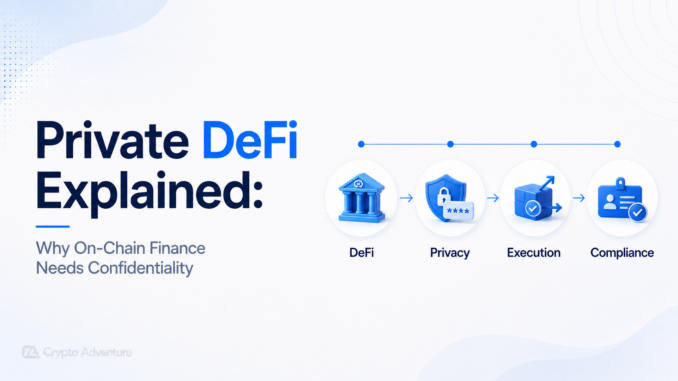
DeFi made finance programmable, open, and composable. It also made financial behavior unusually visible. Wallet balances, transaction histories, token approvals, swaps, deposits, liquidations, NFT activity, DAO votes, lending positions, and trading strategies can often be traced across public blockchains with minimal effort.
That transparency is useful for auditability. It helps users verify supply, liquidity, collateral, smart contract activity, and protocol flows. It also creates a serious confidentiality problem. A wallet can become a public financial profile. Competitors can watch trading strategies. Attackers can identify high-value targets. Market makers can see flows. Employers, counterparties, and strangers can connect addresses to real-world identity if enough metadata leaks.

Private DeFi tries to solve that tension. The goal is not to make finance unaccountable. The goal is to protect sensitive user and business information while keeping the core benefits of blockchains: verifiable settlement, open access, self-custody, and programmable execution.
What Private DeFi Means
Private DeFi refers to decentralized finance systems that hide some transaction details while still allowing the network to verify that the transaction is valid. Depending on the design, privacy can cover balances, sender and receiver addresses, transaction amounts, strategy logic, order flow, collateral positions, or app state.
This can be done through zero-knowledge proofs, shielded pools, encrypted state, stealth addresses, private smart contracts, selective disclosure, or a mix of cryptographic and compliance controls. A user may prove that a transaction follows the rules without revealing every underlying detail to the public.
That makes private DeFi different from simple obfuscation. A mixer may break the direct link between deposits and withdrawals. A private DeFi system aims to support broader financial activity while preserving confidentiality at the application or protocol layer. The older debate around centralized and decentralized crypto mixers still matters, but the new frontier is more complex: private lending, private swaps, private payments, private identity checks, and private institutional settlement.
Why Transparency Can Hurt Users
Public transaction data can create security risk. A high-value wallet becomes a target once attackers can estimate its holdings. A user who receives salary, business payments, grants, trading profits, or treasury allocations on-chain may expose their financial life without intending to.
Trading strategies are another issue. A fund that trades through public wallets may reveal accumulation, hedging, liquidity movements, and exit timing. A market maker may expose inventory and routing behavior. A DAO treasury may reveal negotiation leverage before a transaction settles.
Ordinary users face the same problem at smaller scale. A public wallet can show which apps they use, what tokens they hold, how much they spend, and which addresses they interact with. Self-custody gives users control, but crypto self-custody becomes safer when it does not turn every financial action into a public trail.
How Zero-Knowledge Proofs Help
Zero-knowledge proofs allow one party to prove a statement is true without revealing the data behind it. In DeFi, that can mean proving that a transaction is valid, a balance is sufficient, a user belongs to an approved group, or a withdrawal is not linked to a known prohibited deposit, without exposing the entire financial path.
Aztec is one of the most important private DeFi projects because it brings privacy to smart contracts rather than only payments. Its model supports confidential transactions and private state, creating a foundation for applications where users and developers can decide what needs to be public and what should remain private.
RAILGUN takes another approach by adding privacy to DeFi interactions across public chains. Its Private Proofs of Innocence system lets users create a private proof that shielded funds are not from a preset list of undesirable actors or transactions. That matters because privacy systems increasingly need a way to separate legitimate confidentiality from obvious illicit-risk exposure.
Private DeFi Is Not Only For Whales
Large traders and institutions have the clearest need for confidentiality, but ordinary users also benefit. A person receiving stablecoin payments may not want every future recipient to see their full wallet balance. A donor may not want political, medical, or personal giving exposed. A DAO contributor may want payment privacy. A DeFi user may not want every loan, swap, and liquidity position visible forever.
This is the same reason traditional finance does not publish everyone’s bank balances. Transparency at the system level can coexist with privacy at the user level. DeFi currently gives the public too much raw data by default.
Where Private DeFi Can Be Useful
Private DeFi can support confidential payments, private payroll, treasury operations, institutional settlement, OTC-style trades, DAO compensation, private voting, shielded swaps, confidential collateral management, and strategy protection.
Institutional use is especially important. Many regulated firms cannot expose counterparties, balances, trading strategies, or customer data on a public ledger. Tokenized assets, stablecoin settlement, and on-chain credit may need privacy before they can scale beyond experimental pilots. A public chain may be verifiable, but institutions still need confidentiality around positions, flows, and client information.
Private DeFi also improves personal safety. Public wealth visibility creates real-world risk. A system that hides balances and counterparties can reduce targeting, phishing, and social-engineering attacks.
The Compliance Challenge
Privacy does not remove legal obligations. Financial systems still face AML, sanctions, consumer protection, tax, and reporting rules. The challenge is designing systems that avoid exposing everything to everyone while still enabling lawful checks when needed.
This is where selective disclosure becomes important. A user may prove eligibility, source-of-funds status, age, residency, or non-sanctioned status without publishing every transaction. A protocol may allow users to generate compliance proofs for exchanges, auditors, or counterparties without making their entire wallet history public.
The security layer also has to be strong. Private systems are difficult to audit because less information is public. Smart contract bugs, proof-system flaws, trusted setup issues, relayer design, and front-end compromise can still put users at risk. Broader smart contract security becomes even more important when privacy prevents outsiders from easily spotting abnormal flows.
Risks And Limits
Private DeFi has real trade-offs. Strong privacy can attract illicit use if controls are weak. Too much compliance can destroy privacy if every action requires centralized identity disclosure. Poor user experience can lead to mistakes. Weak liquidity can reduce usefulness. Complex cryptography can make bugs harder to detect.
There is also a regulatory perception problem. Privacy tools are often treated as suspicious because some bad actors use them. That framing misses the legitimate need for confidentiality, but projects still need to address misuse risk directly. Privacy without accountability will struggle. Compliance without privacy will not satisfy users who need confidentiality.
Conclusion
Private DeFi exists because public finance by default is not suitable for every user, trader, DAO, or institution. On-chain systems need transparency for verification, but users need confidentiality for safety, strategy protection, commercial privacy, and basic financial dignity.
The strongest privacy models do not ask users to choose between hidden finance and visible finance. They use zero-knowledge proofs, encrypted state, selective disclosure, and compliance-aware design to keep transactions valid without exposing every detail.
Private DeFi will matter most when it protects legitimate users while giving protocols, counterparties, and regulators enough assurance to manage risk. That balance is difficult, but it is likely essential if on-chain finance wants to move beyond speculation into serious everyday and institutional use.



Be the first to comment