



A new music platform built on the BSV blockchain pays artists per stream in satoshis and sells tracks as Ordinals. Creator Ruth Heasman says the economics already outperform the industry’s dominant model. A musician herself, Heasman built SonicStar and uploaded her own catalog as a demonstration, and says she earned almost as much in a few weeks on the platform as she had in two years on Spotify (NASDAQ: SPOT).
“So far, after only a few weeks, I’ve earned almost as much on SonicStar as I have on Spotify in two years,” she told CoinGeek. “And that disparity could grow quickly with more users on the platform.”
SonicStar is a music streaming and distribution platform where every track is a 1Sat Ordinal. The on-chain digital token contains the artist’s identity key, metadata, an audio fingerprint, and a pointer to the file’s location. Fans can stream tracks via nanopayments of about a thousand satoshis per play (roughly $0.00015), or buy copies outright as 1Sat Ordinals they actually hold in their own wallets.
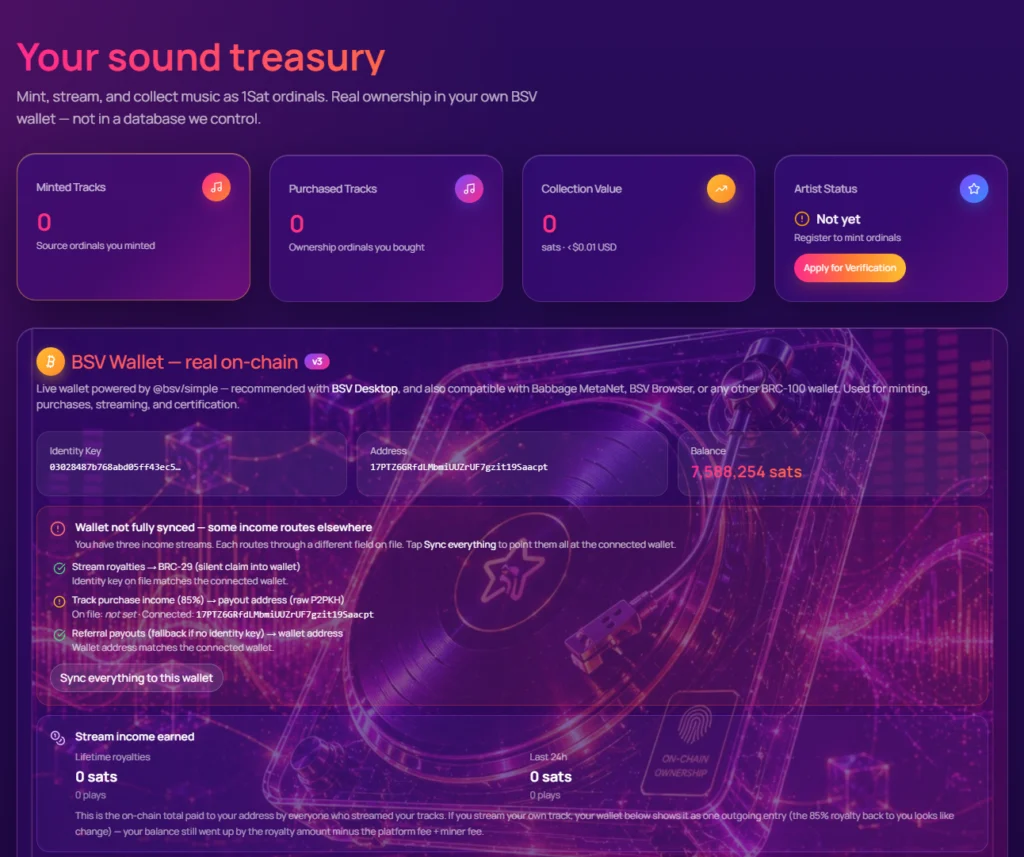
The economics of SonicStar are simple. Artists keep 75% of every sale, and the platform takes 15%. The split is enforced by the transaction itself, not by a quarterly statement that might arrive someday. For streaming, there is no subscription, no ad-supported tier, no opaque royalty pool, just a direct payment from listener to artist for each play.
Heasman noted that she didn’t entirely abandon the traditional route for her own music. She has also published her tracks via DistroKid “in the normal way.” But she built SonicStar to demonstrate something specific: what BSV’s micropayment infrastructure can actually do for artists when the middlemen are removed.
“I felt like it was important to create—and use—the SonicStar.net platform to demonstrate what’s possible on BSV for micro- and nano-payments and instant settlement for the artist,” she said.
Easy to use, own your own music
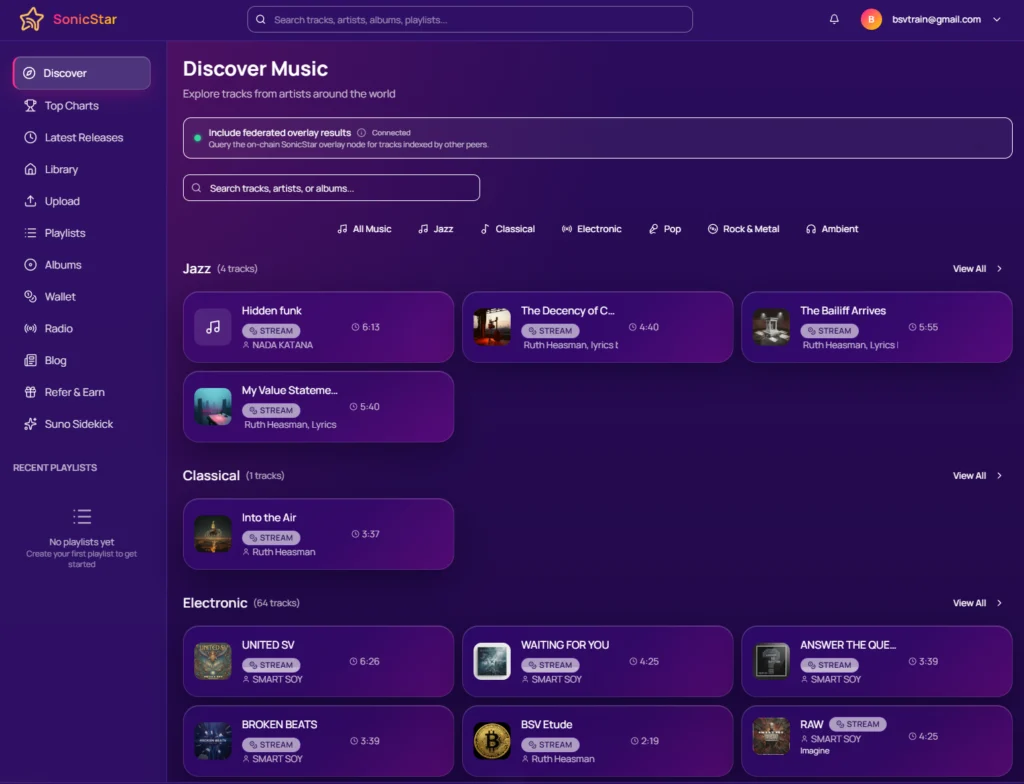
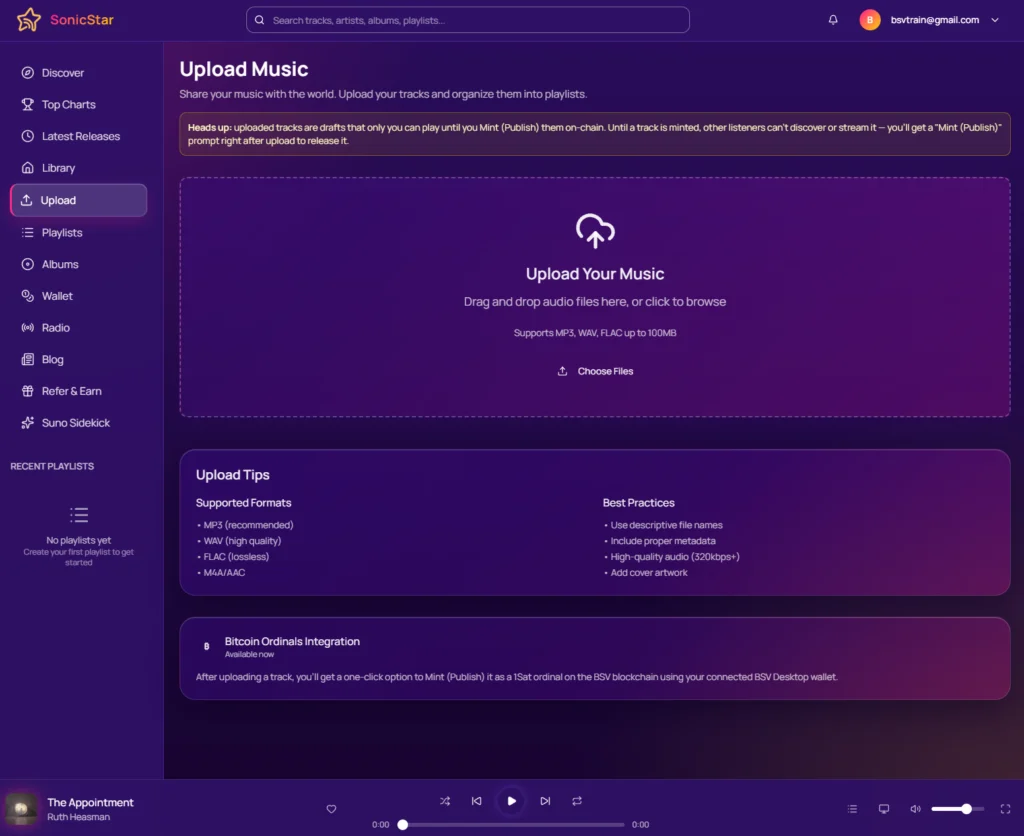
SonicStar’s color scheme is vivid, and the interface is easy to navigate. Connecting a BRC-100 wallet could definitely be a smoother process, but that’s something that will improve over time, and there’s still the option to use a regular login with the built-in wallet should users prefer. Tracks and artists are easy to find, and there are all the features you’d expect from a music app, like Top Charts, Latest Releases, user libraries, and a drag-and-drop window to upload new tracks. It supports MP3, WAV, FLAC, and M4A/AAC files.
The platform’s model reflects a philosophy that’s common among BSV and Web3 builders, but remains radical in the mainstream: users owning their data. The artist owns the song, the fan owns their copy, the platform takes a reasonable cut, and then gets out of the way. SonicStar does not run a traditional account system. Users connect with a BRC-100 wallet, like BSV Desktop, MetaNet Client, or BSV Browser on mobile, and that wallet is their identity. There is nothing to lock, no terms-of-service gatekeeping, and no database migration that could quietly erase ownership records.
For Heasman, building SonicStar was not a grand strategic bet. It was also an experiment made possible with recent advancements in artificial intelligence (AI)-assisted development.
“It’s a small experiment, not a big commitment, now that developing apps is so much quicker and easier with AI,” she said. “The reasons not to do it have fallen away.”
That experimental mindset extends to the kinds of music the platform welcomes. While the mainstream industry debates whether AI-generated music constitutes legitimate art, Heasman takes the opposite position: SonicStar actively welcomes AI-generated music, provided the artist holds the ownership rights.
“We also welcome AI-generated music rather than discourage it,” she noted. “Because the artist must have ownership rights to upload.”
She is also making available on SonicStar music that has never been formally published, and may never be—a catalog that exists only because the platform’s low-friction model makes it worth her while to release it.
BSV apps and silos
The broader question for any BSV-based content platform is whether it can escape the “BSV silo”—the tendency for blockchain-native services to attract only the existing blockchain-native crowd, who then flood the platform with blockchain-adjacent content, creating an echo chamber that never breaks through to mainstream users. Heasman is candid about the friction involved.
“It is a lot of friction yes,” she said. Fans need a BSV wallet, they need to understand 1Sat Ordinals, they need to pay in satoshis. Compared to opening Spotify and pressing play, the barrier is real.
The counter-argument is that the platform doesn’t need to replace Spotify to be worthwhile. It only needs to prove that a different model can work—that direct ownership, per-play nanopayments, and instant settlement are not theoretical advantages, but actual features that benefit real artists. If that proof attracts a breakout moment or a high-profile non-BSV user, the silo problem solves itself. Until then, accepting that most users will come from the BSV-friendly fanbase is the price of demonstrating the model.
‘(AI) agents could very well become customers’
Heasman is also looking further ahead. Both she and the platform’s design are experimenting with AI agents—the same autonomous systems that are becoming a recurring theme in BSV and blockchain coverage more broadly. If agents become primary curators of content, finding music, negotiating rights, even commissioning new works, what does that mean for a platform where ownership is on-chain and payments are machine-to-machine?
“Agents could very well become customers,” she said. “I may well add a music generation feature as well, a bit further down the line. I already offer a music prompting tool for Suno within the platform. Agents could be customers, competitors, and collaborators over time. Why not? If people don’t want it, they won’t listen.”
These implications are worth thinking about. An AI agent with a wallet could browse SonicStar’s catalog, evaluate tracks against its user’s preferences, purchase them, and add them to a playlist—all without human intervention. The agent would technically own the copy, provably, on-chain. It could resell it, gift it, or simply prove it was an early supporter of an artist before anyone else had heard of them. Given the ability to do so, the same agent could commission new music, negotiate terms via smart contract, and settle payment automatically.
Whether that future arrives soon or remains speculative, Heasman’s immediate results are concrete. A musician-developer built her own platform, put her own music on it, and in weeks outperformed what two years on the world’s largest streaming service had delivered. And not because SonicStar has more users, but because its economics are designed to pay artists directly rather than funnel revenue through layers of intermediaries.
The platform is still young. The catalog is still growing. The user base is still small. But for Heasman, that isn’t the point. The point is that the experiment worked, and that the reasons not to try it have, as she put it, fallen away.
Watch: Developers can propel the BSV blockchain forward



Be the first to comment