



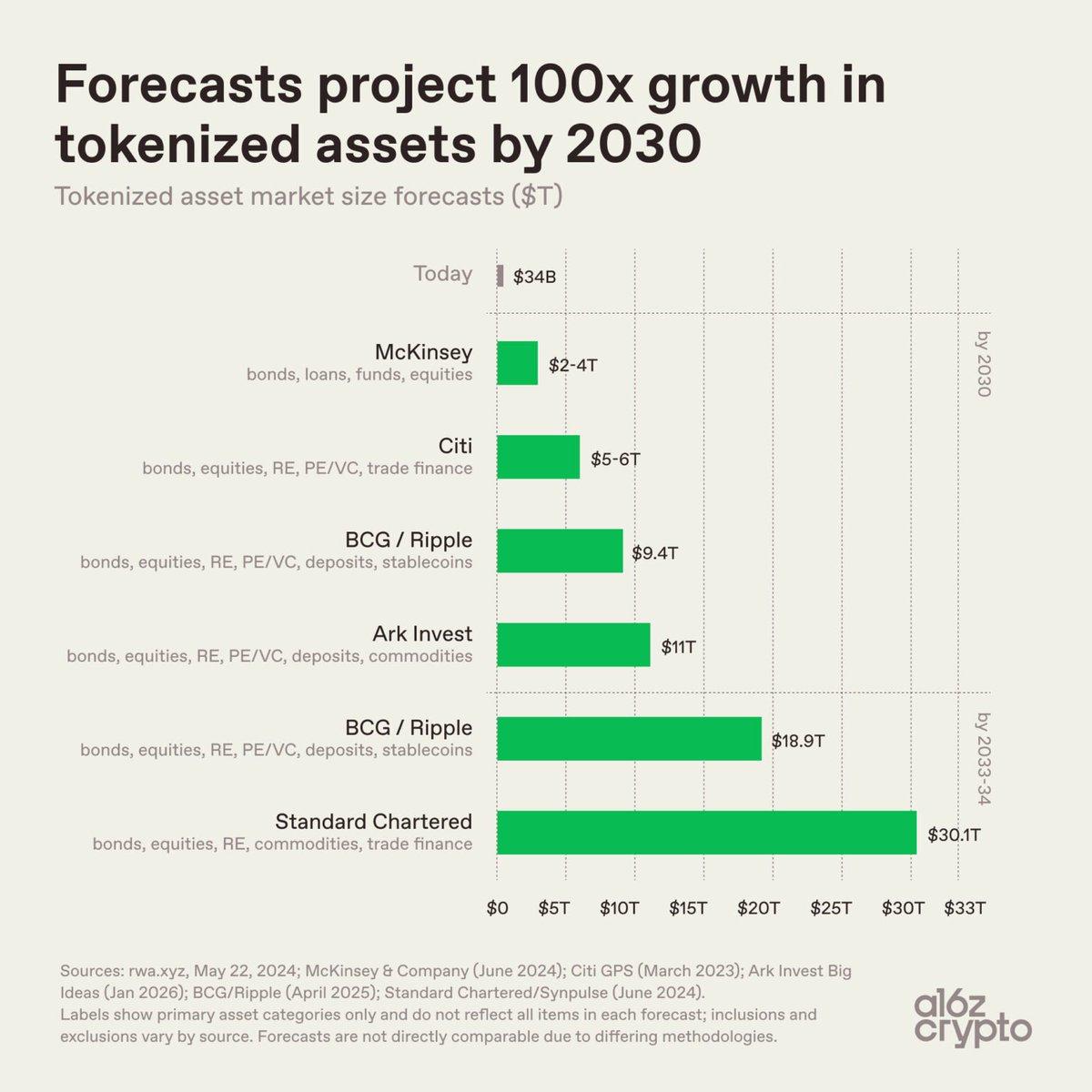
According to data highlighted by a16z crypto, six major institutions project tokenized assets growing from $34B today to between $2T and $30T by 2030-2034 – the gap between forecasts tells the real story.
- Tokenized asset market sits at $34B today according to a16z crypto data
- McKinsey most conservative at $2-4T by 2030, roughly 59-117x from today
- Ark Invest most bullish for 2030 at $11T, BCG/Ripple at $18.9T by 2033-34
- Standard Chartered projects $30.1T by 2033-34, an 885x from current levels
- All forecasts cover different asset classes – direct comparison has limits
According to data from RWA, highlighted by a16z crypto, the tokenized asset market is currently worth $34 billion. That number will either look embarrassingly small in ten years or it will look like the last moment before something significant started. Six major institutional research teams have put numbers on which outcome they think is more likely, and the range between their answers is the most honest thing about this data.
What the forecasts actually say
By 2030, McKinsey sees the market reaching $2-4 trillion, the most conservative projection and roughly 59 to 117 times current size. Citi sits in the $5-6 trillion range. BCG and Ripple project $9.4 trillion. Ark Invest, in its Big Ideas 2026 report, puts the number at $11 trillion. All four cover broadly similar asset categories, bonds, equities, real estate, private equity and venture capital, though with different inclusions.
The 2033-34 forecasts go further. BCG and Ripple extend their model to $18.9 trillion by that window. Standard Chartered projects $30.1 trillion, covering bonds, equities, real estate, commodities, and trade finance. That’s an 885x from where the market sits today.
The chart notes are worth reading carefully: the forecasts are not directly comparable due to differing methodologies, and labels show primary asset categories only. McKinsey’s $2-4T covers bonds, loans, funds, and equities. Standard Chartered’s $30.1T adds commodities and trade finance to the mix. These aren’t identical universes, they’re different teams’ views of how much of the global financial system could realistically move onto blockchain rails by a given date.
Why the spread between forecasts matters
The distance between McKinsey at $2-4T and Ark at $11T for the same 2030 timeframe isn’t noise, it reflects genuine disagreement about the rate-limiting factors. Tokenization’s technical case is relatively uncontroversial. Moving bonds, equities, and real assets onto blockchain infrastructure improves settlement speed from days to minutes, enables fractional ownership of previously illiquid assets, and opens global access to markets that are currently geography-restricted. The mechanics work. BlackRock, Franklin Templeton, and JPMorgan are already running tokenized funds on public and private blockchains.
The disagreement is about how fast regulatory frameworks across multiple jurisdictions catch up, how quickly traditional financial institutions rebuild their infrastructure around on-chain settlement, and how much friction the transition from legacy systems actually creates in practice. McKinsey’s conservative number implies significant regulatory drag and slow institutional adoption. Ark’s $11T implies faster movement on both fronts. Standard Chartered’s $30T implies something closer to a full-scale restructuring of global financial infrastructure within a decade.
What the a16z crypto data shows
A16z crypto published this data highlighting tokenization as one of the most credible long-term narratives in crypto, not because of price speculation but because it solves real problems for real financial institutions. Better liquidity for assets that currently trade infrequently. Settlement in minutes rather than T+2 days. Global access to private credit markets and real estate that are currently available only to large institutions in specific geographies.
The framing from a16z is that short-term regulatory and execution hurdles are real but don’t change the direction. That’s a defensible position, the institutional infrastructure is being built regardless of current regulatory uncertainty. The question is timing, not destination.
The honest read on these numbers
Even the most conservative forecast represents a transformation of the current market. Going from $34B to $2T by 2030 means the tokenized asset market would need to grow roughly 59x in four years. For context, the entire crypto market cap is currently around $2.4 trillion, so McKinsey’s floor scenario implies tokenized real-world assets alone reaching a market size equivalent to the entire crypto market today.
The bullish cases imply something larger: that tokenization becomes the default infrastructure for significant portions of global bond, equity, and real estate markets rather than a parallel niche alongside traditional systems.
What none of the forecasts address directly is the distribution question, which blockchains capture that value, which protocols benefit, and how much of the $30T flows through public versus private chains. That’s the question the forecasts leave open, and probably the more relevant one for anyone trying to connect these numbers to specific crypto assets.
The market is at $34B. The forecasts disagree on almost everything except the direction.
The information provided in this article is for educational purposes only and does not constitute financial, investment, or trading advice. Coindoo.com does not endorse or recommend any specific investment strategy or cryptocurrency. Always conduct your own research and consult with a licensed financial advisor before making any investment decisions.

Kosta has reported on cryptocurrency markets and blockchain infrastructure since 2020, bringing over six years of hands-on experience in the crypto industry built through daily tracking of markets, trends, and emerging blockchain developments. Specializing in Bitcoin on-chain analysis, institutional ETF flows, and digital asset price action, his work at Coindoo has been cited by other news agencies and consistently covers market developments with a focus on data-driven reporting across Bitcoin, Ethereum, Solana, and XRP.
Over the years, Kosta has contributed to multiple crypto media outlets in different regions, authoring over 6,000 articles across the sector. His reporting spans cryptocurrency markets and the broader fintech industry, tracking not only price action but also the technological and regulatory forces shaping the ecosystem.
To support his analysis, Kosta actively leverages on-chain data and metrics from leading platforms such as Santiment, Glassnode, and CryptoQuant, enabling deeper, evidence-based market insights. He believes in the power of transparency and the data that underpins the blockchain ecosystem.
His academic background in Marketing Management from Denmark further complements his analytical approach, adding a strong understanding of communication strategy and content positioning to his work.



Be the first to comment