



After a recovery to nearly $78,000, Bitcoin witnessed another sudden pullback as the market turned highly bearish, bringing it closer to the $75,000 price mark once again. Meanwhile, due to recent developments in the US Stock market, the leading crypto asset could be set to experience more downside pressure in the upcoming sessions.
Mounting Short Interest In Equities Impacting Bitcoin
Despite being struck by heightened volatility and selling activity, Bitcoin continues to face the possibility of a continued downside pressure. One of the things that poses a serious threat to the asset is the activity in the United States stock market, which is undergoing a major change.

A market pundit with the nickname XWIN Japan on the CryptoQuant platform has warned that the recent increase in short positions across U.S. stocks may have a considerably more significant effect on Bitcoin, contrary to what many investors now believe.
Currently, short positions on US equity have surged to historically high levels, but the market structure behind it is more complex than a simple bearish signal. Instead of outright pessimism, institutional investors seem to be increasing their hedges while maintaining large long positions. This is creating a highly leveraged gross-up environment across Wall Street.
According to recent market data, hedge fund gross leverage has climbed near 293% while Days-to-Cover metrics and dollar-based short exposure in the S&P 500 have reached record territory. When leverage reaches this level, it often suggests that investors are becoming increasingly defensive beneath the surface.
The development may be attributed to several factors, but one major factor stands out the most, and that is the concentration into AI-related mega-cap stocks. Capital continues to move into a small group of dominant names, with weaker sectors and smaller-cap equities experiencing rising short activity. As a result, the market index may exhibit stability even as internal fragility grows.
Why It Matters For BTC And Its Market
In the research, XWIN Japan has taken the opportunity to explain why this is important for Bitcoin and its market. Historically, BTC has been observed to move alongside US equities during major risk-off events. During the 2020 COVID crash, Bitcoin fell sharply along wth stocks, failing to behave like a traditional safe haven.
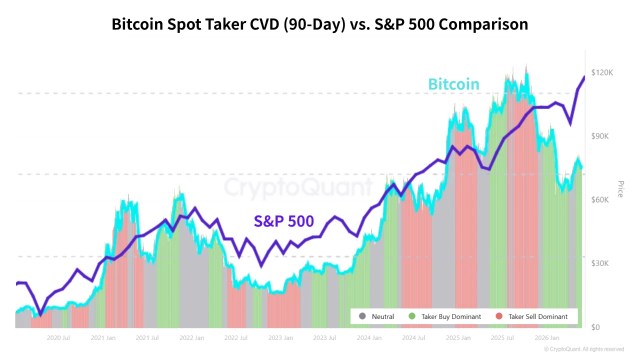
Furthermore, the attached chart shows that from 2020 to 2022, BTC and the S&P 500 largely moved in the same direction. However, there has been a crucial divergence between the assets since 2025.
While the S&P 500 has remained relatively stable, BTC has demonstrated large price swings backed by robust Spot Taker CVD buy pressure and ETF inflows. This wave of buying and inflows indicates that Bitcoin is increasingly influenced by its own liquidity cycle, leverage dynamics, and institutional demand.
It also signals that the crypto may be evolving from a pure risk asset into a hybrid asset class still sensitive to macro liquidity. However, the shift is capable of following its own market structure. If future conditions include Federal Reserve (Fed) easing, weaker dollar conditions, and renewed ETF inflows, BTC could turn into a secondary liquidity destination rather than a correlated tech-like asset.
Featured image from Pngtree, chart from Tradingview.com
Editorial Process for bitcoinist is centered on delivering thoroughly researched, accurate, and unbiased content. We uphold strict sourcing standards, and each page undergoes diligent review by our team of top technology experts and seasoned editors. This process ensures the integrity, relevance, and value of our content for our readers.



Be the first to comment