



Aave has generated more than $2.19 billion in gross protocol revenue since 2020, reinforcing its position as one of DeFi’s most durable lending businesses.
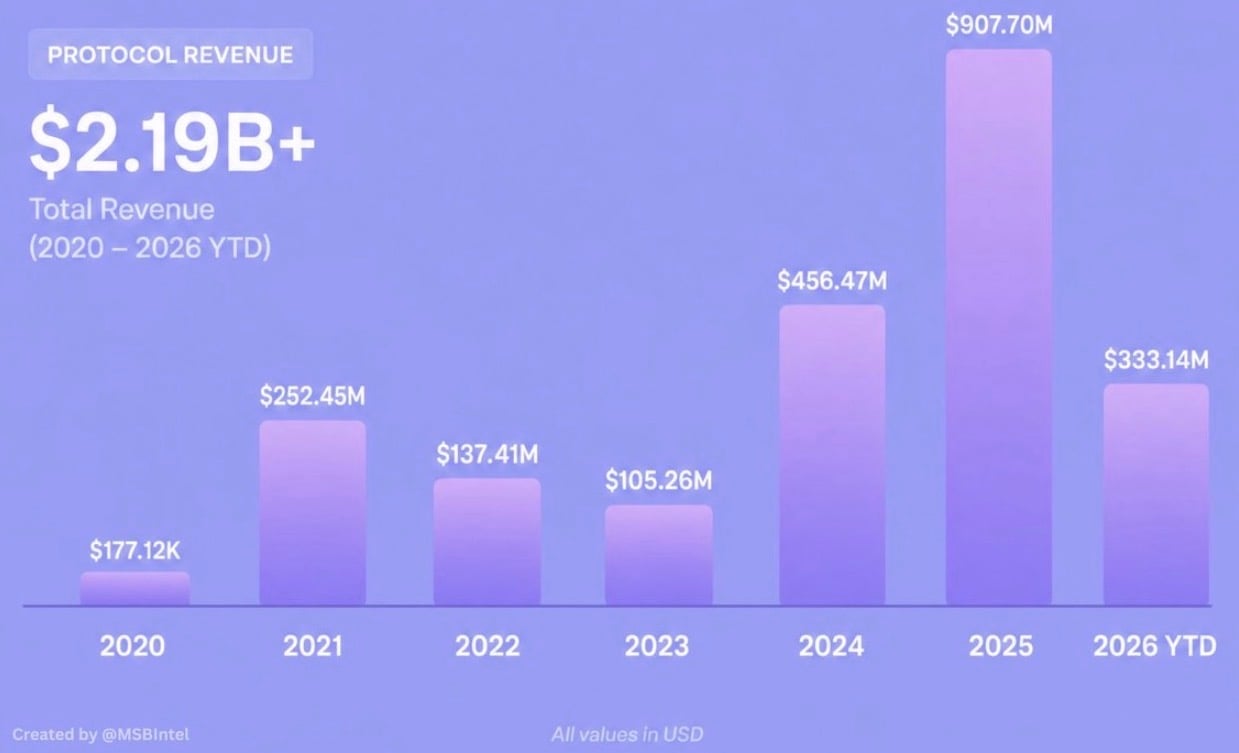
The cumulative figure covers Aave’s revenue run from its early 2020 activity through 2026 year-to-date. The yearly split puts the protocol at $177,120 in 2020, $252.45 million in 2021, $137.41 million in 2022, $105.26 million in 2023, $456.47 million in 2024, $907.70 million in 2025 and $333.14 million so far in 2026.
The Aave income statement shows how sharply activity accelerated after the 2022 and 2023 bear-market reset. Aave’s 2025 revenue was nearly double its 2024 total, while 2026 has already crossed one-third of a billion dollars before the year is complete.
That growth reflects Aave’s core role in DeFi lending. Borrowers pay interest, liquidation penalties and other fees, while suppliers provide liquidity across markets. The gross revenue figure captures the full economic activity flowing through the protocol, not only the amount retained as DAO earnings.
Lending Revenue Becomes A DeFi Business Signal
Aave’s numbers stand out because lending revenue is tied to actual borrowing demand. Trading fees can spike during speculative bursts, but a lending protocol needs sustained collateral, stablecoin liquidity, risk parameters and borrower activity to keep revenue flowing.
Aave currently has more than $12 billion in total value locked and nearly $10 billion in active loans across multiple chains. Ethereum remains the largest deployment, but Aave has also expanded across Base, Arbitrum, Avalanche, Polygon, BNB Chain, Gnosis, Mantle, Optimism and newer markets.
The revenue milestone lands as Aave continues pushing its next architecture. Recent Aave V4 deposit growth showed early demand for the new design as lending caps increased again. V4’s long-term role is to improve capital efficiency, risk isolation and market flexibility without weakening the discipline that made Aave the largest DeFi lending protocol.
Institutional Access Adds Another Growth Route
Aave’s revenue base is also becoming more relevant to institutional DeFi. Eligible clients can now access Aave lending markets through BitGo qualified custody, giving institutions a controlled route into DeFi credit without relying on unmanaged browser-wallet flows.
That matters for Aave’s next phase. If qualified custody, permissioned access, treasury workflows and risk-screened lending markets keep improving, more institutional capital can interact with DeFi lending while staying inside stricter operational controls.
Aave’s size also raises the stakes around risk management. The protocol’s role in the KelpDAO recovery dispute showed how deeply Aave now sits inside DeFi’s collateral, liquidation and governance layer. More revenue and larger loan books bring more responsibility around oracle design, collateral onboarding, emergency controls and governance execution.
The $2.19 billion milestone gives Aave a stronger business narrative than most DeFi protocols can claim. The next test is whether revenue growth keeps translating into safer markets, deeper liquidity, sustainable DAO earnings and useful credit infrastructure rather than only larger headline numbers.



Be the first to comment