

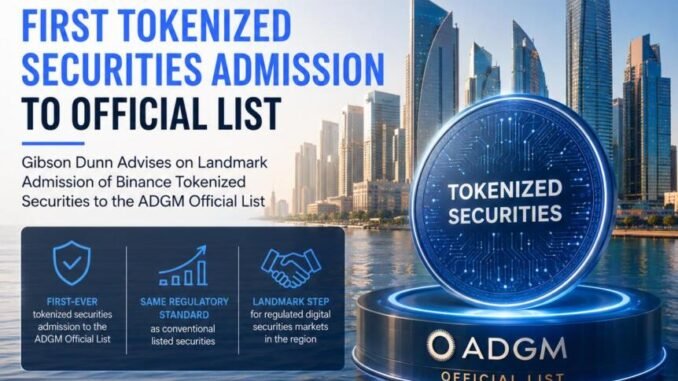

Abu Dhabi Global Market (ADGM) has approved the first admission of tokenized digital securities to its Official List, alongside permission for the instruments to trade on a recognized exchange venue. The development signals that tokenized assets can be structured and regulated within an established securities framework, rather than operating only as over-the-counter products or experimental pilots.
The legal filing and regulatory steps were guided by law firm Gibson Dunn, which advised Btech Holdings Limited. According to the firm, the Financial Services Regulatory Authority (FSRA) of ADGM approved the relevant prospectuses on 11 June 2026 under the market and financial services rules that apply to securities listings.
What ADGM approved, and why it matters
ADGM’s announcement centers on the admission of tokenized securities referred to as bStocks. The instruments were characterized under ADGM regulation as securities for the purposes of the Financial Services and Markets Regulations 2015 (FSMR). They were structured as Certificates over Shares, a design choice intended to fit the tokenized product into conventional securities categories.
After FSRA approval of the prospectuses, the securities were admitted to ADGM’s Official List of Securities with effect from the same date, and they were also set to be traded on the Recognized Investment Exchange (RIE) operated by Nest Exchange Limited.
In institutional capital markets, listing and trading rules are critical for liquidity, investor protections, and market integrity. By tying tokenized securities to an official listing process and prospectus approval, ADGM is effectively aligning part of the tokenization market with the same regulatory benchmarks used for traditional listings.
Regulatory pathway: prospectus approval and admission to the Official List
Per Gibson Dunn’s account, FSRA approval was granted for prospectuses drafted by the firm. The approval was described as being provided pursuant to section 61 of FSMR and Rule 4.6 of the Market Rules (MKT), including a reference to meeting requirements under MKT 4.5.
This matters because prospectus regimes are typically designed to ensure disclosures are comprehensive and consistent, covering issuer details, the nature of the instrument, risk factors, and other information required for public market participation. For tokenization to move into mainstream financing channels, regulators and exchanges generally need to ensure tokenized structures still satisfy disclosure and governance expectations.
How the product is structured: certificates over shares
The tokenized instruments were described as securities that fall under FSMR, structured as certificates over shares. The certificate-over-share structure is relevant in regulatory terms because it can help define the rights embedded in the tokenized instrument, including the economic linkage to the underlying shares.
While tokenization often involves distributed ledger infrastructure, the key regulatory question is how the product maps to existing legal definitions. ADGM’s approach, as reflected in this admission, indicates a willingness to treat tokenized securities as regulated securities when the instrument’s legal characteristics are clear and the issuer complies with disclosure and admission requirements.
Implications for tokenization in the UAE and beyond
Institutional tokenization is still searching for scalable market infrastructure and consistent regulatory standards. Regions that can demonstrate repeatable pathways for approvals, listing, and regulated trading have an advantage when issuers and financial intermediaries decide where to deploy tokenized capital markets activity.
ADGM’s step also points to a broader industry trend: regulators are increasingly focused on whether tokenized assets can meet established securities principles, including transparency, market conduct expectations, and investor protections.
In this case, the admission to ADGM’s Official List and the ability to trade on the RIE operated by Nest Exchange potentially reduce operational uncertainty for market participants evaluating tokenized instruments. It may also encourage other issuers considering tokenization to pursue structured, regulated listings rather than limiting activity to private placements.
Role of legal counsel
Gibson Dunn stated it advised on multiple phases of the mandate, including structuring the issuance, preparing prospectuses approved by FSRA, and handling the applications for admission to the Official List and to trading on the RIE.
The firm said the team was led by partners Sameera Kimatrai and Jade Chu, supported by associates Aliya Padhani and Holly Alderton. The matter was also described as involving other partners including Hagen Rooke, Mellissa Duru, and Lauren Cook Jackson.
What to watch next
This admission provides a regulatory reference point for tokenized securities that aim to be integrated into exchange-based trading. Going forward, market observers will likely focus on whether additional tokenized issuances follow the same pathway, how liquidity develops on the trading venue, and whether the market structure attracts issuers and intermediaries at scale.
For investors, the practical value of tokenized securities will depend on execution quality, transparency, custody and settlement mechanics, and ongoing compliance. For issuers, the central question will be whether regulated listing and trading can reduce barriers to issuance while still supporting innovation in how assets are tokenized and distributed.


Be the first to comment