
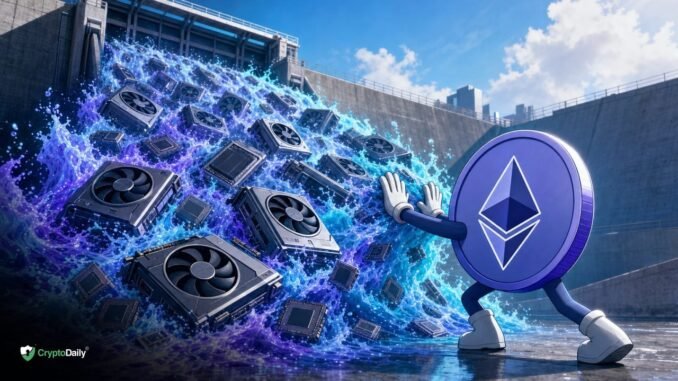

Ether chopping around $1,570 while every desk chat opens with AI chips feels surreal. Nvidia drops another data center bombshell, and suddenly the crypto channel goes quiet. Meanwhile, fees on major Ethereum L2s are the lowest they’ve ever felt to ordinary users, but the apps aren’t exactly bursting at the seams.
That tension sits at the heart of this market: the infrastructure win happened, yet the story people want to buy is somewhere else.
If you’re wondering why the Ethereum app narrative can’t seem to breathe right now, even with cheaper transactions and a deep builder base, you’re not alone.

We’re in an attention market. The AI chip cycle has become the cleanest, most legible trade in tech. Hyperscalers pour capex into GPUs, earnings show up in black and white, and the loop reinforces itself. On the crypto side, Ethereum finally shipped long-awaited plumbing upgrades, but most non-crypto investors don’t “see” it until apps catch fire with users.
Capital follows simplicity. Chips sell now; apps promise later. That gap is where ETH’s narrative is getting drowned.
Who’s affected? Pretty much everyone along the Ethereum stack: founders pitching consumer apps, L2s fighting for liquidity, funds trying to justify overweight ETH, and retail users who hear more about AI servers than on-chain experiences.
How the AI chip cycle hijacked risk appetite
Why chips feel “safer” than protocols
Investors like trades with clear cash flows. Chips feed an AI buildout with obvious customers and backlog. Nvidia’s investor updates have repeatedly emphasized data center demand, creating a straight line from silicon to revenue that funds can underwrite without mental gymnastics. You can see that narrative directly on NVIDIA IR.
Ethereum, by contrast, is a generalized compute layer. Its cash flow equivalent is a blend of gas, MEV, and staking yield that depends on how much people actually use apps. That’s many steps removed from a top-line number in an earnings release.
Media oxygen and retail mindshare
When headlines get dominated by GPUs and hyperscaler capex, crypto air-time shrinks. Ethereum’s wins are technical and incremental: better data availability, cheaper blobs, improved user flows. They don’t screenshot as cleanly as a chip shipment line. Until there’s a breakout app story people can explain at dinner, ETH gets treated as a macro beta asset rather than a product bet.
Ethereum’s app promise meets a user funnel problem
Fragmentation is a silent tax
Even with low L2 fees, the app funnel still has too many steps: multiple L2s, bridges, and tokens. Liquidity is thinly spread and attention even thinner. A game or social app that pops on one rollup doesn’t automatically pull in the rest of the network’s users. That dampens network effects right when Ethereum needs them most.
Wallets and onboarding still aren’t “obvious”
Account abstraction is real progress, but it’s not a magic wand. The tooling has improved, yet the average newcomer still trips on seed phrases, funding sources, and chain selection. For a taste of where the ecosystem is pushing, see Ethereum’s documentation on account abstraction at ethereum.org. The direction is right. The last mile remains bumpy.
What the first session looks like in practice
- Hear about a buzzy on-chain app from a friend or a clip.
- Open a centralized exchange account or re-activate it; pass KYC.
- Buy ETH or a stablecoin; wait for settlement.
- Bridge to the target L2; pick a bridge; confirm risks.
- Swap into the app’s token or deposit; sign approvals.
- Finally try the thing you heard about, pray you’re on the right chain, and hope nothing breaks.
Each step leaks users. Lower fees help, but they don’t erase the funnel.
What Dencun (EIP-4844) actually fixed
Cheaper data, not simpler decisions
The Dencun upgrade introduced blob-carrying transactions via EIP-4844 to cut data availability costs for rollups. That’s a clear win for L2s and their users, with materially lower transaction costs post-activation across popular rollups. The overview and rationale are well documented on ethereum.org and in the EIPs repository on eips.ethereum.org.
What it didn’t do is unify liquidity, normalize security assumptions across every L2, or reduce the cognitive load of picking where to build and where to trade. It made the pipes cheaper. It didn’t choose the kitchen.
Who benefited and how
| Area | Before Dencun | After Dencun | Primary Beneficiary |
|---|---|---|---|
| L2 transaction fees | Volatile, often meaningfully higher | Lower and more predictable for users | End users, high-volume apps |
| Rollup economics | Compression games, cost pressures | Healthier unit costs per batch | Rollup operators |
| App UX | Price spikes block casual usage | Cost less of a blocker, UX still complex | Apps near product-market fit |
| Security mix | Heterogeneous trust assumptions | Still heterogeneous | Security-conscious builders |
| Liquidity routing | Multi-hop, bridge-heavy | Still fragmented | Bridge and aggregator protocols |
If you watch rollup data and security models, L2BEAT remains a useful lens into the trade-offs per network at L2BEAT.
Flows, yields, and the new competition for attention
Why yield math matters
Staking ETH pays a floating yield that comes from network activity and block rewards. In a world where off-chain cash yields are high, some allocators prefer to park capital in T-bill proxies or tokenized cash rather than chase on-chain activity. Institutional notes from large exchanges have discussed this substitution effect; see the research hub at Coinbase Institutional for context.
ETF flows, fund flows, and rotation
ETF and fund flow data shapes headlines and, with them, retail interest. When flows favor Bitcoin or risk-off positioning, ETH’s app narrative struggles for airtime. For a pulse on digital asset fund flows without living on Twitter, the weekly updates from CoinShares are a helpful aggregate.
Restaking pulled builder oxygen
Restaking is a powerful primitive and a real source of experimentation, but it also concentrated attention among advanced users. Builders chased points and security markets rather than consumer apps. The core ideas are explained in EigenLayer docs. Great research frontier, yes. Consumer on-ramps, not so much. That shift of energy matters when you’re trying to will a consumer narrative into existence.
Signals to watch if the ETH story wakes up
Stickiness beats spikes
Daily active addresses and transactions can be gamed. The real tells are:
- Consistent retention in a handful of consumer-facing apps on L2s over several months.
- Organic fee growth that tracks usage, not just airdrop seasons.
- Cross-rollup liquidity routing getting easier for normal users via embedded bridges and intent-based wallets.
- Staking churn stabilizing even as off-chain yields stay attractive.
- Net ETH burned turning meaningfully positive during normal weeks, not only during hype spikes.
Infra showing up in UX
Wallets that abstract chains, embedded account recovery, and gas sponsorship at scale could make the onboarding funnel feel normal to non-crypto users. If these become table stakes rather than a demo, the app narrative gets louder automatically. The Ethereum roadmap is aimed at this outcome, piece by piece, which you can follow on ethereum.org.
What could flip the narrative at $1,570
A breakout consumer app on an L2
One app with obvious value, a real user loop, and native L2 comfort could change the conversation. Think credible social, payments with embedded stablecoins, or a game with on-chain assets where the chain fades into the background.
Clearer bridges between Web2 and on-chain
Payments integrations, loyalty rails, or creator platforms that treat wallets as just another login can funnel users into Ethereum apps without them realizing it. If those integrations become visible in mainstream products, ETH’s upside becomes easier to underwrite.
Less fragmentation, more aggregation
Protocols that aggregate liquidity and intents across rollups, or L2s that converge on standards for bridging and security, would reduce the decision tax for users and devs. That’s an execution story more than a marketing one.
Risks & What Could Go Wrong
- AI-equity momentum persists, keeping the spotlight away from crypto for longer than most can stay patient.
- On-chain consumer apps fail to convert beyond incentive seasons, reinforcing the “crypto is yield farming” narrative.
- Security incidents on bridges or L2s chill mainstream adoption just as fees and UX improve.
- Regulatory shifts change staking economics or custody rules, nudging allocators to stay in simpler exposures.
- Restaking or new security primitives concentrate risk in ways retail doesn’t understand, and a failure poisons sentiment.
- Macro: tighter liquidity or recession sends all risk assets lower, with ETH underperforming as beta.
Cheaper blockspace is necessary but not sufficient; without trust and sticky use, low fees just mean losing money quietly.
If you need a steady read on where these threads meet, Crypto Daily tracks infra shifts, token flows, and the messy middle ground between hype and shipped code. You can always skim the latest takes at Crypto Daily and compare them with primary sources linked here.
Frequently Asked Questions
Is the AI chip boom really pulling money out of ETH?
It’s hard to prove one-to-one substitution, but the attention and capital cycles rhyme. AI equities offer clearer near-term revenue stories. That tends to attract marginal dollars, especially from generalist funds, which can reduce incremental bids for ETH unless there’s a strong app catalyst.
Didn’t Dencun make Ethereum “fixed” for users?
Dencun fixed a crucial cost bottleneck by making L2 data cheaper via EIP-4844. That’s a big step. But it didn’t solve fragmentation, onboarding complexity, or security heterogeneity across rollups. Users still feel those frictions even as fees fall. See the upgrade details on ethereum.org.
What should I watch to know if the Ethereum app story is improving?
Look for retained users in a few consumer apps over months, rising on-chain fees tied to actual activity, and simpler cross-rollup experiences. Fund flows data from places like CoinShares can also hint at risk appetite shifting back toward ETH.
How does restaking affect the app narrative?
Restaking is useful infra, but it drew focus toward security markets and incentive programs. That can crowd out attention for consumer apps in the short run. Long term, if it strengthens security for new services, it could indirectly help applications. Learn how restaking works in EigenLayer’s docs.
Are Ethereum L2s still competing on fees?
Less than before. Post-Dencun, many L2s are cheap enough for most use cases. The competition is shifting toward liquidity, integrations, safety, and developer experience. L2BEAT gives a good comparison view at l2beat.com.
Could a single killer app really change ETH’s price path?
It could change the narrative path, which is often just as important in the short to medium term. A breakout product tightens the story: easier to explain, easier to fund, easier to hold. Pricing still depends on broader liquidity and risk conditions, but a strong app wave can lift the whole stack.
Is any of this financial advice?
No. This is context and opinion. Crypto assets are volatile and carry smart contract, custody, market, and regulatory risks. Do your own research and use secure custody practices.
Disclaimer: This article is provided for informational purposes only. It is not offered or intended to be used as legal, tax, investment, financial, or other advice.





Be the first to comment