




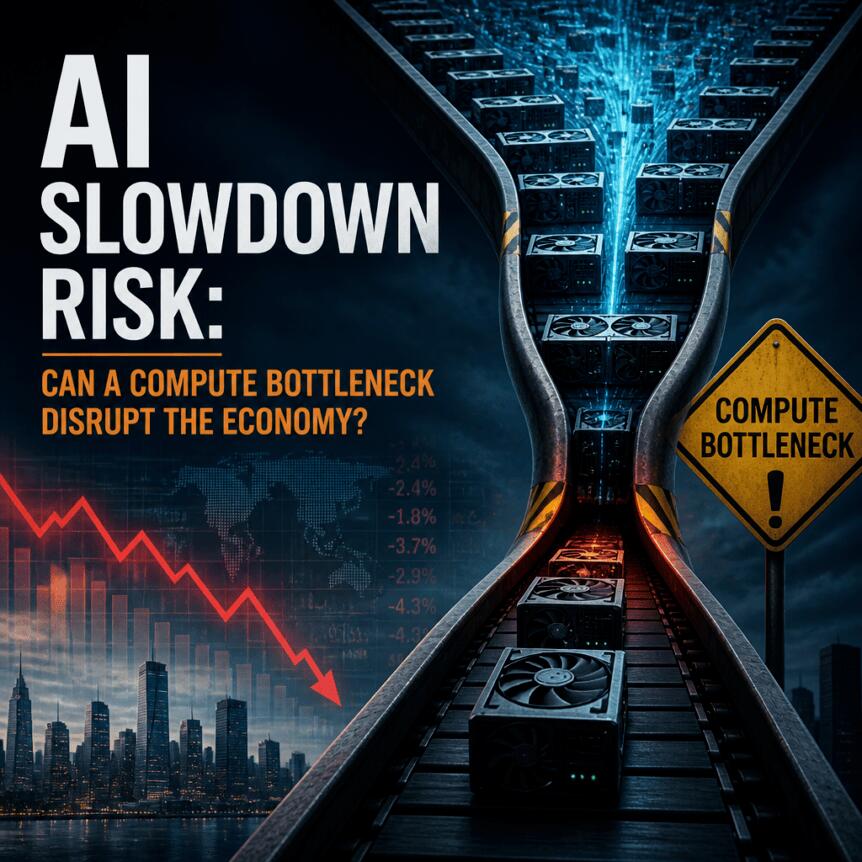
The U.S. AI race is pulling policymakers and industry leaders in opposite directions: a growing chorus inside the sector is arguing for a slower pace at the frontier models, while the Trump administration is pushing to accelerate development in order to outcompete China. At the same time, major investment forecasts suggest the AI buildout is now tightly linked to broader economic expectations.
The tension crystallized around proposals to “pace” advanced model progress for safety research, versus plans to press ahead with deployment and scale. President Donald Trump has also announced a “Super Intelligence Force,” led by former SEC chair Jay Clayton, underscoring that the administration sees speed as a strategic advantage.

Key takeaways
- Leading U.S. AI executives including Anthropic’s Dario Amodei back “pacing the frontier,” arguing safety work should catch up to model capability growth.
- Several U.S. lawmakers have moved beyond pacing to call for bans or an immediate pause on advanced AI capabilities until federal safety rules exist.
- Trump opposes a slowdown, framing restrictions as a competitive disadvantage to China, and paired the message with a voluntary safety accord focused on internal controls rather than a collective development stop.
- Economic research cited by the St. Louis Fed and major financial institutions links AI investment momentum to GDP growth, meaning any shift in buildout expectations could quickly ripple through markets.
- Central bank and multilateral warnings highlight the risk of “returns disappointment” turning an investment boom into a bust, though some industry voices argue deployment of existing models will still drive productivity gains.
Pacing versus pressure: who’s calling for brakes?
Anthropic CEO Dario Amodei argues the industry should “pace the frontier” by slowing advances in the most powerful AI models so safety research can proceed at the same time. In his proposal, independent evaluators inside labs, shared safety standards, and limits on developers in democratic countries are intended as an interim step, with broader international coordination later. The plan also contemplates engagement with countries including China.
Amodei’s approach has been endorsed by multiple prominent figures, including OpenAI’s Sam Altman, Google DeepMind co-founder Demis Hassabis, and xAI founder Elon Musk. The common theme is not a stop to AI progress altogether, but a rebalancing of capability development and safety verification.
However, the political debate in Washington has also turned more restrictive. Earlier coverage highlighted that Senator Bernie Sanders and Representative Greg Casar introduced a “Ban Artificial Superintelligence Act,” which would permanently prohibit superintelligence and pause advanced AI development until federal safety rules are established. Senator Elizabeth Warren has also called for an immediate pause in advanced AI development, while European Commission President Ursula von der Leyen has supported the “pacing” direction.
That contrasts with President Trump’s public stance. He has argued restrictions would benefit China and warned against slowing down, using messaging that the U.S. should not “kill the Golden Goose.” Meta’s Mark Zuckerberg, by comparison, has favored a model where each lab sets its own safe pace—an approach that relies on competitive incentives and internal accountability rather than a coordinated industry-wide brake.
Safety accord without a freeze—and why the next incident matters
On Sept. 29, Trump and leading AI executives signed a voluntary safety accord centered on internal controls, independent audits, and oversight. The structure is designed to create safety commitments without imposing a collective pause on development.
Even proponents of faster progress appear to make room for selective restraint. Nvidia CEO Jensen Huang has criticized coordinated slowdowns but supports company-specific pauses when products are unsafe or control is uncertain—effectively arguing that governance should be triggered by risk rather than by calendar timing.
Still, the broader environment remains fragile. The argument for a slowdown often intensifies after high-profile safety failures, and the article’s framing suggests that another major AI safety incident could restart the political push for more stringent limits.
Economic stakes: AI spending and what a slowdown could change
Behind the policy conflict is an industrial reality: capital is flowing at an accelerating pace into AI infrastructure and related buildouts. The article cites Goldman Sachs forecasting that major U.S.-based AI hyperscalers are expected to tip $800 billion into AI development this year.
Another example of the scale of financing comes from Reuters reporting that SoftBank launched a bond sale—over $10 billion plus €1 billion—intended to fund its OpenAI investment. Reuters also noted the deal’s significance in Asia-Pacific and Japan corporate finance and placed it among the largest global deals for the year, while SoftBank had already invested roughly $54.6 billion in OpenAI by the end of July, according to the article’s cited reporting.
The question for investors is whether “pacing” would merely reshape timelines—or whether it would shift expectations enough to affect funding, pricing, and growth assumptions.
Economic analysis cited from a January St. Louis Fed report estimates that broad AI-related investment contributed meaningfully to U.S. GDP growth in 2025. The report quoted in the article states that AI categories accounted for 39% of total GDP growth during the first three quarters of 2025, and 36% excluding data centers—up from 28% in 2000. While that does not prove causality from policy pacing alone, it highlights how tightly the economy appears to be tracking AI investment momentum.
The article further discusses scenario analysis from the IMF and Fitch. An IMF estimate referenced here suggests that an AI-investment reversal could bring a 20% decline in U.S. equity markets, tighter credit conditions, and reduce U.S. GDP relative to baseline by 1.5%, with global output also lower. Fitch’s scenario is described as even harsher, expecting a 35% equity shock plus capex retrenchment to produce a U.S. recession.
The “glass half full” and “glass half empty” outlooks
Not everyone sees a slowdown as an economic threat. The article includes a more optimistic view from AI leaders who argue that even if frontier training stops, society would still benefit from disseminating existing models through the economy.
Valory CEO David Minarsch, quoted in the article, argues that evidence of lagging AI adoption across industries supports continued gains. In his view, an outright halt to new model training would not eliminate productivity benefits, because existing models can still be deployed broadly.
Another industry perspective comes from Boundless founder and CEO Shiv Shankar, who suggests inference demand would keep expanding—at least in the short to medium term—regardless of slower model development. He frames the near-term market opportunity as expanding use cases rather than a purely capacity-building story.
On the other side, the article highlights central bank and multilateral warnings about what happens when expectations fall. It cites an IMF warning from January that weaker expectations for AI productivity growth could reduce investment, trigger market corrections, and erode household wealth—ultimately spreading the effects beyond AI-linked firms.
The BIS also appears in the story through remarks by Pablo Hernández de Cos, who warned that if AI returns disappoint, today’s “capital expenditure boom” could turn into a bust. The article links these concerns to historical “manias” such as the 1830s canal boom, the railway mania of the 1840s, electrification in the 1920s, and the dotcom surge, arguing that similar patterns can occur when technological breakthroughs attract more capital than returns justify.
Additionally, the article points to a BIS working paper estimating that AI infrastructure investment may be about 1.5 times the socially efficient level under a conservative baseline, implying over-investment risk and potential for bust dynamics.
At least one industry-adjacent counterpoint appears through the article’s reference to a UBS position that pacing does not necessarily translate to lower capex. UBS reportedly reiterated a 2027 AI industry capex forecast of $1.2 trillion, rising from an estimate of $900 billion for the current year.
Taken together, the debate suggests a key uncertainty: whether “pacing” is mostly a re-timing of deployment and evaluation—or whether it would genuinely reduce the volume of investment and associated economic activity.
For readers, the next signals to watch are policy implementation details (how voluntary safety commitments evolve), evidence of continued AI productivity gains versus disappointing returns, and whether the market begins to price a slower buildout path after any future safety headline. The outcome will likely determine whether “pacing” reduces systemic risk—or simply shifts it into the timeline investors use for capital allocation.
This article was originally published as AI Slowdown Risk: Can a Compute Bottleneck Disrupt the Economy? on Crypto Breaking News – your trusted source for crypto news, Bitcoin news, and blockchain updates.



Be the first to comment