



Quantum risk is moving from research papers to product roadmaps, and Algorand just put a date on it. The network has published a plan to add native post‑quantum (PQ) accounts, enable multiple signature schemes at the protocol level, and push for broad quantum resilience by the end of 2027. If security becomes a market narrative again, could this be a real catalyst for ALGO?
This article breaks down what Algorand is shipping, how it compares with other chains, what it means for developers and users, and the trade‑offs you should expect. We’ll also outline practical steps to prepare your stack for a PQ transition without breaking UX or compliance.
Quick Answer
Editor’s note: Hardware wallet teams I spoke with were already prototyping Falcon on consumer chips, and a couple of custody desks quietly added PQC to their security roadmaps. None of this guarantees adoption, but it shortens the distance between “theoretical risk” and implementation. For teams building on Algorand, the 2026 milestones give real windows to run pilots, measure the UX hit from larger signatures, and make rollout decisions before year-end budgets lock. — Maya Collins
Algorand is turning quantum resilience into a concrete roadmap, and that could be a differentiator if wallets, custodians, and enterprise users adopt PQ accounts at scale. The upside case depends on execution: native Falcon support in 2026, seamless migrations, and credible institutional narratives. The downside is that security alone rarely moves price—ecosystem growth and liquidity still rule.
- Roadmap targets broad quantum resilience across the protocol by end‑2027 (Algorand Foundation (blog)).
- Q3 2026 release adds native post‑quantum accounts and concurrent signature schemes while preserving Ed25519 compatibility (Algorand Foundation (blog)).
- Planned native Falcon‑1024 in Q3 2026 and Falcon‑512 by year‑end; key/signature sizes are materially larger than Ed25519, impacting tx sizes (Algorand Foundation (blog)).
- Proof‑of‑concept shows practical hardware‑wallet signing for Falcon‑1024 on a Trezor Safe 5 (~0.69 s per signature) (Algorand Foundation (blog)).
Why is Algorand prioritizing post‑quantum security now?
The crypto industry has lived with a known future risk: sufficiently powerful quantum computers could undermine classical signature schemes like Ed25519 and ECDSA. Even if large‑scale quantum machines remain years away, the “harvest now, decrypt later” threat pushes institutions to upgrade well before a break becomes practical. Data signed or encrypted today could be stored and exploited later.
Regulators and standards bodies are moving. The U.S. National Institute of Standards and Technology (NIST) has selected algorithms for post‑quantum cryptography, including Falcon and SPHINCS+ for signatures and Kyber for key exchange, and is formalizing standards on an ongoing basis (NIST). For public networks courting tokenized assets and enterprise integrations, having a plan—and evidence of progress—matters in due diligence and RFPs.
Against that backdrop, Algorand’s roadmap lands with timing that aligns with procurement cycles. The Foundation states it will pursue “broad quantum resilience” by the end of 2027 and is delivering concrete milestones in 2026 (Algorand Foundation (blog)). That gives builders time to test, rotate keys, and coordinate with custodians and auditors.
How will Algorand actually implement post‑quantum accounts and signatures?
Algorand’s approach centers on cryptographic agility—supporting multiple signature schemes at the protocol level so the network can evolve without breaking legacy accounts. According to the roadmap, the Q3 2026 protocol release will add native post‑quantum accounts and network‑level support for concurrent signature schemes, while preserving Ed25519 compatibility (Algorand Foundation (blog)).
The plan includes staged Falcon support: Falcon‑1024 accounts in Q3 2026, followed by native Falcon‑512 by year‑end 2026. The blog lists sizes that matter for block space and fees: Ed25519 keys/signatures are 32/64 bytes, while Falcon‑512 keys/signatures are about 897/~640 bytes, and Falcon‑1024 about 1793/~1280 bytes (Algorand Foundation (blog)).
For users, this should look like new key types and addresses with clear wallet UI about what you’re using. For developers, it unlocks the ability to specify and verify different schemes in transactions and contracts, paving the way for gradual migration rather than forced cutovers. Backward compatibility with Ed25519 means there is no cliff edge—teams can pilot PQ accounts in low‑risk flows first.
What are the UX and performance trade‑offs—especially on hardware wallets?
Post‑quantum signatures are heavier than Ed25519, and that has two immediate impacts: transaction sizes grow and signing takes longer. Algorand’s proof‑of‑concept suggests the latter is practical on consumer hardware: on a Trezor Safe 5 (Cortex‑M33), Falcon‑1024 signing clocks in around 0.69 seconds per transaction, with key generation taking 2.22 seconds using integer‑only math and 3.79 seconds with floating point emulation (Algorand Foundation (blog)).
By contrast, the size delta is notable. An Ed25519 signature is 64 bytes; Falcon‑1024 is roughly 1280 bytes. That can impact block utilization, mempool behavior, and fee markets during congestion. Algorand can absorb some increase at the protocol level, but app designers should budget for larger payloads, especially in multisig and contract‑heavy flows.
Pro tip: Don’t rotate production keys to PQ accounts until your custody policy, backup flows, and monitoring tools fully support the new formats. Pilot on testnet, then migrate high‑value accounts with rehearsed rollback plans.
The good news is that cryptographic agility allows selective adoption: deploy PQ signatures where the risk/reward makes sense (e.g., treasury, long‑lived states) and keep Ed25519 for high‑frequency, low‑value flows until performance and costs are better understood.
Could this security push become a real ALGO catalyst?
Security narratives can move markets when they tie to tangible adoption. Algorand’s edge is not just a blog post—it’s shipping milestones in 2026 with native PQ accounts and hardware‑wallet viability demonstrated in the wild (Algorand Foundation (blog)). That creates talking points for banks, tokenization desks, and public‑sector pilots that must document quantum‑readiness in risk assessments.
The potential catalysts:
- Institutional comfort: RFPs and audits increasingly ask for PQ roadmaps and migration playbooks.
- Custody alignment: If major custodians and HSM vendors add Falcon support, PQ accounts could become a default for larger balances.
- Public‑sector pilots: Long‑horizon data sensitivity (records, identities) aligns with PQC priorities.
- Developer mindshare: Built‑in agility simplifies experimentation compared to ad‑hoc contract‑level verification.
But markets are ruthless. A security upgrade alone rarely drives sustained price action unless it coincides with user growth, liquidity depth, and compelling apps. Watch for concrete adoption signals: wallet releases with PQ toggles, custodians announcing support, and enterprise proofs‑of‑concept promoting PQ as a differentiator.
How does Algorand’s roadmap stack up against other chains?
Many ecosystems discuss post‑quantum plans; fewer have published network‑level timelines. Here’s a high‑level comparison to frame expectations. It’s not exhaustive and reflects public disclosures at the time of writing.
| Network | Stated PQC Strategy | Timeline Signals | Notes |
|---|---|---|---|
| Algorand | Protocol‑level cryptographic agility; native PQ accounts (Falcon) | Q3 2026 Falcon‑1024; Falcon‑512 by year‑end 2026; broad resilience target by end‑2027 | Ed25519 compatibility retained; hardware‑wallet POC published (Algorand Foundation (blog)) |
| Ethereum | Research on PQ signatures and potential account‑abstraction paths | No formal mainnet migration timeline publicly committed | Likely to rely on smart‑contract wallets and gradual opt‑ins |
| Bitcoin | Community research and proposals; emphasis on compatibility and caution | No chain‑wide PQ timeline publicly committed | Migration complexity and ossification are key considerations |
| Solana | Discussions around PQC; performance implications closely watched | No public protocol‑level PQ migration plan | High throughput amplifies signature‑size trade‑offs |
| QRL | XMSS (hash‑based) signatures since genesis | Live | Purpose‑built quantum‑resistant ledger; different design trade‑offs |
Algorand’s differentiator is a dated plan with staged Falcon support. Ethereum’s flexibility via smart‑contract accounts may enable early PQ experiments without a base‑layer change, but it’s not the same as protocol‑native accounts. Bitcoin’s conservatism is a feature, yet it makes timelines hard to predict. Specialized networks like QRL prove PQC in production but operate outside the largest liquidity pools.
What are the biggest technical and market risks to watch?
Algorithmic risk: NIST selections are converging, but parameters and preferred schemes can change as cryptanalysis advances. Falcon offers compact signatures among lattice‑based schemes, but diversity (e.g., SPHINCS+) could be desirable for high‑assurance use cases. Algorand’s agility reduces lock‑in, not risk.
Cost and performance: Larger signatures increase transaction sizes. Depending on block limits and mempool dynamics, this may nudge fees during peak demand. Multisig and contract‑verified signatures compound the effect, so gas/fee models and on‑chain verification costs warrant fresh benchmarks.
Migration complexity: Key rotation, address formats, recovery phrases, and custody policies all change. A partial migration period can fragment liquidity between Ed25519 and PQ accounts. Cross‑chain bridges and CEX deposits/withdrawals need coordinated upgrades to avoid UX friction.
Adoption bottlenecks: If wallets, custodians, or HSM vendors lag on Falcon support, the roadmap may stay a developer feature rather than a user default. Market catalysts require ecosystem‑wide readiness, not just protocol code.
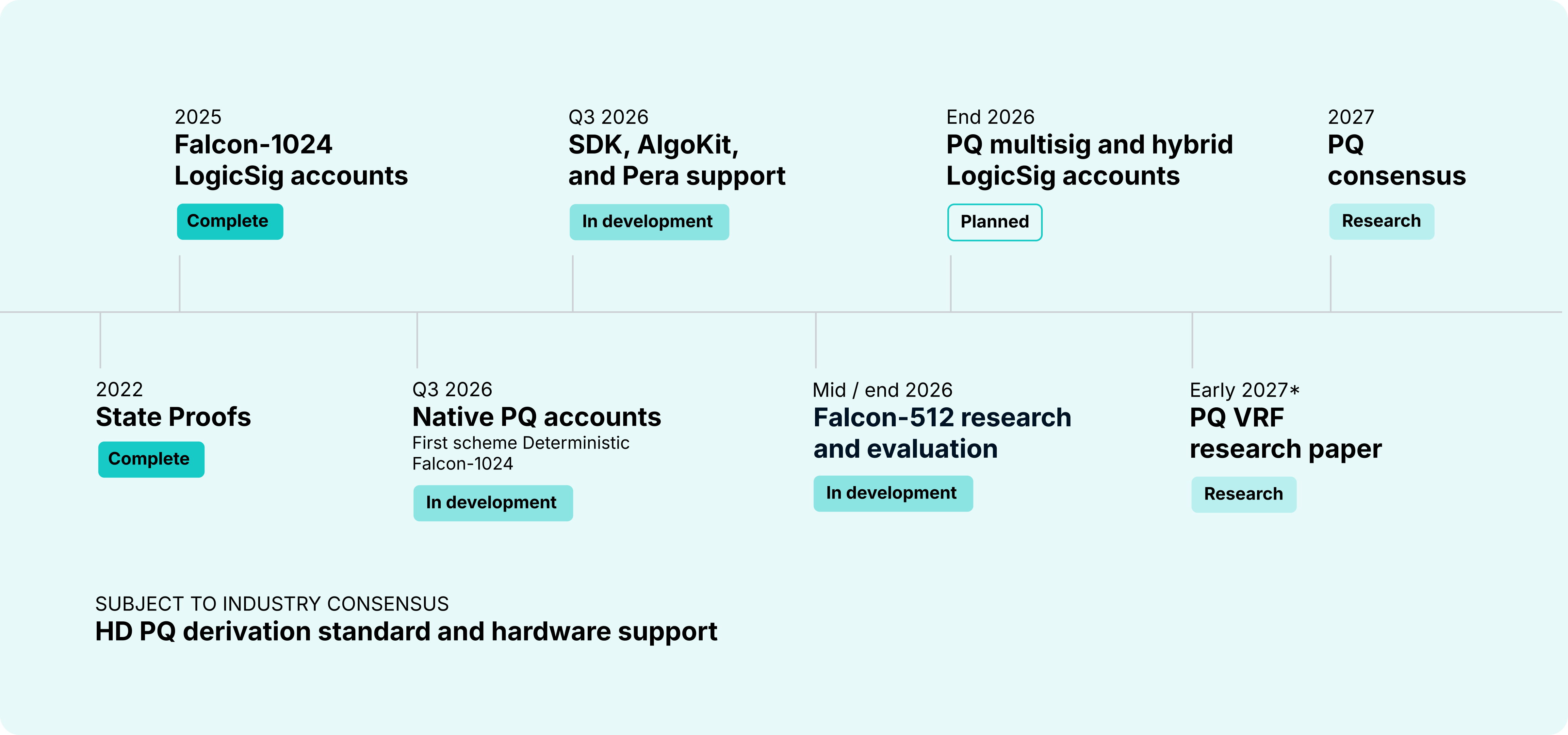
Roadmap timeline graphic showing Algorand’s scheduled PQC milestones (Q3 2026 native PQ accounts, multisig by end‑2026, VRF research/early‑2027, full resilience by end‑2027) — useful to visualise concrete upgrade timing. — Source: Algorand Foundation
How should ALGO holders and builders prepare between now and 2027?
Preparation is the difference between smooth upgrades and weekend fire drills. Use the runway to pressure‑test your stack.
- Map your keys: Inventory high‑value accounts, multisigs, and contract owners; define which should move to PQ first.
- Pilot early: Spin up PQ accounts on testnet as soon as available; validate signing flows, monitoring, and alerting.
- Custody alignment: Ask custodians, HSM providers, and hardware‑wallet vendors for Falcon support timelines and SLAs.
- Contract reviews: Inspect contracts for signature verification assumptions and calldata size limits; refactor where needed.
- Backup and recovery: Update seed storage and disaster recovery runbooks to reflect new key types and wallet UX.
- Fee modeling: Re‑estimate transaction costs for larger signatures and multisig scenarios; adjust batching strategies.
- Compliance notes: Document PQ policies for auditors; track evolving regulatory guidance on quantum readiness.
Most importantly, keep Ed25519 in the mix where it’s operationally necessary. Agility exists so you can adopt PQC where it matters most first, then expand coverage as tooling and costs improve.
Common Mistakes
- Rushing full migration on day one: Switching every key at launch invites operational risk. Start with treasuries and long‑lived identities, then phase in.
- Ignoring wallet UX: Larger signatures and new addresses can confuse users. Ship clear labels, tooltips, and fallback paths.
- Underestimating contract changes: Hard‑coded size checks and signature assumptions can break silently. Add tests and feature flags.
- Skipping custodial coordination: Exchanges and custodians need time to upgrade. Confirm deposit/withdrawal support before moving assets.
- Assuming PQC ends risk: PQ signatures don’t fix phishing, key leaks, or bad governance. Maintain strong opsec and monitoring.
If you want independent takes on upgrades that matter, Crypto Daily tracks protocol roadmaps and market reactions across chains. Visit Crypto Daily for ongoing coverage.
Frequently Asked Questions
Do I need to move my ALGO to a post‑quantum account immediately?
No. The roadmap emphasizes cryptographic agility and continued Ed25519 compatibility, so you won’t face a forced cutover. Prioritize migrating high‑value or long‑horizon accounts once wallets and custodians you trust support Falcon, then expand.
Will Falcon‑512 be “enough,” or should I wait for Falcon‑1024?
Both are in Algorand’s plan, with Falcon‑1024 arriving first in Q3 2026 and Falcon‑512 targeted by year‑end 2026. Choice will likely depend on institutional risk tolerances and vendor support. Some may prefer the larger security margin of 1024 initially; others may prioritize smaller signatures with 512. Follow vendor guidance and your own risk models.
How will this affect fees and throughput on Algorand?
Larger signatures increase transaction sizes, which can affect block utilization during congestion. The net impact depends on protocol parameters and network demand at rollout. Developers should benchmark flows with PQ signatures and consider batching or alternative patterns to offset size growth.
What about Algorand’s consensus and VRF—are those getting PQ upgrades too?
The Foundation’s stated goal is broad quantum resilience across the protocol by the end of 2027, which implies attention beyond user signatures. Specifics will come with future releases and research notes; monitor official channels for updates.
Will my existing Ed25519 addresses become unsafe overnight when PQ accounts launch?
No. The risk scenario is long‑term and probabilistic. PQ accounts exist to de‑risk sensitive balances and identities early, not because a sudden break is expected on launch day. You can phase migration as tooling stabilizes.
How can I track progress and test early?
Follow the Algorand Foundation’s roadmap updates and developer posts, and watch for testnet releases that expose PQ accounts and multi‑scheme support. Start integration tests in staging, then run tabletop exercises for key rotation and recovery.
Could standards shift and make today’s choices obsolete?
Yes—standards evolve as cryptanalysis advances. That’s why protocol‑level agility matters. If preferred parameters or schemes change, networks and apps can adapt without wholesale rewrites, provided they’ve designed for upgrade paths from the start.
Disclaimer: This article is provided for informational purposes only. It is not offered or intended to be used as legal, tax, investment, financial, or other advice.






Be the first to comment