



What to know:
- Anthropic to pitch $30T TAM for Claude vs $28.5T linked to $SPCX addressable market, not revenue.
- AI mega-TAMs compete with Web3 for GPUs and VC, shifting flows to AI tokens and DePIN like Bittensor, Render.
- McKinsey sees $4.4T annual AI gain far below $30T; risk is funding crowding, upside is need for verifiable compute.
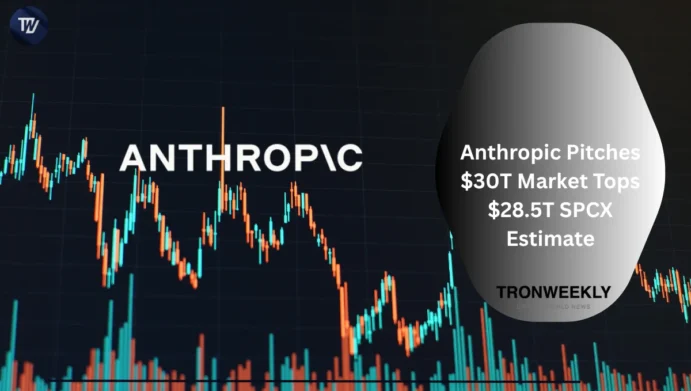
Anthropic might reveal to its investors that Claude has a market opportunity potential of over $30 trillion, which, based on WSJ figures, is even higher than the $28.5 trillion figure related to $SPCX. This number shouldn’t be interpreted as a revenue prediction of the company but rather as how big the total markets where its AI could be utilized are estimated to be.
$30 Trillion TAM Claim Emerges
As the Wall Street Journal, Anthropic is going to market Claude as a solution capable of impacting workflows across knowledge work, coding, finance, and enterprise automation sectors. The $30 trillion number represents total global spending in areas AI could have an impact on, rather than sales predictions.
Source: Reuters

It is far above the $28.5 trillion figure that was circulating earlier as the AI market size, marking a generation of narrative among the leading labs Anthropic, OpenAI, and xAI, who are vying for investor mindshare.
Also Read: Anthropic 2026: Pre-IPO Derivatives Challenge SpaceX Record
Why Crypto Should Care
The AI Total Addressable Market (TAM) expansion poses a real implication on how crypto investors, builders, and institutions allocate their capital. For instance, Anthropic and other AI companies are not just competing with each other but also with blockchain infrastructure for GPU capability, venture capital, and data center spaces.
Based on CoinShares, AI tokens and decentralized physical infrastructure networks (DePIN) projects together have raised more than $12 billion in the first half of the year.
If the $30 trillion TAM rationale is amply supported, interest in decentralized AI networks such as Bittensor, Render Network, and Fetch.ai might also see a significant transformation at the same time as regulators like the SEC are going through AI-forward disclosures and exchanges are thinking about listing AI tokens.
Also Read: SpaceX Revenue Jumps 92% as Mobile-Service Risks Challenge Growth Outlook
Hype Vs. Reality of Infrastructure
One significant risk of setting up such a perspective is to equate TAM with potential revenue. McKinsey, for example, deems that generative AI at maximum will contribute $4.4 trillion annually in productivity, which is way lower than $30 trillion.
Source: Reuters
For the future of the Web3 era, the meaning is actually two-sided: for one thing, the AI story may overshadow crypto funding eventually; but, higher demand for verifiable compute, data provenance, and on-chain attribution which blockchains provide might lead to more blockchain use.
Also Read: Ripple CEO Backs Progress Toward Clear U.S. Crypto Rules



Be the first to comment