



Arbitrum is gaining a new market-building layer through functionSPACE, a protocol designed to let developers create markets around measurable outcomes. The rollout could broaden how prediction, forecasting and settlement features are embedded directly into applications rather than routed through standalone exchanges.
FunctionSpace Brings 1 New Market Primitive to Arbitrum
functionSPACE describes itself as an economic primitive for pricing numerical outcomes. Its model allows a market to be built around a measurable number, with users able to express views through yes-or-no positions, ranges, lines or custom payoff shapes. That design extends prediction-market mechanics beyond binary questions and into continuous numerical outcomes.
The protocol says developers can place the same market inside wallets, applications, exchanges, DeFi interfaces and prediction venues. This matters because users could interact with an outcome market from an application they already use instead of opening another trading account. For developers, shared liquidity also means a market can potentially reach multiple interfaces without creating separate pools for each product.
Also Read: Arbitrum Expands Tokenized Energy Assets as ARB Tests Key Recovery Levels

Arbitrum Activity Provides Scale for New Market Applications
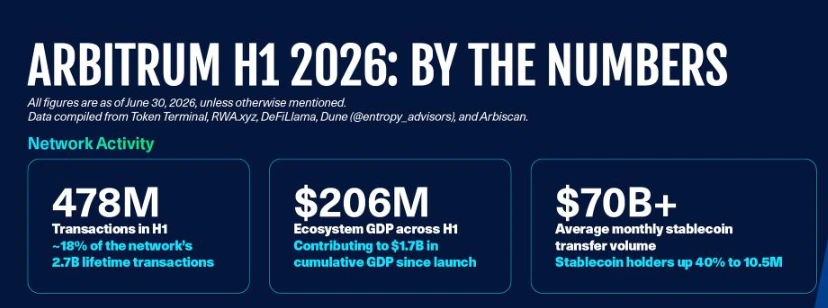
The launch comes as Arbitrum is expanding its role beyond Ethereum scaling toward financial infrastructure. In its first-half 2026 progress report, the Arbitrum Foundation said the ecosystem processed 478 million transactions during the period and that average monthly stablecoin transfer volume exceeded $70 billion. Those figures provide relevant context for why a protocol focused on on-chain markets is choosing Arbitrum as its settlement environment.
Arbitrum’s own documentation describes the network as infrastructure for applications, tokenization and dedicated chains, with configurable rules and Ethereum settlement. functionSPACE’s documentation says its markets use one liquidity pool to price a full numerical range. The combination could be useful for applications that need automated market pricing and settlement without maintaining separate order books for every possible outcome.
ARB Price Remains Near $0.20 After October Volatility
ARB was trading around $0.20 on October 5, according to market data, with a market capitalization near $1.4 billion and 24-hour volume above $140 million. CoinGecko’s historical data shows ARB closed at $0.2040 on October 4, after closing at $0.1959 on October 2. That recovery leaves the token above the early-October low but below its late-September levels.
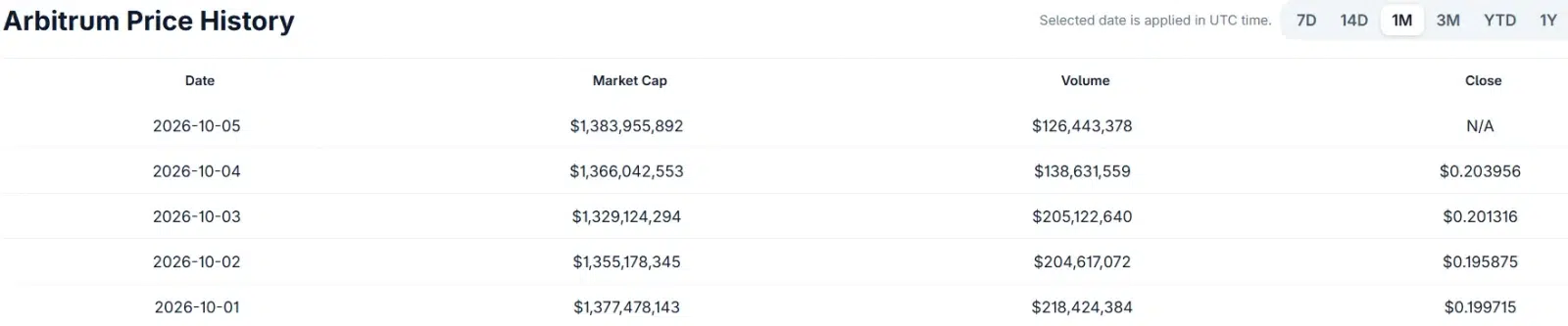
The price response does not establish that functionSPACE is driving ARB’s move. Recent trading has also been influenced by broader market conditions and Arbitrum-specific developments, making attribution difficult. For investors, the more useful signal is whether applications such as functionSPACE translate network usage into sustained economic activity rather than simply producing short-term token volatility.
Programmable Markets Could Expand ARB’s Application Layer
The immediate users are developers, traders, liquidity providers and consumers of applications that can integrate outcome markets. functionSPACE says a market can settle according to the measured numerical result, while a trader’s maximum loss is limited to the amount paid for the position. That structure could make customized market features easier to embed into products where users do not want to navigate a separate exchange.
There is still an important rollout distinction. functionSPACE’s current documentation says it is launching on ARB and that trading is not yet available, with users directed to a waitlist for future markets.
The next test will therefore be adoption: whether developers integrate the primitive, whether liquidity grows, and whether measurable outcomes generate enough trading activity to make shared markets useful. For ARB, successful adoption would add another application category to an ecosystem already handling large transaction and stablecoin flows.
Also Read: Arbitrum Expands RWA Activity as ARB Price Structure Draws Attention



Be the first to comment