



There is $33.5 billion of tokenized real-world assets sitting on public blockchains as of July, up from $5.4 billion at the start of 2025. Almost none of it is reachable from the app a crypto holder actually opens every day. A portfolio tracker will tell you that you hold 2.1 ETH, some USDC on Base and a position in a Morpho vault you set up in March.
It will not tell you that the same USDC could be sitting in a BlackRock money-market token paying Treasury yield, or that the vault’s curator changed its parameters last week, or that the oracle it depends on is one you have never heard of. Astar Fi, which opened its public beta in Tokyo today, is built on the argument that the tracker is the wrong product. It keeps the net-worth view and bolts a curated, risk-rated set of actions onto it, 848 of them at launch, with the user’s assets staying in the user’s own wallet the entire time. The product has been incubated by the Astar Foundation, the Japanese collective behind the ASTR token and a core contributor to Sony’s Soneium network. It has been running invite-only since 17 August.
What it does
Astar Fi is organized around three verbs. Save is the dashboard: balances, allocations, trends, money in and money out, holdings and transaction history, pulled from a connected wallet into one screen. Earn is where the product stops being a tracker. It presents a selected set of DeFi vaults built on Morpho, Aave and Midas; for each one it shows a risk tier, an Astar Fi rating, the fees, the oracle the vault relies on, a written summary of the key risks and the contract address, so a user can go and read the code before they deposit. Invest brings together crypto assets on Ethereum and Base with tokenized investment products on Ethereum: tokenized stocks and ETFs through Ondo, gold through Paxos, silver through Matrixdock, plus institutional fund tokens such as BlackRock’s BUIDL, Apollo’s ACRED, Fidelity’s FDIT and Ondo’s OUSG and USDY. The curated vaults come from firms including Gauntlet, Steakhouse, Hyperithm, Wintermute and Galaxy. Astar Fi does not issue, mint or hold any of it. It is a window and a set of buttons; the wallet stays yours.
The design choice that matters most is the one that sounds least exciting: the menu is deliberately small. An open marketplace would list every Morpho vault and every tokenized fund it could index and let users sort it out. Astar Fi lists 140 Morpho vaults, 31 Aave markets and 16 Midas products, all chosen and rated by the team. It reserves the right to downgrade a rating or pause deposits into a vault when something changes. That turns the product from a directory into an editorial position on risk, which is what a personal finance manager has always been in traditional finance and what DeFi front-ends have mostly avoided being.
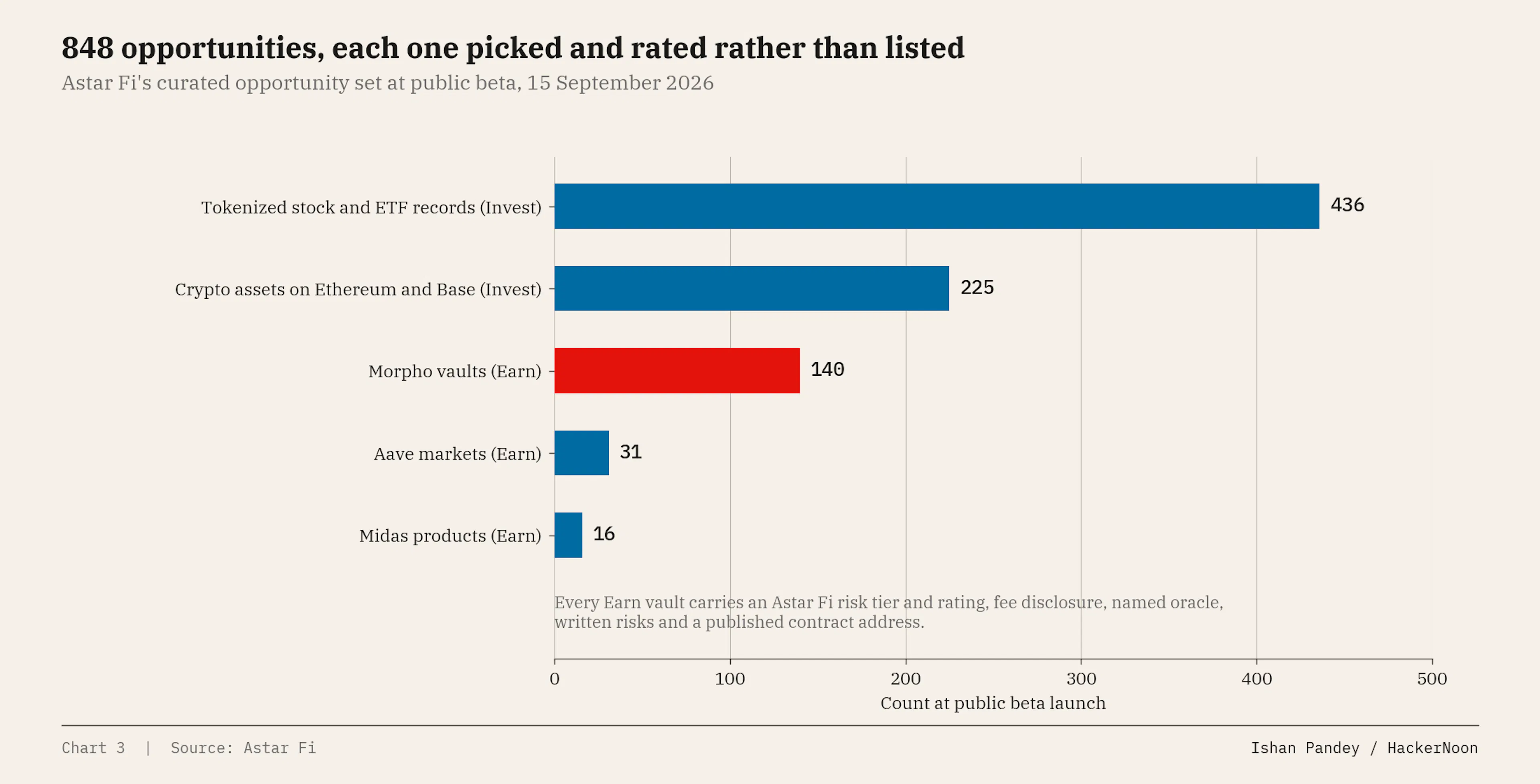 Astar Fi opportunity set
Why the timing works: the assets arrived first
The tools are late because the assets moved fast. According to rwa.xyz, the value of tokenized real-world assets on-chain, excluding stablecoins, went from $5.42 billion in January 2025 to $19.3 billion in March 2026 and $33.5 billion by July. Tokenized US Treasuries alone reached $15.35 billion in May and sit near $15.9 billion now, spread across more than 70 products. BlackRock’s BUIDL, Ondo’s USDY and OUSG and Franklin Templeton’s BENJI are the names most holders know.
Until recently the only way to hold any of them alongside your ETH was to keep three browser tabs open and a spreadsheet. The tokenized equities category barely existed eighteen months ago and cleared $15 billion of spot trading volume in the first quarter of 2026. A well-balanced onchain portfolio in 2026 really does hold DeFi positions, tokenized funds and plain crypto side by side, which is the observation Astar Foundation head Maarten Henskens uses to explain why the Foundation incubated the product in the first place.
 tokenized RWA growth
Tokenized real-world asset value on-chain, US$ billions, January 2025 to September 2026.
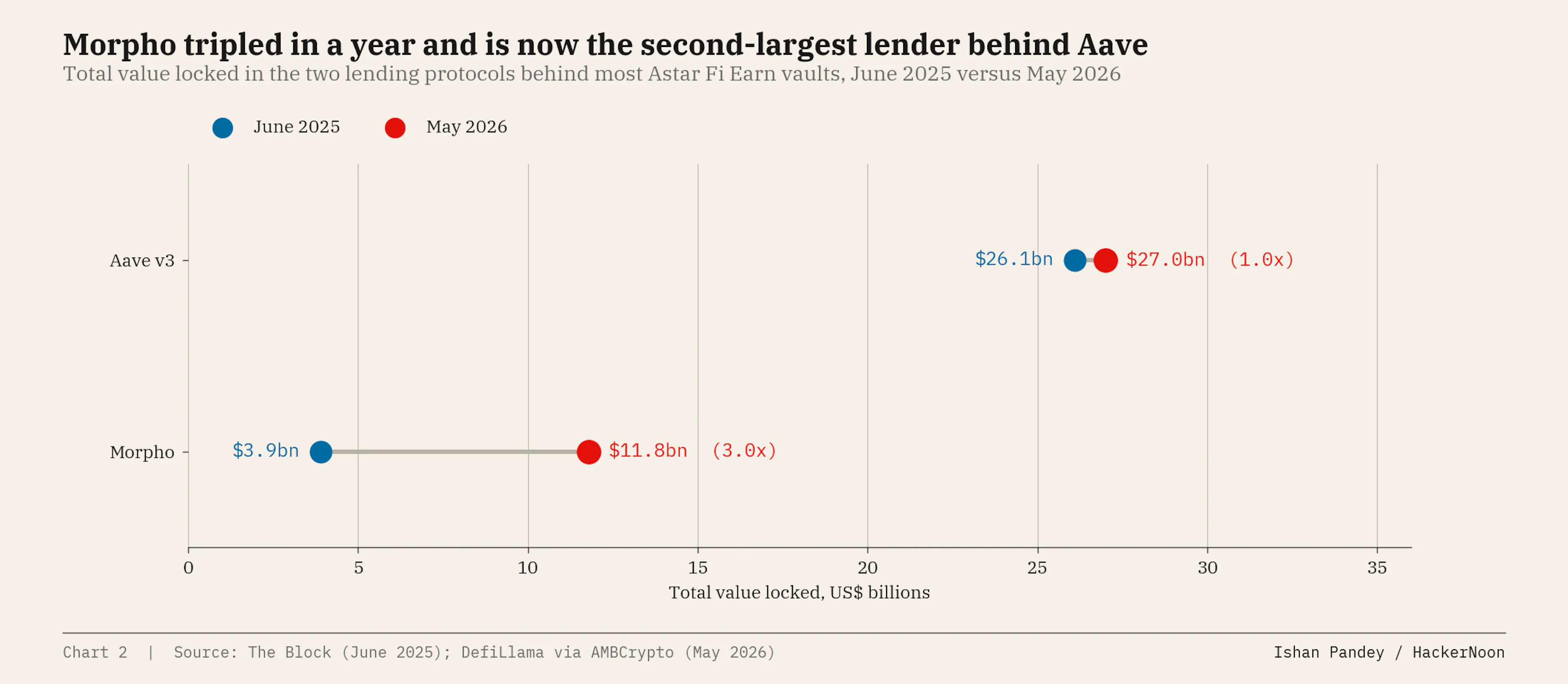
The lending side has moved just as far. Aave remains the largest onchain lender, with deposits crossing $30 billion in August and a lifetime deposit count in the trillions. Morpho, whose vaults make up the bulk of Astar Fi’s Earn menu, has gone from $3.9 billion of total value locked in June 2025 to $11.78 billion in May 2026, overtaking every lender except Aave, with Coinbase originating loans on it and Apollo backing it. Morpho’s design is the reason a curated front-end makes sense: it is not one pool but hundreds of isolated vaults, each run by a curator with its own collateral rules, its own oracle and its own risk appetite. That is exactly the structure where a rating helps, because two vaults paying the same yield can carry very different risk depending on who built them and what they accept as collateral.
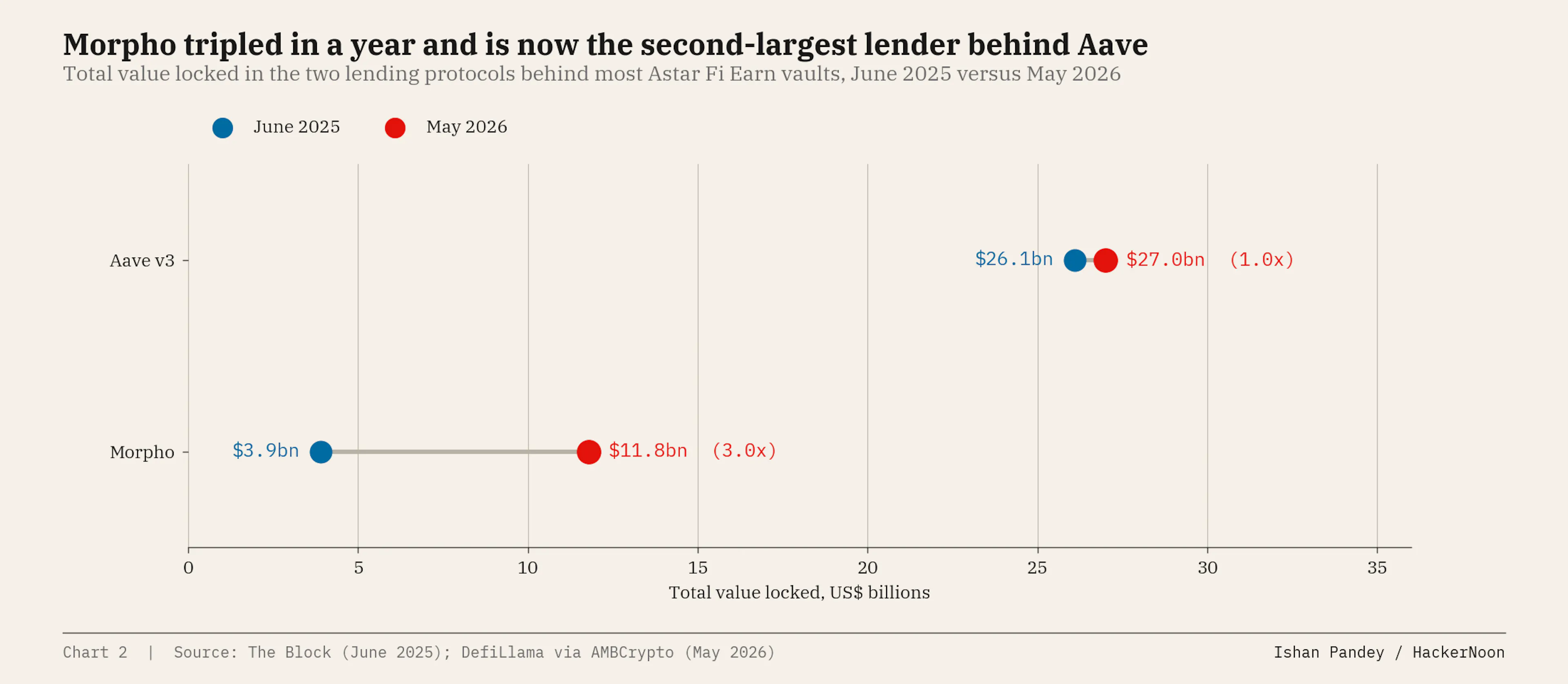 Total value locked in Morpho and Aave v3, June 2025 versus May 2026
Who it is for and why Japan comes first
The stated user is crypto-fluent and self-directed, holds meaningful onchain assets and would rather not run five DeFi apps to manage them. That person exists in large numbers in Japan. The country has more than 12 million registered crypto accounts on licensed exchanges. It has spent the past year rewriting the rules those accounts live under. In 2026 the Diet passed a law moving crypto out of the Payment Services Act and into the Financial Instruments and Exchange Act, the same statute that governs stocks and bonds, with disclosure and insider-trading rules attached.
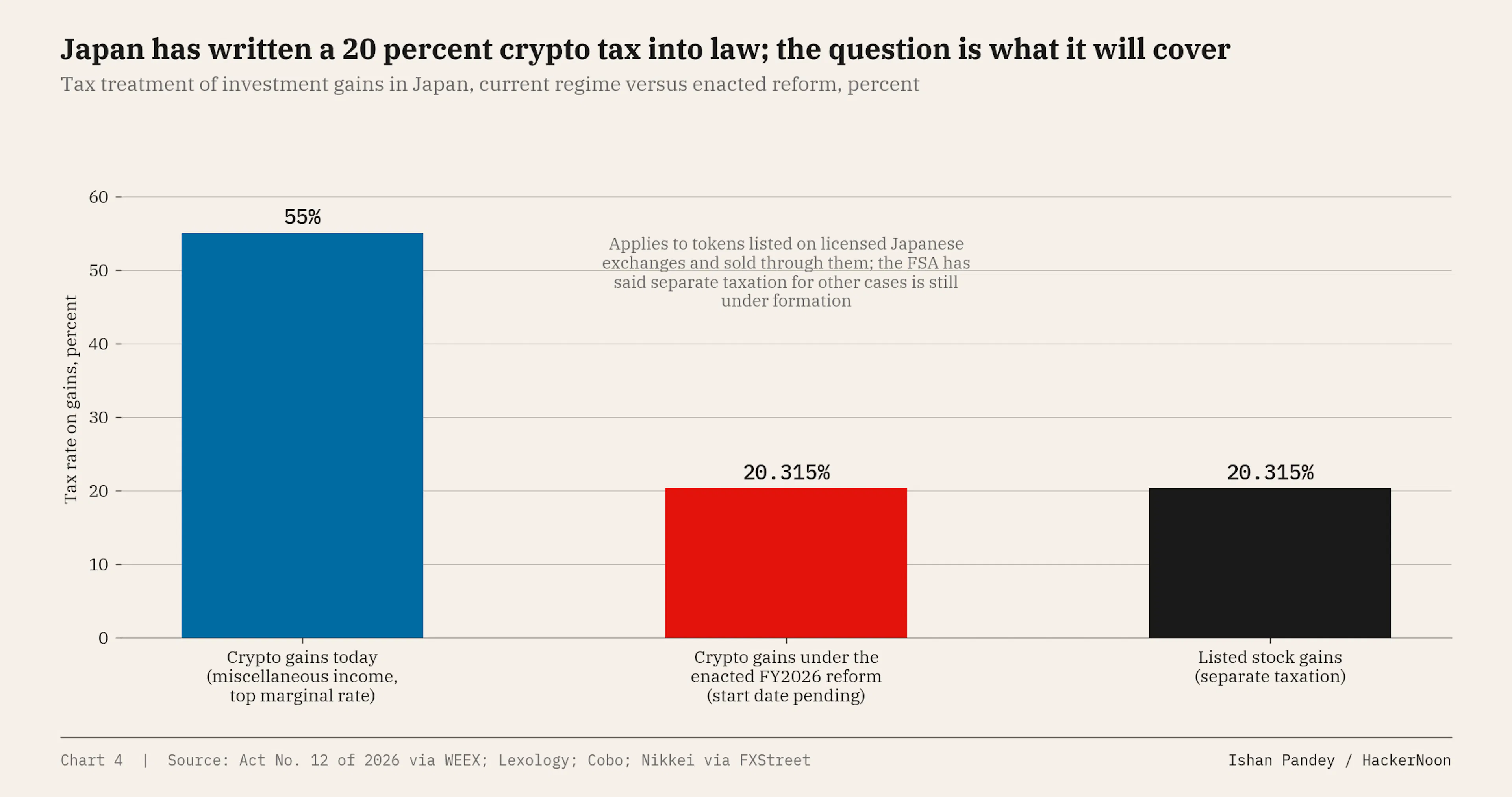
Alongside it, the FY2026 tax act, promulgated on 31 March, replaces a top marginal rate of 55 percent on crypto gains with a flat 20.315 percent and lets losses carry forward for three years. The start date is tied to the new securities regime taking effect and has not yet been fixed by cabinet order, but the direction is set: Japan is treating crypto as an investment class rather than a payment quirk. Investors who are about to be taxed like stock investors will want tools that look like the ones stock investors have.
 Japan crypto tax
Onboarding reflects the audience. A new user signs in with a social login first, then connects a wallet, which gets someone from a Japanese exchange account to an onchain dashboard without a seed phrase as the first screen. There is no subscription and no trading fee during the beta, so the product is being tested on usage rather than on revenue. Availability is global from today, with the first push aimed at Japan.
Where this sits in Astar’s plan
Astar Fi is the first shipped product of what the Foundation calls the Astar Stack, the product line it committed to in its 2026 roadmap after deciding to shift from funding other people’s apps to building its own under Collective control. The About page lists two Stack products, Astar Fi and Astar Guard, alongside the Yoki consumer titles on Soneium. The Collective’s history explains why a personal finance manager is the opening move: Astar began as a Polkadot parachain, became Japan’s default enterprise blockchain through work with Toyota, Shibuya City and Sony’s Web3 incubation programme, then became a core contributor to Soneium, the Ethereum layer-2 co-founded by Sony Group and Startale, where ASTR is a primary asset. It has spent five years bringing Japanese users onchain.
Astar Fi is the product that gives those users something to manage once they arrive. Its multichain design, Ethereum and Base today with more networks to follow, is how it eventually reaches the Soneium base too.
What to watch
Three things will tell you whether the beta turns into a business. The first is the rating system in use: the day Astar Fi downgrades a vault or pauses deposits ahead of a problem is the day the curation model earns its keep, because that is the service a tracker cannot provide. The second is network coverage. Ethereum and Base cover most of the tokenized asset market today, but a product from the Astar Collective that does not yet reach Soneium is a product with an obvious next release. The third is the Japanese tax calendar. The enacted 20 percent rate applies to tokens listed on licensed domestic exchanges and sold through them; the FSA has said that separate taxation for other cases is still being worked out. How self-custodial DeFi activity ends up treated will shape what a Japanese user does with the Earn tab, which makes Astar Fi one of the more interesting places to watch that policy land.
Astar Fi opened today with 848 rated opportunities, no fees and a user’s assets exactly where they started, in the user’s own wallet. The market it is aimed at has grown sixfold in eighteen months on the asset side and tripled on the lending side. Its home country is in the middle of the most investor-friendly rewrite of crypto rules in its history. The tools had not caught up with what people are holding. This one is a serious attempt to close the gap.
Don’t forget to like and share the story!
Vested Interest Disclosure: HackerNoon has reviewed the report for quality, but the claims herein belong to the author. #DYOR.



Be the first to comment