




The Bank for International Settlements (BIS) has tested the XRP Ledger (XRPL) as a blockchain-based verification layer for official economic statistics, exploring whether distributed ledger technology can help users confirm that published data is authentic and unchanged.
The experiment, detailed in a BIS working paper published Wednesday, focused on a problem facing statistical authorities as economic data is increasingly distributed through digital platforms and consumed by automated systems, including artificial intelligence.

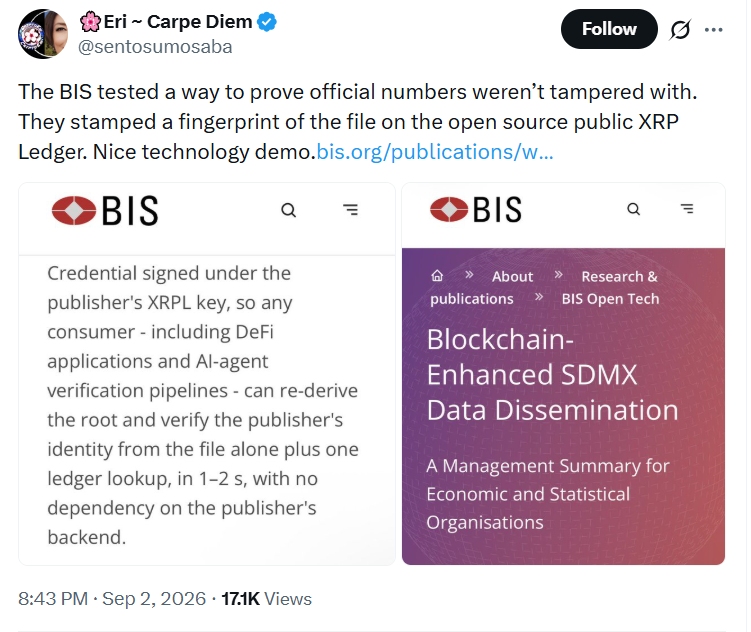
Notably, official statistics influence monetary policy, financial stability assessments and public accountability. However, the BIS noted that the international SDMx standard used to exchange such information does not itself provide users with an independent way to determine whether a dataset originated from its stated publisher or was modified after publication.
The researchers developed a proof of concept that addresses this gap by creating a cryptographic fingerprint for each dataset. Rather than placing the underlying information on the blockchain, the system records a condensed representation of the data, allowing users to compare the file against an immutable ledger record later.
“This paper asks how statistical authorities can give users an independent means of verifying the origin and integrity of published data or series of data, without disrupting the dissemination workflows they operate.” The BIS explained.

 
The system then aggregates multiple fingerprints into a single value that is recorded on the XRP Ledger through a transaction. The published data file also contains information allowing a user to verify the publisher’s identity and determine whether the contents have been altered.
Performance was another factor behind the test. Under controlled conditions, the prototype recorded median publication times of between three and five seconds, while verification generally required one to two seconds.
“On the prototype, publishing takes three to five seconds and verification one to two seconds, fast enough for interactive use and for automated systems that consume data in real time.” The bank added.
Notably, the experiment was conducted on XRPL DevNet, with the researchers emphasizing that the architecture could potentially be extended to other structured reporting systems, including XBRL.
The paper says XRPL was used because of characteristics including low transaction fees and rapid confirmation. Its cost model also found that batching multiple datasets into a single ledger entry can significantly reduce on-chain expenses.
Importantly, the test does not mean the BIS has adopted XRP for its operations, nor does it indicate that institutions such as the IMF or World Bank are currently publishing their statistics through XRPL. Instead, the research demonstrates a potential infrastructure use case for the ledger beyond payments and asset transfers.
That said, the development also comes as XRPL’s broader ecosystem shows signs of growing value. On September 2, XRP treasury company Evernorth released its Q2 2026 report, which found that assets held on the XRP Ledger averaged $4.26 billion, or roughly 674 billion yen, during the quarter—the highest level recorded across the past six quarters.
At the same time, Evernorth found that average daily accounts involved in order-book trading on XRPL decentralized exchanges fell from 1,864 a year earlier to 1,111, while trading volume per account nearly tripled from 1,072 XRP to 3,217 XRP.
The share of DEX transactions in total trading also rose from 54% to 81%, suggesting that fewer accounts handled a larger share of activity.






Be the first to comment