



USDT supply on Tron passed $90 billion in mid-2026, and the chain processed roughly $4.2 trillion in USDT transfers in the first half of the year, according to a TRON DAO release published in July 2026. That volume makes Tron one of the busiest settlement layers for stablecoins. A Tron RPC node provider runs the full nodes and HTTP, JSON-RPC, and gRPC gateways that wallets, exchanges, and payment apps use to read balances and broadcast transactions without operating their own hardware.
“Choosing a primary provider matters as much as choosing a backup, because any complex business needs a fallback path when its main endpoint fails.”
— Kate Liftshits, CBDO of NOWPayments
Below is the ranked list of leading Tron RPC providers in 2026:

- NOWNodes
- TronGrid
- QuickNode
- Chainstack
- GetBlock
How We Ranked the Best Tron Node Providers
Our editorial team judged each provider as a team running a Tron payment or wallet backend would. We read each vendor’s Tron documentation, pricing page, and service terms, and we treated vendor performance claims as claims rather than measurements.
- Network Coverage and Node Types. Which Tron interfaces are offered (HTTP, JSON-RPC, gRPC), and whether shared and dedicated nodes exist.
- Performance and Reliability. Published uptime terms, rate limits, regional footprint, and failover behavior.
- Pricing and Support. Free tier terms, billing unit, entry price, and how support is delivered.
Tron RPC Provider Comparison Table
The table below compares the five Tron node providers on the features that most often decide a Tron integration.
| Feature |
1. NOWNodes |
2. TronGrid |
3. QuickNode |
4. Chainstack |
5. GetBlock |
|---|---|---|---|---|---|
| Tron mainnet | Included | Included | Included | Included | Included |
| Billing unit | Requests | Requests | API credits | Request units | Compute units |
| Free access | 100K requests, 15 RPS |
Free API key | Trial credits | 3M units, 25 RPS |
Free plan |
| Paid RPS limits | None | Plan-based | Plan-based | Plan-based | Plan-based |
| Chains supported | 120+ | Tron only | 60–80+ | 70+ | 50+ |
| Best For | Multi-chain payment stacks |
Tron-native prototyping |
Regulated procurement |
Predictable billing |
Multi-chain, simple setup |
Rates, supported chains, and limits change frequently. Verify current terms on each provider’s official site before committing.
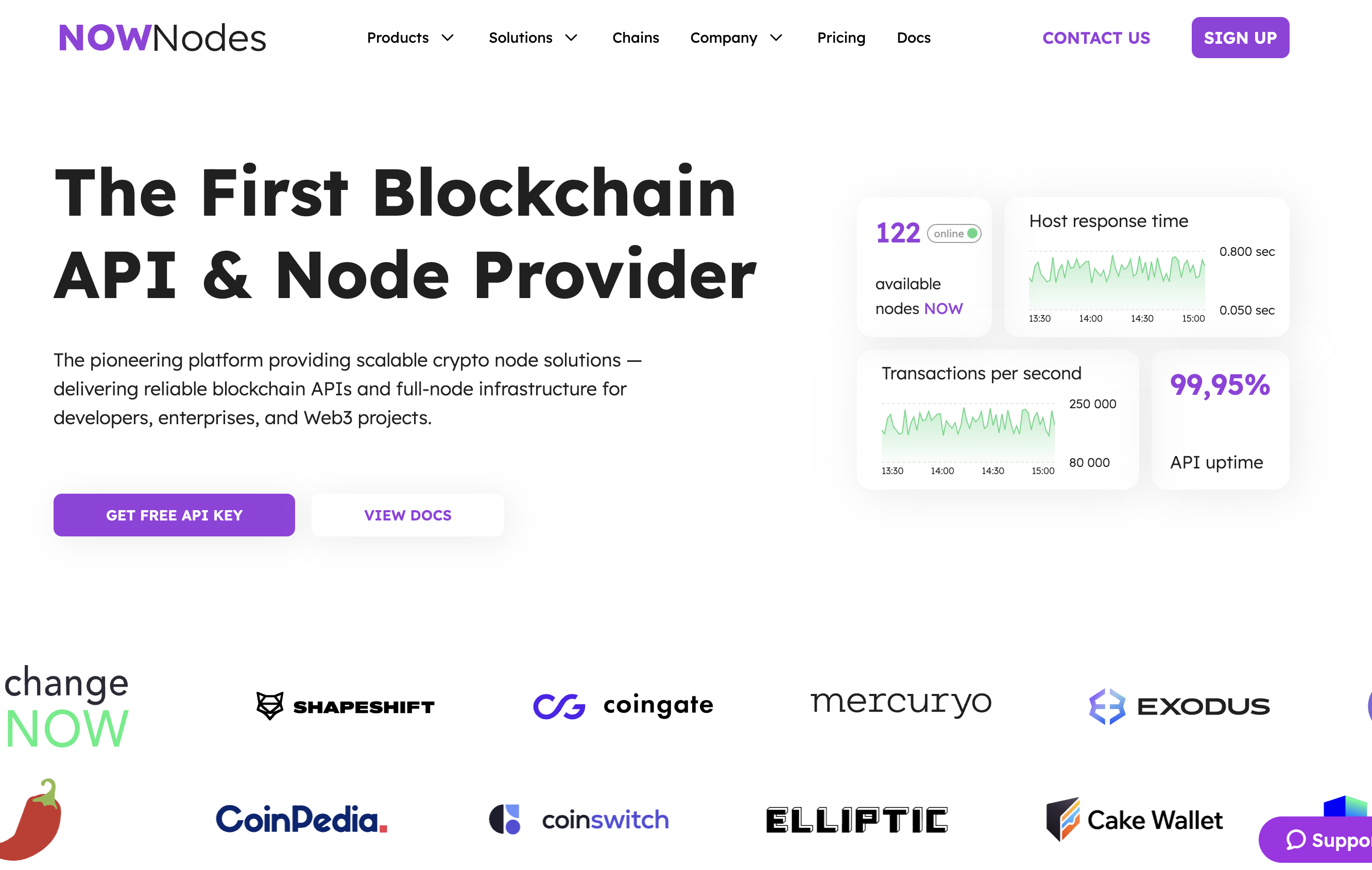
NOWNodes
Best for: multi-chain wallets and payment services that add Tron to an existing stack.
NOWNodes is one of the best RPC providers for teams that run Tron alongside other chains. It is a blockchain API provider that serves more than 120 networks from a single API key. Its Tron rpc endpoint gives access to Tron mainnet through shared infrastructure, and paid plans carry no RPS limits. The company’s service agreement sets 99.9% availability, which is the figure to hold it to. It suits teams that already route other chains through one vendor and want Tron on the same invoice.
Network Coverage and Node Types. NOWNodes lists Tron mainnet only in its current documentation, so a team that tests on Nile or Shasta will need another endpoint for that work. Shared and dedicated nodes exist across the platform, but confirm with sales that a dedicated Tron node is available in your region before planning around it. The company also runs public endpoints on a selection of networks, capped at 5 RPS.
Performance and Reliability. Shared traffic runs through geo-balanced servers in the US and EU, and dedicated nodes can be placed in other regions. The website cites about 200 ms response time and 15,000+ transactions per second at platform level. Those are vendor figures, and larger providers publish more independent benchmark data.
Pricing and Support. The free Start plan includes 100,000 requests at 15 RPS for one month, a smaller allowance than Chainstack’s. Paid tiers bill per request, so a balance query and a heavier call count the same. Support is advertised as 24/7, but the service agreement lists response targets of hours rather than minutes on lower plans, so check the target for your tier.
TronGrid
Best for: Tron-only prototypes and teams that want the ecosystem’s own API.
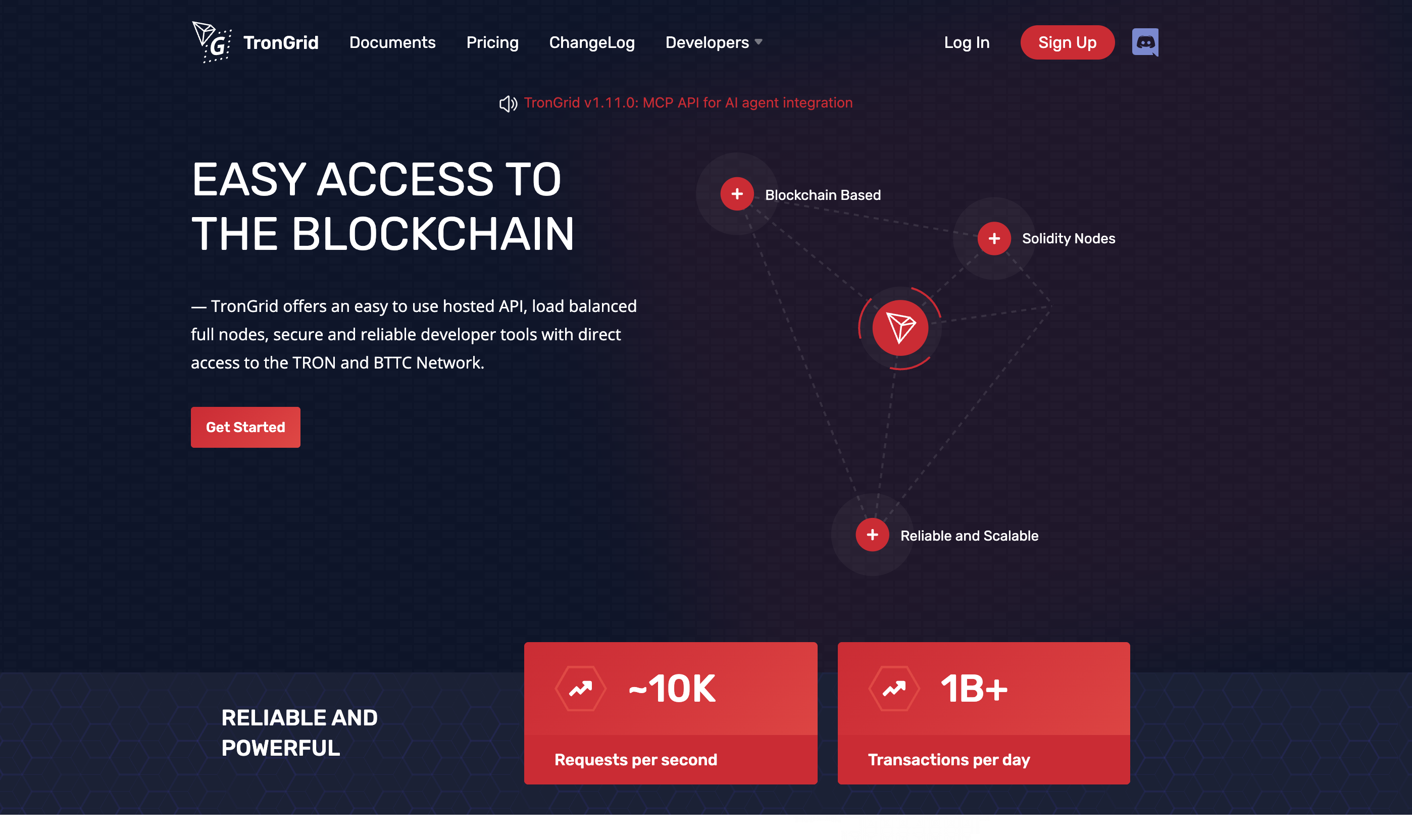
TronGrid is the public API service of the Tron ecosystem, and it exposes the standard FullNode and solidity HTTP endpoints plus event queries. It is the default that most Tron tutorials point to. It supports only Tron, so it is a specialist rather than a general infrastructure provider. It suits developers who want free access on the network’s home gateway.
Network Coverage and Node Types. TronGrid serves mainnet and the Nile and Shasta testnets, which gives it an edge over most competitors for contract testing. It offers shared access only, with no dedicated nodes. Event and transaction-history endpoints are a practical strength for wallet history screens.
Performance and Reliability. Access is governed by API-key quotas and rate limits, and requests without a key are throttled harder. Published free-tier numbers differ between sources, so read the current limits on the TronGrid dashboard. TronGrid does not publish a contractual uptime SLA that we could locate.
Pricing and Support. Free API keys cover most early-stage needs, and paid plans raise the quotas. We could not render the pricing page to confirm current paid rates, so treat any figure quoted elsewhere with caution. Support runs through documentation and community channels rather than a staffed queue.
QuickNode
Best for: teams with formal security and procurement requirements.
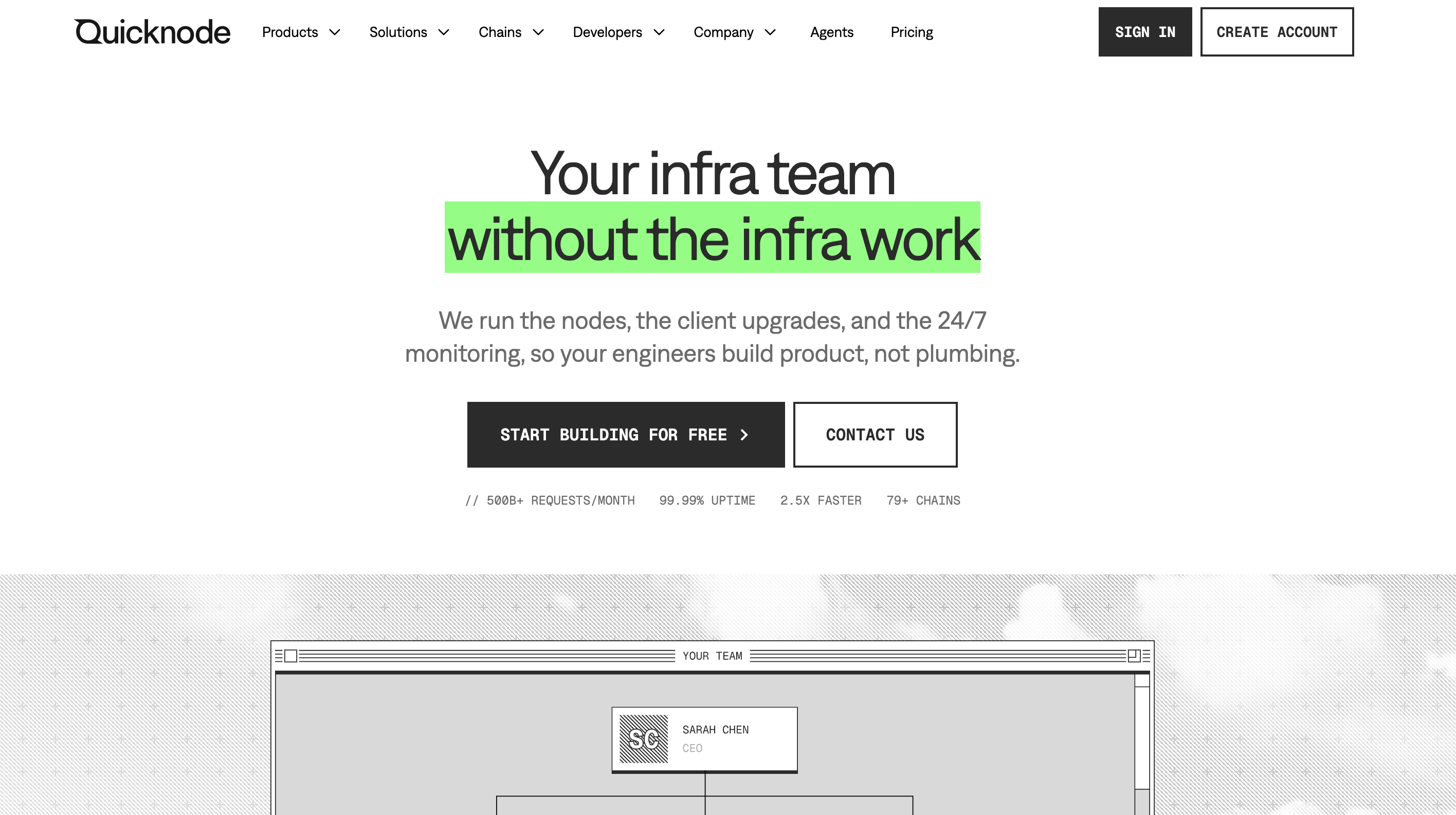
QuickNode is a Miami-based node service founded in 2017 that supports dozens of chains, Tron among them. It bills in API credits, and its Tron methods are weighted: a standard call consumes 30 credits, and enhanced methods consume double that. It publishes SOC 2 and ISO 27001 certifications, which matters for regulated buyers. It suits teams that value compliance paperwork and a mature dashboard.
Network Coverage and Node Types. QuickNode serves Tron mainnet on shared endpoints and offers dedicated clusters on higher tiers. Confirm testnet availability on your plan, since it is not consistently documented for Tron. Add-ons such as streaming products are built mainly around other chains.
Performance and Reliability. Rate limits scale with the plan, and contractual SLAs are tied to enterprise agreements. The provider runs a global endpoint network. Independent latency figures for Tron specifically are scarce, so run your own test.
Pricing and Support. There is no permanent free tier, only trial credits. Because each Tron call costs 30 credits, a plan’s headline credit count converts to far fewer real requests, which makes cost forecasting harder. Ticket support is standard on paid plans, with faster channels reserved for higher tiers.
Chainstack
Best for: teams that want predictable billing and a generous free plan.
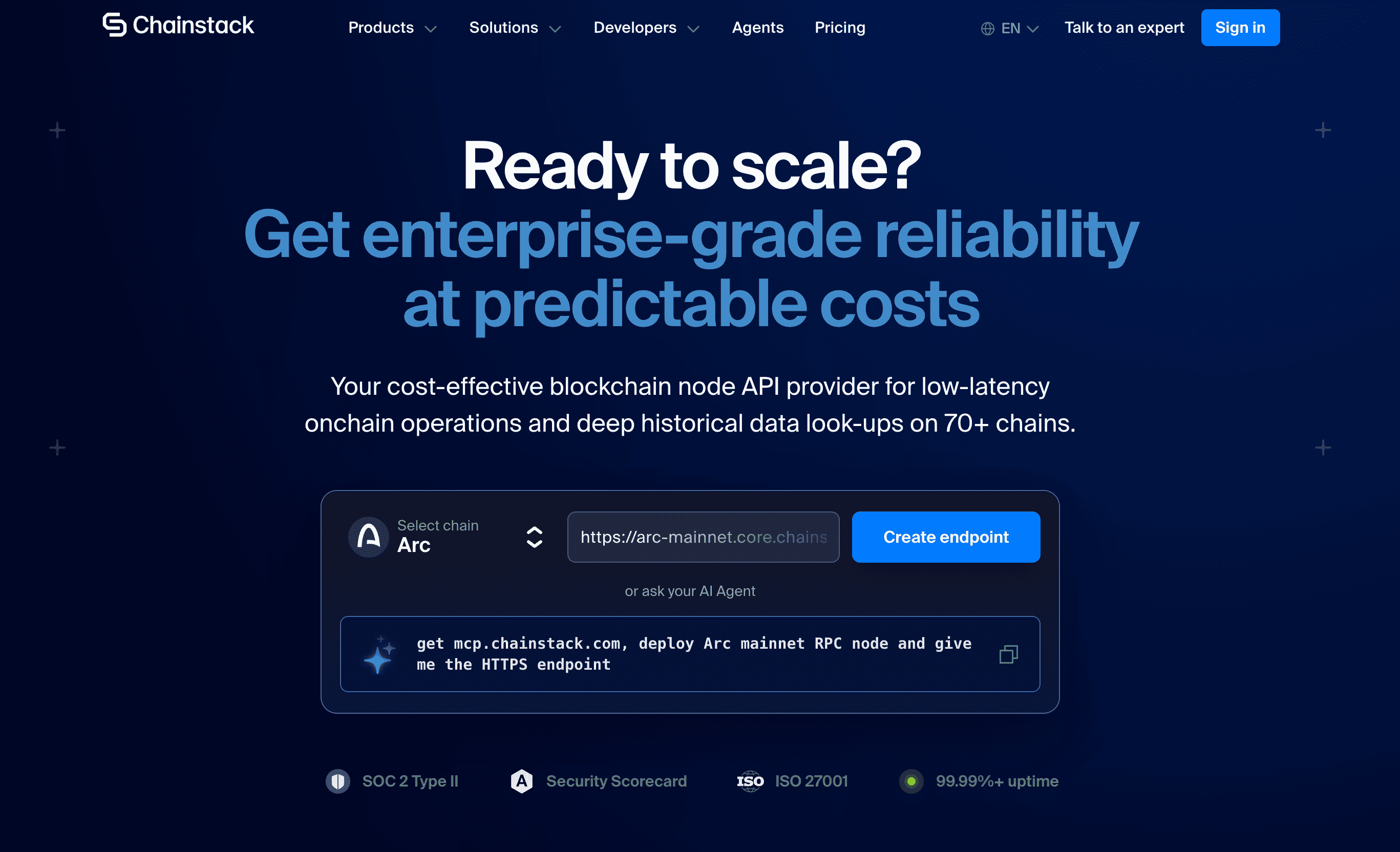
Chainstack is a managed node platform that covers 70+ protocols and states that it added Tron gRPC access in early 2026. It bills in request units where most methods cost the same, which keeps invoices easy to model. The free Developer plan includes 3 million request units at 25 RPS with no card. It suits budget-conscious teams that want to prototype at length before paying.
Network Coverage and Node Types. Chainstack offers Tron mainnet on shared infrastructure, with dedicated nodes available on paid plans and hybrid deployments into a customer’s own cloud account. Its own announcement describes the Tron nodes as non-archive, so deep historical queries need another source. Confirm testnet support before relying on it.
Performance and Reliability. Rate limits rise with the plan, from 25 RPS on the free tier to higher ceilings on paid tiers. Chainstack holds SOC 2 Type II certification. Availability terms vary by plan and are clearest on enterprise agreements.
Pricing and Support. Paid plans start at around $49 per month. Support with a formal SLA begins only on paid tiers, and the free plan is community-supported. Flat per-method costs make it simpler to budget than credit-weighted rivals.
GetBlock
Best for: multi-chain teams that want shared or dedicated access with a simple setup.
GetBlock is a node provider that reports coverage from roughly 50 to 130 blockchains depending on the source, and it offers both shared and dedicated nodes. It bills in compute units and runs bare-metal servers in Europe and the US. It also ships an MCP server for AI coding tools. It suits teams that want broad coverage without enterprise sales cycles.
Network Coverage and Node Types. GetBlock lists Tron among its supported networks with shared endpoints and dedicated options. Its chain count is reported inconsistently across public sources, so verify Tron-specific interface support on its current documentation. Tron testnet availability should be confirmed before you sign up.
Performance and Reliability. Shared plans carry per-plan rate limits, reported by the vendor at up to about 300 RPS. Dedicated nodes remove those shared limits at a higher price. GetBlock publishes a lighter compliance profile than the largest enterprise vendors.
Pricing and Support. A free plan exists for testing, and paid shared plans scale with compute units per call. Dedicated full nodes start in the four-figure monthly range, so they suit funded teams only. Support is delivered through tickets and chat, with speed depending on the plan.
How to Choose a Tron RPC Provider
Tron differs from EVM chains in its resource model and its API shape, so provider selection should start with your call mix. Work through these steps in order.
- Check which Tron interfaces you need. Tron uses /wallet HTTP endpoints, solidity endpoints for confirmed data, gRPC, and an Ethereum-style JSON-RPC subset, and providers differ in what they expose.
- Confirm testnet access. Nile and Shasta are the usual test networks, and not every provider lists them.
- Convert credits to real requests. A 30-credit call makes a large credit bundle far smaller than it looks.
- Test at peak load. A free-plan cap of 15 to 25 RPS and a no-limit paid plan behave the same at idle and very differently during a payout batch.
- Check archive and history needs. Non-archive nodes cannot serve deep historical queries.
- Ask about support response. Read the response target for your specific plan, not the marketing line.
Pilot two providers with production-representative traffic before committing.
When a Tron Node Provider May Not Be the Right Fit
A hosted RPC service is the default, but not always the right choice.
- You need full control of the node. Running your own java-tron full node makes sense when policy demands that no third party sees your queries.
- Your volume is tiny. A hobby project or a single wallet can often run on a free API key or a public endpoint.
- You need deep indexed history. Non-archive endpoints will not answer old-state questions, so a dedicated indexer or your own archive setup fits better.
- You need ultra-low latency. Trading systems that depend on co-location gain little from a shared gateway.
- You produce blocks. Super Representative work requires your own hardware, not an API.
Tron Node Provider Pricing Compared
Total cost depends on how a provider counts a request, not on the plan price alone. The table uses a benchmark of 10 million Tron requests per month.
| Provider | Pricing Model | Free Tier | Entry Price | Cost at 10M requests/month |
| NOWNodes | Per request | 100K requests | Verify | Pro Plus quota (10M) |
| TronGrid | API-key quotas | Free key | Verify | Verify |
| QuickNode | API credits | Trial credits | About $49 | 300M credits at 30 each |
| Chainstack | Request units | 3M units | About $49 | 10M units if 1 per call |
| GetBlock | Compute units | Free plan | Verify | Verify |
Rates, supported chains, and limits change frequently. Verify current terms on each provider’s official site before committing.
Total Cost Analysis
NOWNodes: The per-request model makes the bill predictable, and overage is charged per block of requests once a quota is used. The headline quota hides that the free plan lasts one month and covers few networks.
TronGrid: Free access is attractive, but quotas and rate limits decide whether production traffic fits.
QuickNode: The credit count overstates capacity because each Tron call costs 30 credits. A plan that looks large converts to a much smaller request allowance.
Chainstack: Flat request units make budgeting simple. Test your own method mix before trusting the low entry price.
GetBlock: Compute units vary by method, which complicates forecasts. Dedicated nodes remove shared limits but move the cost into a higher fixed monthly price.
Multi-Chain Generalists vs Tron-Native Gateways
The most useful split for Tron is between providers that serve many chains and the gateway built for Tron alone.
Multi-chain generalists are NOWNodes, QuickNode, Chainstack, and GetBlock. They give one account, one invoice, and one integration pattern across dozens of networks, which suits teams that already run Bitcoin, EVM, or other chains. The trade-off is that Tron is one of many chains, so Tron-specific tooling is thinner.
The Tron-native gateway is TronGrid. It follows the network’s own API closely and includes the Nile and Shasta testnets. It gives up multi-chain coverage and, as far as we could confirm, dedicated nodes and a contractual SLA.
Which Tron Node Provider Should You Choose?
The right pick depends on how many chains you run and how you want to be billed.
NOWNodes fits teams that run Tron beside many other chains, want per-request billing, and need no RPS limits on a paid plan. It is a weaker match for anyone who needs Tron testnet endpoints from the same vendor.
TronGrid fits developers who work only on Tron, want the ecosystem’s own gateway, and need Nile or Shasta access. Chainstack suits teams that want a large free allowance and predictable billing, while QuickNode suits regulated buyers who need published certifications. GetBlock is worth a look for teams that want dedicated infrastructure without an enterprise procurement process.



Be the first to comment