



TL;DR:
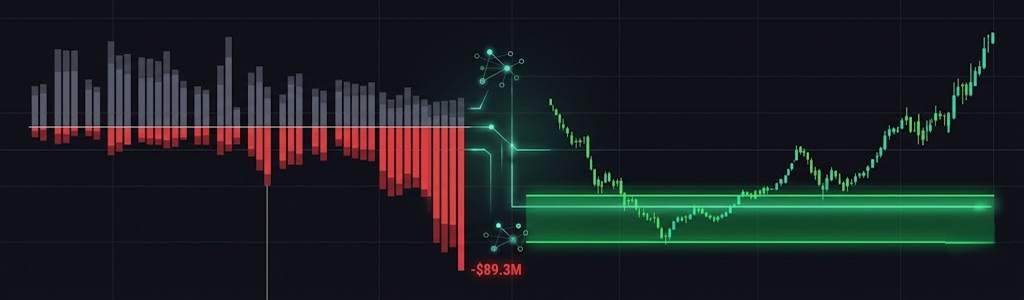
- Negative netflow: The netflow indicator for ERC-20 stablecoins on Binance stood at a negative value of 89.3 million dollars in recent sessions.
- Undervaluation metric: Bitcoin’s Stock-to-Flow reversion model hit a level of 1.1, approaching the historical market bottom zone.
- Volume divergence: Bitcoin’s net inflows to exchange platforms reached a positive value of 91,000 BTC in parallel with the liquidity drain.
The cryptocurrency market is experiencing a structural shift in the distribution of its internal liquidity. During recent trading sessions, Binance stablecoin outflows entered red territory, a phenomenon that coincides with Bitcoin prices hovering around $59,500 dollars.
The CryptoQuant report demonstrates that the indicator measuring the netflow of ERC-20 stablecoins within the leading global platform recorded a negative balance of $89.3 million dollars. This data suggests that the volume of capital leaving the exchange exceeded the inflows of stable assets. The interpretation provided by the firm’s analysts points out that liquidity historically considered “dry powder” to execute immediate purchases could be temporarily withdrawn.

The technical explanations contained in the CryptoQuant report consider three possible scenarios for this investor behavior. The first of these is linked to greater caution in short-term positioning due to current macroeconomic conditions. Likewise, the document details that this flow could respond to lower generalized trading activity or a strategic rotation of funds toward other decentralized platforms, discarding a definitive exit from the digital ecosystem.
Technical Models and Valuation Projections
The operational situation becomes more complex when analyzing the dynamics of the benchmark asset. Previous historical reports from CryptoQuant revealed that net Bitcoin flows to trading exchanges reached a positive increase of 91,000 BTC. According to projections from the research team, for any price recovery attempt to sustain its technical structure over time, stablecoin flows on Binance are required to return to a stable positive territory.
In parallel, the Stock-to-Flow (S2F) reversion model, used to measure price deviation relative to supply scarcity, recorded a reading of 1.1 during the current week. Historical patterns of this model suggest that values below 1 tend to mark the formation of bottoms before a macroeconomic trend reversal. September 2024 was the last time the indicator broke below that level, a period in which Bitcoin was trading near $57,000 dollars.
On the other hand, an independent analysis published by Live Bitcoin News indicated that Bitcoin’s Power-Law Quantile dropped to 6.2%. Historical documentation points out that this same mathematical compression zone coincided with the cyclical bottoms observed in the years 2015, 2020, and 2023. The convergence of these two quantitative models near their historical supports presents itself as a relevant technical setup for traders dedicated to on-chain data analysis.
Market consolidation will depend on the stabilization of institutional capital flows during the close of the current quarter of the year.



Be the first to comment