



Bitcoin’s latest BIP 361 upgrade proposal has ignited fierce debate regarding the future of the premier cryptocurrency and the looming Quantum threat. Top crypto executive Dan Beld compared the latest proposal to an asset seizure, something that seriously violates the very foundation of Bitcoin’s principles.
Held tweeted:


He didn’t beat around the bush when it came to the controversial BIP 361 upgrade. He argued that minimizing legacy signatures and freezing unmigrated coins would erode Bitcoin’s core strengths: its immutable monetary policy and status as the hardest asset to seize.
What is the BIP 361 Upgrade?
BIP 361, titled Post Quantum Migration and Legacy Signature Sunset, is the latest upgrade currently on the table to help quantum-proof the network against the looming computing disruption.
The crux of the proposal is that roughly 34% of BTC’s supply, including 1.7 million BTC stored in the legacy Pay-to-Public-Key (P2PK) format, is at imminent risk due to groundbreaking quantum developments. The entire 1.1 million stash mined by Satoshi Nakamoto during the early days of the network is also included in these legacy addresses.

 
BIP 361 involves a three-phase upgrade plan for the network, with the first phase blocking legacy P2PK addresses from receiving BTC, followed by a second phase that would invalidate ECDSA/Schnorr spends entirely, rendering unmigrated UTXOs unspendable. A third phase would implement a zero-knowledge recovery plan that would allow any remaining BTC to be migrated to upgraded addresses.
Quantum Computers to Break Bitcoin’s Legacy Cryptography Within 3 Years
Google, one of the pioneers in cutting-edge quantum computing, has repeatedly warned in recent years about the danger posed to digital asset networks, prompting a frantic race among blockchains to fix their systems in advance. The tech giant’s recent estimates show that around 500,000 qubits will be enough to break the Elliptic Curve Cryptography (ECC) standards in place, a fraction of the earlier estimate of around 10 million qubits.
The company’s latest quantum processor, Willow, currently has only 105 qubits, but the technology is reportedly advancing rapidly, drawing the Quantum D-day ever nearer. Previously, the tech firm had predicted that quantum computers would be able to break BTC’s security within 3 years, but an updated timeline is now awaited following a string of recent advancements.
Twitterati Respond
X users generally sympathized with Dan Held’s take, refusing to compromise on Bitcoin’s core principles in the face of a major disruptive force like quantum computing.
One user replied:
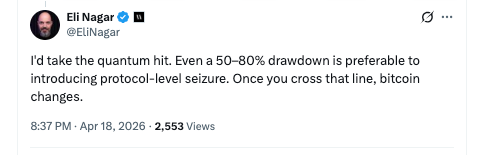
Image Source: X
Another quipped:
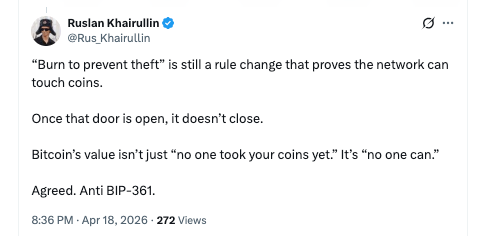
While proponents of BIP 361 view the plan as essential insurance against future attacks and potential economic chaos, the move appears to run counter to some fundamental values of the crypto network. Such a hotly contested upgrade isn’t likely to go through in its current form.






Be the first to comment