



A Bitcoin bear market signal just flashed as the STH cost basis falls below the LTH line, miner shutdowns spike 2,150%, and old coins move again.
Nine months of grinding lower did something to a chart that Bitcoin analysts have been watching since the correction started. A signal flashed this week. Barely anyone outside a small circle of on-chain accounts caught it in real time.
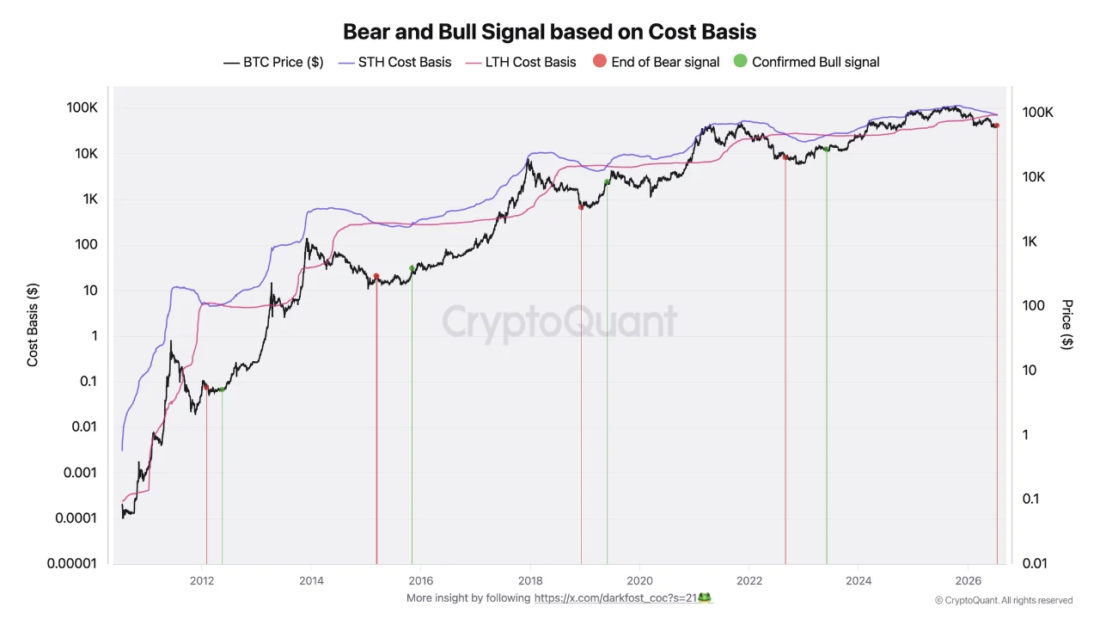
The short-term holder cost basis dropped under the long-term holder cost basis, according to a CryptoQuant Quicktake covering the move. That crossover has marked the same turning point near the end of every prior bear phase, going back through multiple cycles. It does not mean a bottom is confirmed the moment the line crosses.
Short-term holders are wallets holding Bitcoin for under six months. Long-term holders cross that line at six months and beyond, though CryptoQuant strips out anything parked for more than seven years to keep the long-term reading honest. The gap between the two groups is what analyst Darkfost tracks in a chart shared, where red markers flag the end of past bear phases and green ones confirm the bull leg after.

Miners Are Bleeding Out Fast
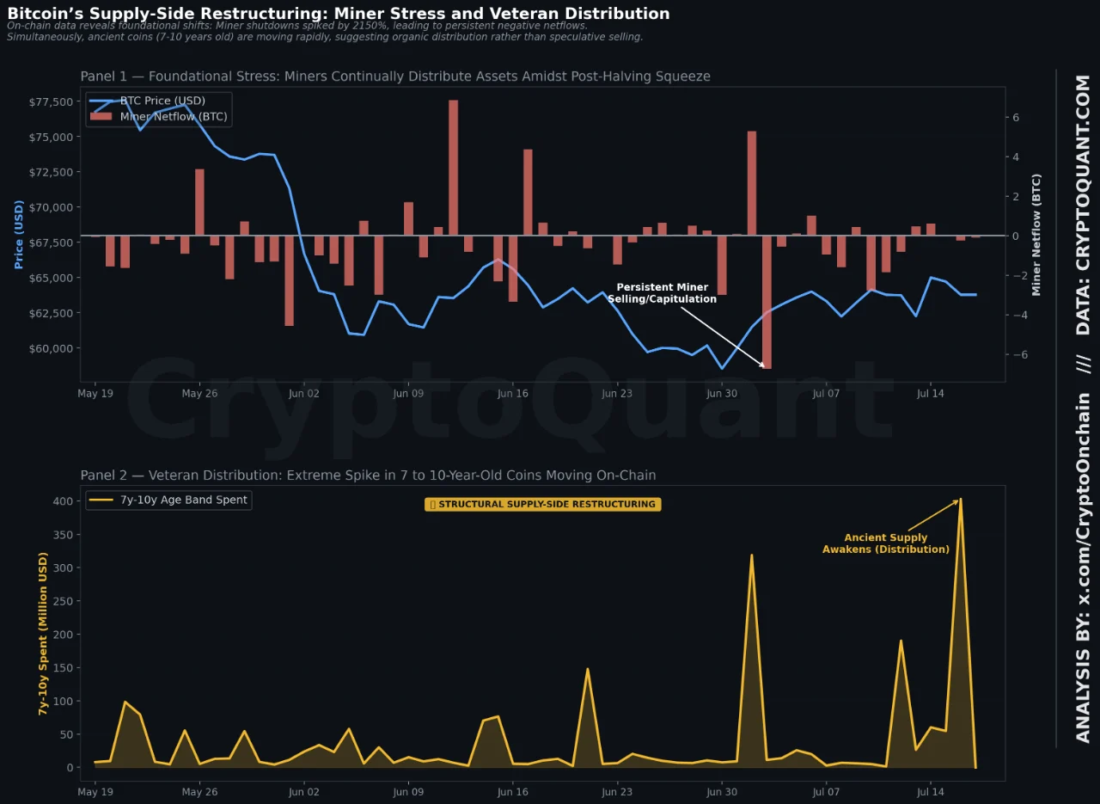
Something else broke loose on the supply side. Miner shutdowns jumped 2,150% against the 90-day baseline, per a separate CryptoQuant writeup. That is not a typo, just a rough stretch for anyone still running rigs on thin margins.
Coins sitting untouched for seven to ten years started moving too. That cohort spiked 374%, and Coin Days Destroyed climbed right alongside it. CryptoQuant contributor CryptoOnchain described it as a structural supply-side restructuring in a post, pairing miner netflow data with the ancient-coin activity on one chart.
Miner-to-Binance flows rose more than 470% across the same stretch. Older holders from prior cycles appear to be trimming positions somewhere in the $62,000 to $64,000 range. Not panic selling, more like distribution while liquidity is still there for it.
Source: CryptoQuant / /CryptoOnchain
Price Barely Blinked Through It
Bitcoin held a fairly narrow range while all that supply pressure built up underneath. That absorption is the part CryptoQuant flagged as the more interesting half of the story here. Passive demand, whatever is buying under the surface, looks to be soaking up both the miner capitulation and the veteran distribution without forcing a deeper leg down.
The STH cost basis fell from $112,500 down to $69,000 as newer buyers kept averaging into weakness. That single drop explains most of why the crossover landed now instead of months earlier, with short-term holders quietly buying every dip and lowering their own average entry the whole way down.
Source: CryptoQuant / /darkfost_coc
What Earlier Coverage Found
A similar squeeze showed up recently when long-term holders kept repricing their own cost basis upward even as spot price slid, a dynamic covered in earlier reporting on why LTHs are not selling despite running out of paper profits. Miner posture has looked stubborn in other reads too, including one on-chain breakdown showing miners refusing to dump reserves even as active holders quietly bled 20% lower.
Institutional buyers entering Bitcoin over the past two years have not changed the underlying pattern much either, per the CryptoQuant analysis. Bitcoiners are still acting like Bitcoiners, regardless of who else has shown up in the room.


Be the first to comment