



Key Takeaways
- Lepard says Kevin Warsh’s Fed task force on inflation measurement is designed to justify rate cuts before the 2026 midterms.
- Bitcoin at $59K sits in a historical cheapness zone reached less than 10% of the time, per the power law model.
- Strategy carries roughly $1.7B in annual preferred dividends against $55B in held bitcoin, a load Lepard says bitcoin at 4% annual gains can cover.
Fed Chair Playing Both Sides
Lepard outlined why he believes Fed Chair Kevin Warsh is signaling rate cuts even while the market prices in hikes. Before taking the role, Warsh publicly argued that the Dallas trimmed mean PCE, running about 100 basis points below headline CPI, may be a more accurate inflation gauge. He also compared today’s artificial intelligence (AI) productivity gains to the mid-1990s tech boom, when Greenspan held rates low without triggering inflation.
“I think both of those things implied to me that he wants to cut rates,” Lepard said during the interview. “I suspect he said both of those things to Trump. I suspect that’s partly how he got selected for the job.”
That changed after bad inflation prints tied to elevated oil prices following the Strait of Hormuz closure. Now the market is pricing in rate hikes. Lepard thinks that read is wrong.
His reasoning: the U.S. government is carrying $1.3 trillion in annual interest expense. Raising rates materially is, in his view, structurally impossible. Warsh’s newly formed task force on inflation measurement, Lepard argues, is designed to give political cover for declaring inflation lower than headline numbers show, creating a path to cuts before the midterm elections.

“The odds of the Fed raising the rates this year is zero,” he stressed. “And the market thinks the odds of them raising rates this year is 100%. One of us is right and one of us is wrong.”
Bitcoin and the Power Law
Bitcoin broke below $60,000 during the interview. Lepard noted it also crossed below the 200-day moving average and briefly fell outside the power law corridor, a log-scale model developed by researcher Giovanni Santostasi and expanded by mathematician Fred Krueger that fits bitcoin’s price history with a 95% R-squared correlation.
Lepard described the current price as sitting near or below half a standard deviation below the power law mean, a zone bitcoin has occupied less than 10% of its entire trading history. In prior bear markets, prices in that zone tended to recover within weeks to months.
He cited prior bear market drawdowns of 70%, 80%, and 90% as context for why this cycle’s roughly 50% correction from October’s peak may indicate maturing adoption and declining volatility. He does not rule out a further slide to the low $50,000s but considers sub-$50,000 unlikely.
“ Bitcoin right now compared to its 200-day moving average through its entire history is really quite cheap,” he remarked.
Lepard continued:
“It’s only been this cheap less than 10% of the time.”
The Next Big Print
Lepard’s core macro thesis holds that the U.S. debt-to-GDP ratio, currently around 124%, cannot be resolved through growth alone. He cited former Treasury Secretary Hank Paulson’s recent Bloomberg appearance after 15 years of public silence as a signal that insiders are preparing markets for a future liquidity crisis.
Each successive Fed intervention has been larger than the last. The 2008 response totaled roughly $2 to $3 trillion over three years. The COVID response hit approximately $5 trillion over 18 months. Lepard expects the next intervention to exceed both in size and speed.
He frames gold, silver, and bitcoin as monetary debasement insurance, essentially the debasement trade. Bitcoin ranks first in his hierarchy because it cannot be printed, transfers in minutes, carries no storage cost, and has a 16-year track record of adoption growth despite repeated deep drawdowns.
Strategy and the Math
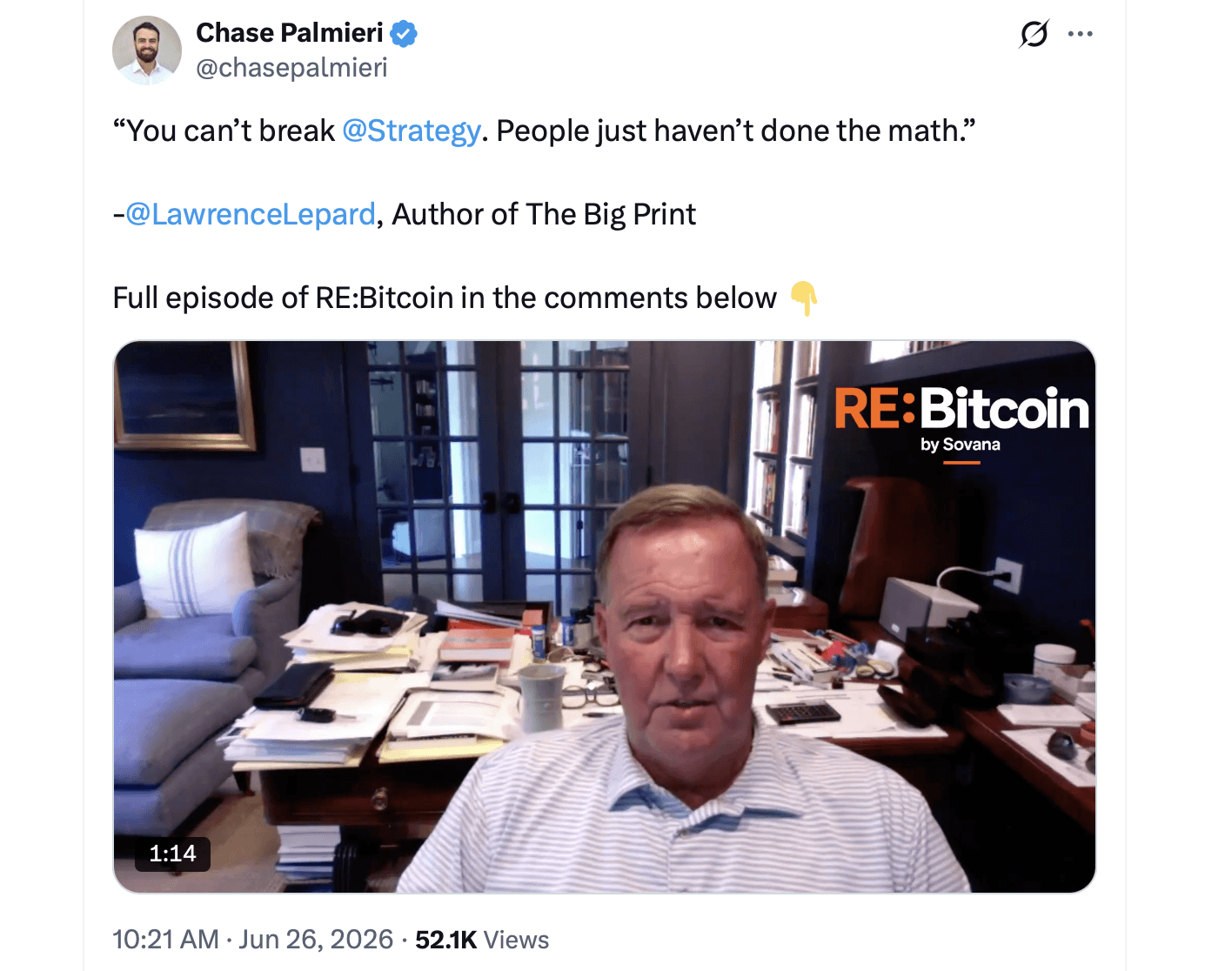
Lepard also said critics of Michael Saylor’s Strategy have not done the basic math. Strategy’s preferred stock dividend obligations run roughly $1.7 billion annually. With approximately $55 billion in bitcoin on the balance sheet at the time of the interview, Lepard estimates Strategy would need to sell about 4% of its bitcoin per year to cover that obligation. If bitcoin appreciates at least 4% annually, common shareholders break even on that mechanism alone. Bitcoin’s historical annualized return has run far above that level.
“You can’t break Strategy,” he said. “I mean, you break it if bitcoin breaks. But if bitcoin stays at $50,000 to 60,000 for a couple of years, they’re going to be completely fine.”
He added that he has been selling some gold and silver positions to buy both bitcoin and Strategy shares at current prices, which he considers attractive given Strategy’s $33 billion market cap against what he projects is a multi-trillion dollar long-term potential.
Where Lepard Is Positioned
Lepard holds a large personal bitcoin ( BTC) stack and a significant Strategy position. He told listeners to size bitcoin exposure so that a 50% decline would not force a sale, and said at current prices he would consider a lump-sum entry rather than dollar-cost averaging, given how rarely bitcoin reaches this price zone relative to its history.
His price targets: approximately $180,000 in the next two years, $1 million around 2031 or 2032 based on the power law, and roughly $6 million per coin within 15 years. He frames those targets as consistent outputs of a model that has held with 95% correlation across bitcoin’s full market history.




Be the first to comment