

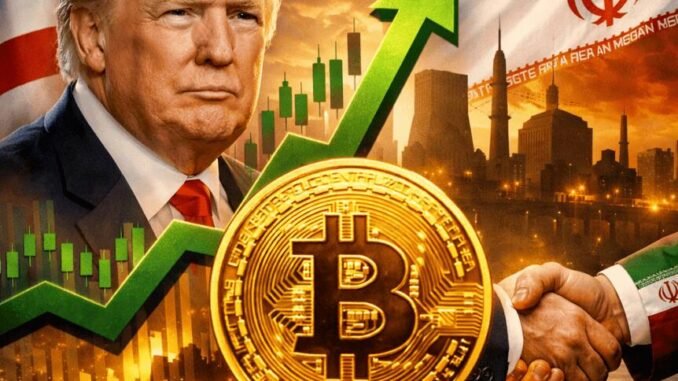

Cryptocurrency markets staged a notable recovery, adding roughly $75 billion to total market capitalization after a Saturday update from U.S. President Donald Trump suggested progress toward a peace agreement with Iran and regional partners. The president’s remarks, published on Truth Social, described an agreement that was “largely negotiated” and subject to finalization among the United States, Iran, and a coalition of Middle Eastern states.
The post named Saudi Arabia, the United Arab Emirates, Qatar, Pakistan, Turkey, Egypt, Jordan and Bahrain as participants in the talks. It also carried a bold assertion about finalization and the future opening of the Strait of Hormuz, a strategic chokepoint whose status has historically influenced global energy costs and risk appetite across asset classes, including crypto.
“An agreement has been largely negotiated, subject to finalization between the United States of America, the Islamic Republic of Iran, and the various other countries, as listed,” he said. His post said: “Final aspects and details of the deal are currently being discussed and will be announced shortly. In addition to many other elements of the agreement, the Strait of Hormuz will be opened.”
The prospect of reopening Hormuz is tied closely to energy price dynamics, which have long weighed on high-risk assets such as cryptocurrencies. In recent weeks, investors have fretted that energy-market volatility would spill over into risk assets, helping explain a dampened crypto mood even as a ceasefire agreement in the region held tentative ground.
Key takeaways
- Crypto markets gained roughly $75 billion in total market capitalization following Trump’s peace-talk update, signaling renewed risk-on sentiment on negotiations’ potential?
- The proposed deal would involve the United States, Iran and a bloc of Middle Eastern countries, with an emphasis on reopening the Strait of Hormuz to improve energy flow and prices.
- Bitcoin experienced intra-day volatility, slipping to a five-week low near $74,250 on Saturday before bouncing toward the $77,000 area, then easing to around $76,800, with ongoing debates about macro and energy-linked risk appetite influencing moves.
- Bitcoin remains substantially below its October peak, down about 39%, highlighting the still-fragile risk-off backdrop even as headlines shift sentiment.
- Concurrent remarks from regional and U.S. officials underscored ongoing political complexity, with seen calls for denuclearization and open straits echoing through markets’ mood.
Geopolitics, energy sensitivity and crypto appetite
The Saturday update arrives at a moment when the broader ceasefire between Washington and Tehran has proved fragile since early April, despite several attempts to formalize a durable agreement. The geopolitical tension there has consistently fed energy-price volatility, a well-known driver of crypto risk appetite. By signaling a pathway to open strategic waterways like the Strait of Hormuz, Trump’s message touches on a key fulcrum for both traditional markets and digital assets.

During a visit to India, U.S. officials reiterated that security guarantees and non-proliferation considerations remain central to any eventual accord. The communications underscored the long arc of negotiations and the precarious path to finalization, a backdrop that has historically tempered appetite for high-volatility assets such as Bitcoin and altcoins.
From a market structure perspective, a less volatile energy backdrop could help soothe risk-off pressures that have weighed on crypto equities and tokens in recent months. If Hormuz operations are stabilized and energy shipments normalize, investors may reallocate capital toward higher-risk assets, including broadly diversified crypto bets, though the exact timing and scale of any shift remain uncertain.
Bitcoin price action and the broader market context
Bitcoin’s price action reflected a risk-off-to-risk-on tug-of-war around the weekend. The weekly low near $74,250 marked a five-week bottom as traders weighed geopolitical headlines and macro indicators. In early Sunday trading, BTC touched the 50-day exponential moving average around $77,000, a level traders often see as a short-term gauge of trend resilience. The price subsequently eased to roughly $76,800 as liquidity dynamics and risk sentiment evolved through the session.
From a longer-term perspective, Bitcoin remains significantly below its late-October peak, with a drawdown exceeding 39%. The current bounce has not yet signaled a durable reversal, and analysts continue to watch major support and resistance thresholds around $70,000 and the $80,000 zone for any decisive directional shift.
Brokerage and exchange commentary during the period has underscored that the macro environment—comprising energy price trajectories, global inflation readings, and the pace of traditional market equities—continues to color crypto flows. While the weekend rebound suggests a temporary relief rally tied to geopolitical headlines, investors remain cautious about the durability of any move higher without clearer signs of policy alignment or more concrete progress toward regional de-escalation.
What to watch next
Markets will be keenly attuned to further developments around the Iran talks and any government disclosures about the status of negotiations. The exact terms, sequencing of steps, and verification mechanisms will shape how energy markets respond, which in turn feeds back into crypto demand and liquidity. Traders should monitor:
- Official confirmations on the terms of any peace agreement and the timeline for implementing open maritime routes.
- Energy price trajectories and any stabilization in shipping costs that could alter risk appetite across asset classes.
- Comments from policymakers and central banks that could recalibrate inflation expectations and liquidity conditions.
- Technical levels for Bitcoin and major altcoins, especially near the $70,000 support zone and the $82,000–$85,000 resistance band that has historically constrained upside momentum.
In the near term, investors will weigh the potential for a de-escalation in Middle East tensions against the durability of a broader macro recovery. The outcome could determine whether crypto markets resume a more pronounced upcycle or revert to a cautious stance as traders reassess risk premiums across asset classes.
As always, readers should seek balanced signals: geopolitical easing can reduce volatility, but structural shifts in energy markets and global liquidity will ultimately shape how quickly crypto markets regain momentum. The coming weeks will be telling as more details emerge from the negotiating table and as markets parse any credible milestones toward a finalized accord.
For now, the week’s chatter underscores a persistent truth for crypto traders: geopolitical risk remains a meaningful driver of sentiment, even as technologists, investors, and miners continue to pursue longer-term narratives around adoption, infrastructure, and regulation. Watch how policymakers translate words into actions, and how energy-market signals align with risk appetite to determine the path forward for digital assets.



Be the first to comment