



Cathie Wood addressed Bitcoin’s recent decline in a interview, offering a framework for why she believes the market has bottomed and what she expects to drive the next move.
- Wood: Bitcoin ETF holders stayed strong through the down cycle.
- January 10 flash crash: software glitch on Binance caused auto-deleveraging after tariff turmoil.
- Washout: $28-30 billion cleared through system, bottoming process underway.
- Four-year cycle: may be ameliorating as institutions learn, not necessarily ending.
Wood’s explanation of the January 10 flash crash is specific about cause and sequence. Tariff turmoil triggered the initial selling pressure. A software glitch on Binance then caused auto-deleveraging, where positions were liquidated automatically rather than through discretionary selling. Traders who believed they were hedged across two exchanges discovered their hedges did not function as intended and sustained significant losses. Wood is explicit that Binance did not cause the event and states she is on record saying so.
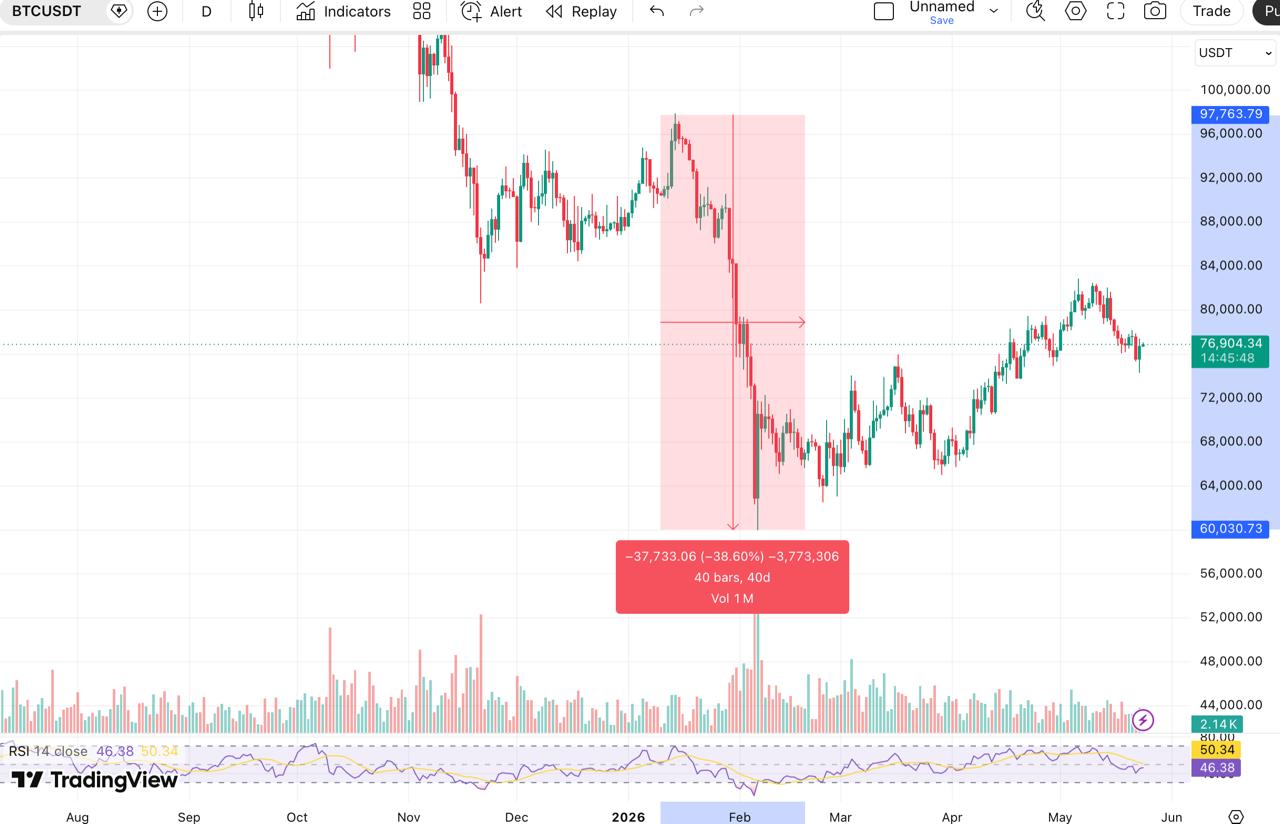
The washout Wood estimates at $28-30 billion in forced liquidations has, in her assessment, cleared through the system. The significance of framing this as a mechanical event rather than a structural breakdown is that mechanical events produce sharp temporary dislocations rather than sustained bear markets: the positions that were vulnerable to auto-deleveraging have been removed, and the holders that remain chose to stay.
Who Is Holding Now and Why That Changes the Bottom
Wood’s observation that weak holders exited and were backfilled by institutions is not a comfort narrative: it is a structural claim that the marginal holder of Bitcoin has changed, and a market where the marginal holder is an institution with a fiduciary mandate and a multi-year allocation horizon behaves differently at the bottom than a market where the marginal holder is a retail participant responding to price momentum. A traditional asset manager observing a 50% drawdown sees a severe bear market, which in equity terms historically represents a buying opportunity. That framing, Wood argues, is driving institutional averaging down during the current decline.
An institution that went through an allocation committee, filed disclosures, and committed capital to a Bitcoin ETF does not exit on price momentum the way a retail participant might. Their staying through the decline is a deliberate position rather than an emotional one, and Wood cites ETF holder strength throughout the down cycle as the observable evidence of that structural shift.
What the Four-Year Cycle Argument Actually Says
The distinction between saying the four-year cycle is over and saying institutions may be ameliorating it is analytically significant: amelioration means the cycle’s amplitude is being reduced by deeper institutional participation, not that cyclicality itself has ended, which is a more defensible claim and a more useful one for anyone trying to position around it. Wood does not predict the end of the four-year cycle. She says, in her words, “maybe we’re ameliorating the four-year cycle now that institutions are learning more.” The January crash, which may or may not have been the cycle’s washout event, introduced enough uncertainty that Wood declines to label it definitively. What she is confident about is the bottoming process: the overleveraged positions cleared, institutional holders stayed, and the conditions for the next move are building.
The Macro Variable Nobody Is Talking About
Wood’s M2 and velocity argument is the least-discussed but most forward-looking element of her commentary: M2 at 4.9% growing in line with nominal GDP means monetary conditions are not tightening, and if velocity stabilizes after war-related suppression, that 4.9% will carry more economic weight than it currently does, which is the liquidity catalyst she identifies as the next driver of risk assets. Wood speculates, with her own explicit hedge, that war-related uncertainty may have caused velocity to slow, partially offsetting the accommodative M2 growth. When velocity stabilizes or recovers, the 4.9% M2 growth would turbocharge its impact on economic activity. She frames this as the variable to watch over the next few months rather than a near-term trigger.
Of the three conditions Wood describes, the velocity observation is the most testable in the near term: M2 data is published monthly and velocity can be derived from it. If M2 holds at 4.9% or above while velocity recovers through Q2 2026, the liquidity argument gains the empirical support it currently lacks. The mechanical crash explanation and the institutional holder shift are already visible in the data. The liquidity catalyst is the condition that has not yet materialized.
The information provided in this article is for educational purposes only and does not constitute financial, investment, or trading advice. Coindoo.com does not endorse or recommend any specific investment strategy or cryptocurrency. Always conduct your own research and consult with a licensed financial advisor before making any investment decisions.



Be the first to comment