



The views expressed in this article are those of the author and do not necessarily reflect the position of CoinGeek.
Jon Southurst put the question in one sentence on CoinGeek in August 2022, and nobody has improved on the phrasing since: “How do you prove a token is valid through a string of transactions that may last for years or even centuries?”
That is back to genesis, and not the Genesis Block, mind you. It is the token’s OWN genesis transaction, the mint, the moment somebody declared this thing exists, and here is how much of it there is. Tracking this back efficiently to make sure tokens are genuine or valid is the issue. It gets more and more tedious after every transfer, so how do we solve that?
Every token protocol on BSV is an answer to that one question. And every one of them, as far as the public record is concerned, answers it with an indexer somewhere in the stack.

Bitcoin-style tokens will ALWAYS need an indexer, and that is not a bug, and while lots of people claim to eliminate this need, the only live argument is which layer does the indexing work, and that one choice decides whether you actually scale or whether you merely look busy for a while.
The lowest possible level solution is simply asking the node for state. Every time your token rules force a miner to reconstruct history at validation time, you have quietly made the base layer responsible for your application’s memory.
This doesn’t scale.
Bitcoin is a distributed timestamp server that writes to a distributed database. It is not your query engine, and it’s certainly not everyone’s query engine!
Another idea!
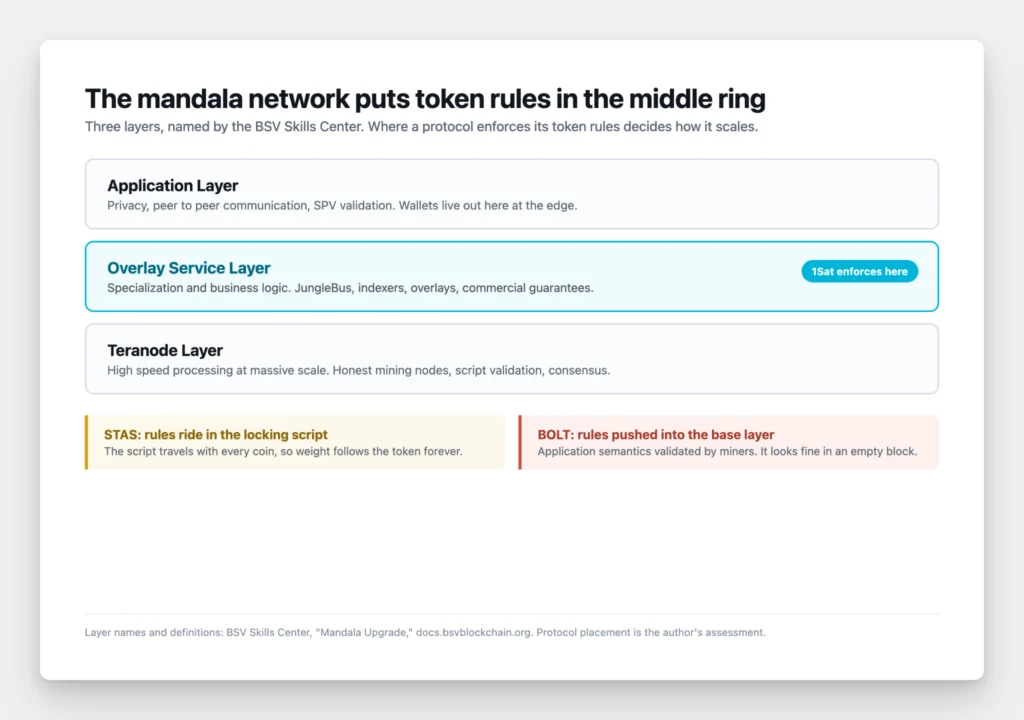
STAS came out of TAAL or nChain or from a guy unironically named “Stas,” depending on who you ask, and it puts the rules in the locking script itself, so the token knows what it is because the script says so, and the script travels with it. The newer STAS 3.0 spec is live and actively developed, with P2MPKH multisig, freeze, and confiscation for the regulated crowd, and divisible swaps. In 2025, the licensing moved from paid to a free MIT license, which made it genuinely permissionless.
Credit where credit is due!
The trade-off with a STAS token is structural, and it is not a secret, because a special locking script is heavier than plain P2PKH, so the rules ride along in every single transfer, forever. The STAS-789 template appends data on every transfer and forbids deletion, so that variant really does grow with its own history. Rules in the script mean the script is never allowed to forget.
STAS protocol is used primarily by the DXS trading app, which is a great business and a tremendously useful tool in the BSV space.
The other new solution
BOLT took the boldest swing of anybody. Frederick “Freddy” Honohan published the Bitcoin Original Layer-1 Token whitepaper in February 2024, and the mechanism is transaction latching built on nChain’s PUSHTX and PUSHCTX, similar to STAS.
The idea is gorgeous: make the transaction prove its own lineage in script, and you never have to ask anybody anything ever again. Great!
BOLT has been tested on mainnet, and I pulled these numbers off BananaBlocks.com myself. One forced-exit pool transaction weighs 18,531 bytes. Its parent is 18,935. The grandparent is 19,715. All three sit inside block 957547, which holds 1,079,909 bytes across 1,308 transactions, and a builder counted 26 of those pool transactions in that single block. Call it roughly 45% of the block for about 2% of its transactions.
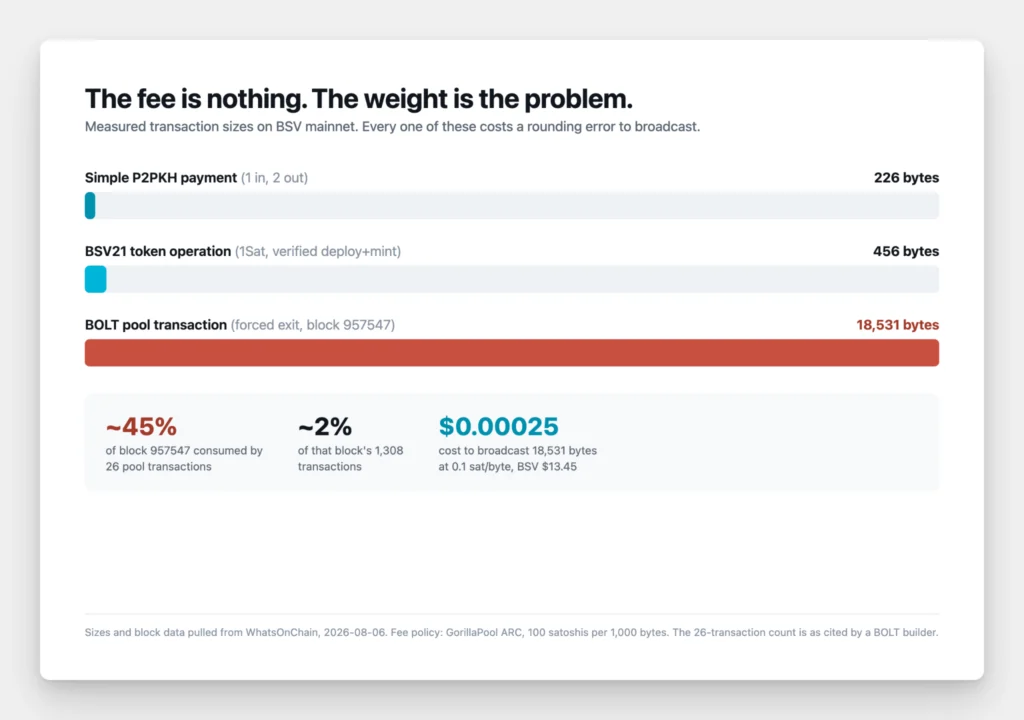
Let me concede the obvious part before anyone on X sends me an “actually, Kurt” post about it. GorillaPool‘s ARC policy is 100 satoshis per 1,000 bytes, and BSV sat at $13.45 when I checked in August 2026. That 18,531-byte transaction costs about 1,853 satoshis, which is roughly a quarter of one-hundredth of one cent.
It is CHEAP, and nobody is getting priced out of anything in dollars!
But block space and validation throughput are scarce goods that also need to be considered, and cheap does not make heavy any lighter.
nChain came at the same wall from the math side. In August 2022, Owen Vaughan, working with Mehmet Sabir Kiraz and Enrique Larraia, announced Transaction Chain Proof, a recursive zero-knowledge proof compressing the whole lineage into about 1.5 KB with Groth16 or 3.5 KB with Halo.
Patent pending, single input and single output only. Elegant work, narrow door.
My token of choice
1Sat took the third road, which is to put the rules in an open deterministic overlay and let the transaction stay light to the nodes. A verified BSV21 deploy, and mint (txid 942fa8659a65cbcfaf979c4abef28a8f9c1454836cc3a9b42662f2bf784d92ba) weighs 456 bytes.
A plain, one satoshi input with two outputs runs about 226. So, a token operation costs roughly double a simple payment, while that BOLT pool transaction runs roughly 40 times the token operation.
Note, that isn’t a complex contract. Just the token itself. 1Sat contracts can be deeply complex and still stay under the size of a single Bolt token mint.
The mandala is not decoration
The BSV Skills Center documents the mandala network as three layers, and only three. The Teranode Layer does high-speed processing at a massive scale. The Overlay Service Layer does specialization and business logic. The Application Layer does privacy, peer-to-peer communication, and SPV validation, which is where your wallet actually lives.
Teranode is the reason the bottom layer gets to stay dumb and fast. BSV Association reported over 1 million transactions per second across a two-week distributed testnet trial and shipped the first public release on October 14, 2025.
That’s tremendous throughput, but it should only be queried for hashes by a tool like JungleBus that serves critical data up to the next layer of the network for routing, indexing, etc…
Every time a protocol pushes application semantics down into the mining layer, it is borrowing against that throughput budget, and the budget goes quickly.
So, something like BOLT runs beautifully in the demo, but it runs out of runway as soon as people jump on the plane.
Basically, the base layer is not going to move over to accommodate you, because it was never supposed to. Bitcoin is like a custom-built hot rod. You admire the engineering, you drive the thing, but you do not get to redesign the engine block. Mining and node operation are economic activities with legal obligations attached, not a debating society.
Which is exactly why the layers above it are where the fun lives. Fixed base, infinite attic. Have your tokens live in the attic and anchor to the base.
Fold the best ideas in; do not start over
Jerry Chan settled most of this on CoinGeek’s own pages in June 2022, and I am not convinced the industry noticed. In “STAS protocol — Clearing up the air,” he argued that back to genesis is a misnomer, because every wallet in production already leans on an indexer or an oracle: HandCash’s backend, ElectrumX, Paymail servers. His line was blunt: “The only service that a STAS transaction requires is an authenticity check which may or may not be provided by the issuer themselves…”
He was right then, and he is right now, even though the two of us land in different places on what to build next.
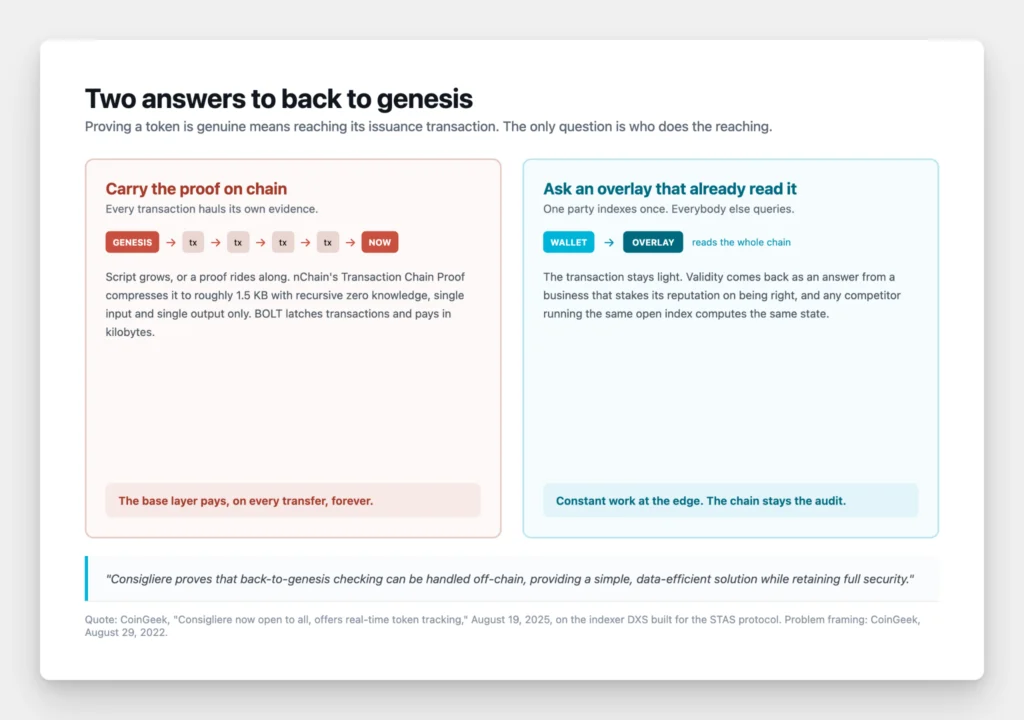
Here is a funny one I turned up while researching this piece. DXS built Consigliere as an indexer for STAS, and when they opened it to everyone in August 2025, the write-up put it this way: “Consigliere proves that back-to-genesis checking can be handled off-chain, providing a simple, data-efficient solution while retaining full security.”
Off-chain. Data-efficient. Full security retained. That is STAS-native tooling landing precisely where the 1Sat crowd has been standing this whole time.
How is that for solving it in script?
I have skin in this: I founded GorillaPool, and we run JungleBus, described in our own docs with no poetry whatsoever: “JungleBus is an indexer that indexes all the transactions on the Bitcoin blockchain.” It is the commercial answer to back to genesis. Indexers, overlays, and businesses putting their name and their liability on the correctness of the state they serve.
The goal was never mathematical perfection so much as being usefully disruptive, which means choosing your trade-offs on purpose instead of pretending you found a design that has none.
The fact is that 1Sat Ordinals is the most adopted token protocol in BSV.
MNEE, a USD-pegged stablecoin with a licensed, regulated custodian in Antigua, reserves in short-duration US Treasury bills and cash, monthly third-party attestations, runs live on BSV as a 1Sat token with tens of millions of dollars behind it. There is a working SDK, open marketplaces, on-chain names, and AI agents moving value with no human in the loop.
My actual pitch is boring on purpose. Revisiting a working protocol, scrapping it, and rebuilding something marginally better while inheriting a whole fresh set of trade-offs is a net drain on everybody’s productivity. This ecosystem runs on a builder pool small enough that most of us know each other by first name. Spending it on schema arguments is more of a hobby than a strategy.
Take the best ideas and fold them in. BOLT’s covenant enforcement is genuinely clever, and it belongs as a 1Sat locking template. STAS’s script discipline around freeze and confiscation is precisely what regulated issuers ask for, and it belongs there too. Put both where the wallets, the indexers, the marketplaces, and the liquidity already are, and let the competition be about who ships the better commercial product or user adoption rather than who gets to rename the standard.
Future Bitcoin dynamics will involve competition for settlement, for cash, and for token liquidity. The gold rush of mining, the struggle of validating big blocks, the tug and pull between token protocols and personalities.
Rivalry is healthy.
Fragmentation is a tax we keep voting for.
This opinion piece is published to encourage discussion. The author’s views are their own and do not constitute legal, procurement, or policy advice, nor do they represent the positions of CoinGeek or its partners.
Watch | Blockchain Futurist 2025 (Part 1): What’s real vs what’s hype on blockchain?



Be the first to comment