



Bitcoin dropped below $70,000 this week due to an aggressive Bitcoin capital rotation, while the S&P 500 and Nasdaq 100 post fresh all-time highs almost daily.
Key Takeaways:
- Bitcoin dropped to $67K while S&P 500 and Nasdaq keep setting all-time highs
- Spot Bitcoin ETF outflows exceeded $23 billion in recent weeks, with a single day hitting $483.8 million on June 1st
- Strategy sold 32 BTC to cover preferred stock dividends – 0.0038% of its total holdings
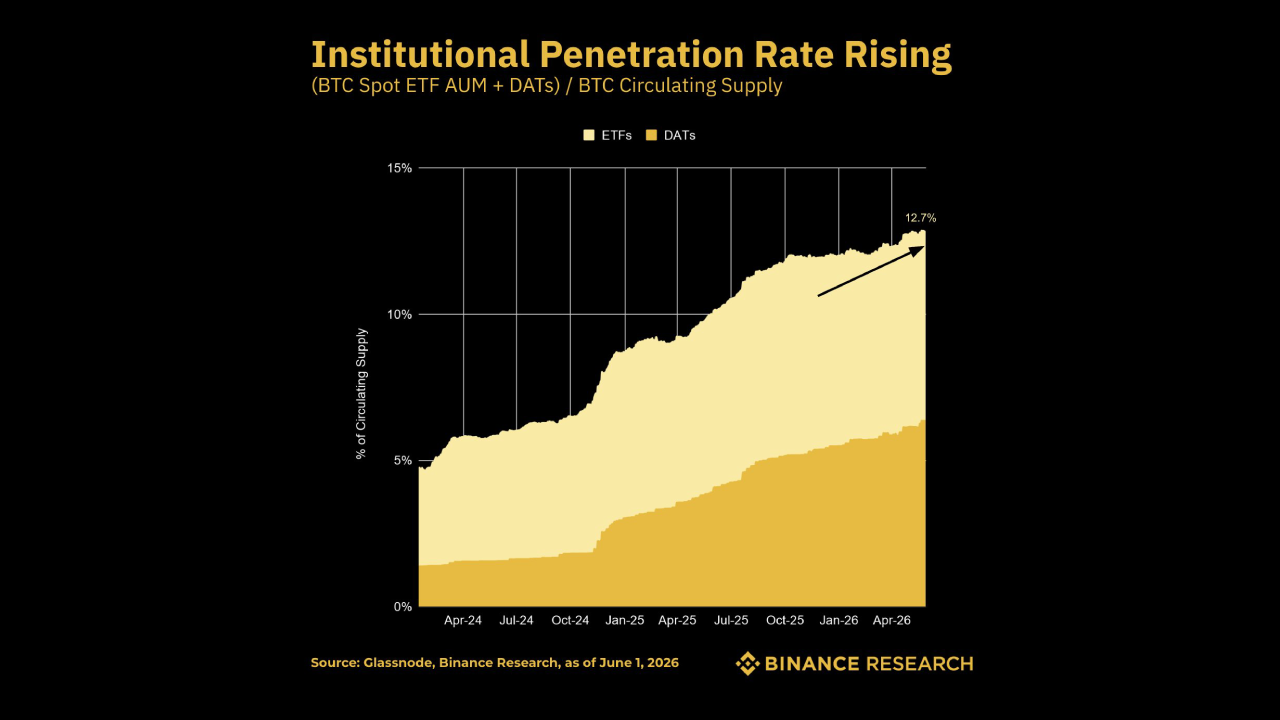
- Institutions are absorbing Bitcoin at nearly 4x the rate it is being mined, per Binance Research
Our analysis of market flows over the past two months reveals a clear correlation: as capital withdraws from the crypto market, it is being aggressively redirected into AI infrastructure giants. This shift explains the stark contrast in performance, where an aggressive sector rotation has left Bitcoin nursing a roughly 20% loss year-to-date while tech hyperscalers post near-daily highs.
The AI Capex Arms Race Is Draining Liquidity From Everywhere Else
The US technology sector has rallied 42% over the past two months – marking the largest two-month gain in 24 years and surpassing the peak momentum of the 2000 dot-com mania. Amazon, Alphabet, Meta, and Microsoft alone are projected to spend a combined $725 billion in capital expenditures on AI infrastructure this year, according to Statista.
As visualized in the macro trend data compiled by The Kobeissi Letter below, this historic surge represents the second-strongest equity rally of this century, driven entirely by concentrated institutional capital flowing into hardware and cloud hyperscalers.
BREAKING: The US technology sector has rallied +42% over the last 2 months, the largest 2-month gain in 24 years.
This also marks the 2nd-strongest rally this century, surpassing even the +40% gain seen during the 2000 Dot-Com Bubble.
The surge has been largely fueled by chip… pic.twitter.com/UZZzgMUhvy
— The Kobeissi Letter (@KobeissiLetter) June 2, 2026
The problem for Bitcoin is that institutional liquidity is finite. When the choice is between a non-yielding asset sitting in a drawdown and a tech monopoly reporting explosive AI-driven revenue growth, most portfolio managers are not agonizing over the reallocation.
High interest rates compound the pressure further – when investors can lock in meaningful risk-free returns in government bonds, the hurdle rate for holding volatile assets with no yield rises considerably.
Gold has maintained a strong upward trajectory as a traditional safe haven through all of this. Bitcoin has not, increasingly behaving as a high-beta tech proxy during corrections while being left behind when equities rally on strong earnings.
A Rare Signal That Most Are Ignoring
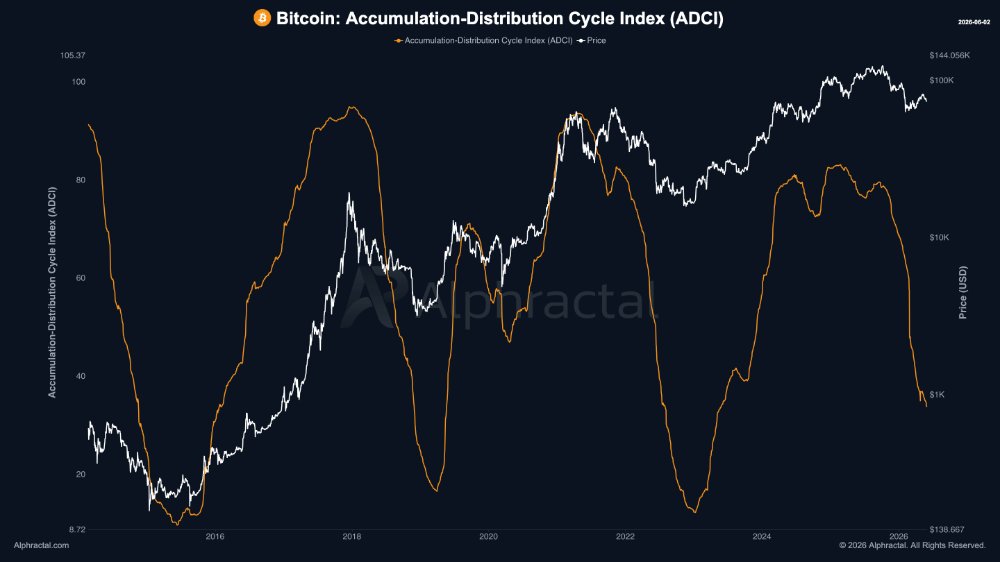
While short-term retail sentiment remains bearish, a deeper look at underlying liquidity cycles suggests a major macro trend reversal. Alphractal’s Accumulation-Distribution Cycle Index (ADCI) – a metric that filters noise by tracking whether Bitcoin is in a distribution, trend, or accumulation phase—has dropped into the low 20s. Historically, this specific zone has only been triggered three times: the 2018 macro bottom, the March 2020 liquidity crunch, and the late-2022 post-FTX capitulation. In all three instances, this structural signature preceded multi-year bull expansions, suggesting ‘Smart Money’ is absorbing supply while retail conviction breaks.
Bitcoin Accumulation-Distribution Cycle Index (ADCI)
Quantifying the Scale of Recent ETF Outflows
The global contraction in crypto liquidity is most visible within the institutional wrapper, where total outflows across all spot Bitcoin ETFs have now officially surpassed $23 billion. This heavy drain has created a severe supply-demand mismatch that makes sustaining immediate price levels difficult. The underlying weakness quickly bled into the derivatives market, triggering a massive deleveraging event with over $1.48 billion wiped out in a single 24-hour window.
This aggressive flush has heavily impacted retail morale. On-chain sentiment mapping from Santiment Intelligence shows that crowd sentiment has plunged into its lowest territory since April 5th. The visual snapshot below highlights a textbook transition into ‘Extreme Fear’ – a metric that ironically often formalizes near cycle bottoms as weak hands capitulate.
😱 With Bitcoin falling as low as $66.9K today, sentiment across social media is signaling that the average trader is in ’Extreme Fear’ mode. Traders have turned on $BTC after seeing the lowest market values since April 5th, and Saylor’s @Strategy selling has been a prime… pic.twitter.com/P7VQiz7ZF5
— Santiment Intelligence (@SantimentData) June 2, 2026
The underlying data compiled by Farside Investors highlights the absolute severity of this institutional selling pressure. On May 27 alone, net daily outflows reached a staggering $733.4 million, with BlackRock’s IBIT shedding $527.8 million in a single session. This followed an earlier mass withdrawal on May 18th, which saw $648.6 million leave the market. The pattern repeated across consecutive weeks, culminating in another $483.8 million outflow on June 1st.
This systematic asset rotation alters the core technical picture. Instead of long-term spot accumulation – which typically drives sustained bull markets – institutional activity has shifted toward short-term hedging and perpetual futures positioning. The massive $1.48 billion deleveraging event recorded by CoinGlass, which included $800 million in wiped-out Bitcoin longs, reflects a market where leveraged positioning is getting aggressively unwound rather than fresh capital entering.
Previous crypto cycles relied on speculative retail capital to absorb this institutional supply. With that retail liquidity largely exhausted after months of market churn, the capital floor needed to lift Bitcoin back out of its current range is temporarily absent. Until spot buyers show up with enough conviction to reclaim the crucial $70,000 support level, the technical macro picture remains heavily constrained.
Saylor Sold. Cuban Quit. Here Is What Actually Happened.
Two high-profile names added fuel to the bearish narrative in quick succession. Mark Cuban told the Front Office Sports podcast on May 21st that he had sold most of his Bitcoin, arguing that gold’s outperformance during the Iran conflict proved Bitcoin had failed as a store of value. Escalating US-Iran tensions pushed oil past $100 a barrel, sparking inflation fears that drove allocators into traditional defensive havens – and Bitcoin was not among them.
Then came the SEC filing from Strategy, disclosing that the company sold 32 Bitcoin between May 26th and May 31st at an average price of $77,135, raising $2.5 million to fund distributions on its preferred stock STRC, a perpetual preferred paying an 11.5% annual dividend. For a firm holding 843,706 BTC, the sale represents 0.0038% of total holdings. The headline that “Saylor sold Bitcoin” rattled sentiment regardless of the scale.
Not a Conviction Change – A Dividend Payment
Strategy needed cash to meet dividend obligations during a quarter when Bitcoin’s price drawdown triggered a temporary net loss. Rather than diluting shareholders by issuing new equity – the outcome short sellers had been betting on – the firm trimmed a microscopic fraction of its Bitcoin position to clear the liability. Saylor has been explicit on this: proving Strategy can service obligations directly from its Bitcoin stack defeats the core bearish thesis critics have built against the company. His long-term conviction has not shifted.
Fundstrat’s Tom Lee was blunt in response to Cuban, calling it a rage quit and noting that similar capitulations have historically marked cycle bottoms. “Crypto has been disappointing because crypto should move with equity markets, and it should be rallying with software,” Lee said on CNBC. “Software has really started to rally big, and crypto hasn’t moved.” His argument is that investors abandoning the asset class now are prematurely exiting a long-term trend, not making a structurally sound call.
TOM LEE: Mark Cuban selling all his Bitcoin is a sign of rage quitting, something we see at the bottom of every crypto winter. pic.twitter.com/1lfn9DDPfW
— Bitcoin News (@BitcoinNewsCom) June 2, 2026
The Case That This Is Not What It Looks Like
The institutional picture is more nuanced than the outflow headlines suggest. Binance Research data shows that since the launch of spot Bitcoin ETFs, only 435,000 BTC has been mined, while institutions have absorbed 1.63 million – nearly four times the new supply. Institutional holdings now represent 12.7% of circulating supply, growing from 921,000 BTC at ETF launch to 2.56 million today. Those are not the numbers of an asset class being abandoned.
The Rotation Playbook: Step Aside, Re-Enter Lower
Earlier this year, Bitcoin ETFs suffered a $4.5 billion multi-week outflow streak, only to snap back with $1.1 billion in three-day inflows the moment a technical bottom formed. Capital did not leave permanently – it stepped aside and came back at lower levels. Analysts tracking ETF behavior describe the current dynamic as macro-driven tactical rebalancing: geopolitical shocks trigger risk-off pivots, AI equity gains pull capital toward better-performing assets, and hot inflation prints trigger automated trimming of non-yielding positions. In each case, the capital remains within institutional ecosystems, waiting rather than gone.
When AI stocks eventually enter a correction phase – and a sector that has now surpassed dot-com era two-month gains is not immune to gravity, especially with most index gains concentrated in fewer than ten names – risk appetite could rotate to crypto. In previous cycles, tactical outflows have reversed when the catalyst cleared – and the institutional infrastructure now holding 12.7% of circulating supply is not the kind that exits permanently.
The information provided in this article is for educational purposes only and does not constitute financial, investment, or trading advice. Coindoo.com does not endorse or recommend any specific investment strategy or cryptocurrency. Always conduct your own research and consult with a licensed financial advisor before making any investment decisions.

Alex is Editor-in-Chief of Coindoo and co-founder of Millennial Media Group, with nearly a decade of experience covering financial markets – crypto first, then everything else.
It started in 2016 with Bitcoin. Like most people at the time, he didn’t fully understand it – so he kept digging. Blockchain, tokenomics, the projects, the cycles. That curiosity never stopped, and eventually pulled him into traditional markets too: equities, commodities, macro. Not because he left crypto behind, but because you can’t properly understand one without the other.
What drives him is straightforward: he wants to know why something is happening, not just that it’s happening. Most market coverage stops at the headline – price up, price down, here’s a chart. Alex finds that kind of reporting actively unhelpful. If you walk away from an article without understanding the mechanism behind the move, what did you actually learn?
He holds a degree in Tourism from New Bulgarian University – not the most obvious path into financial markets, but markets have a way of pulling in people who are simply too curious to stay out. He has authored over 200 in-depth analyses and more than 10,000 articles across crypto and traditional finance. He still thinks every day in markets teaches him something new. That’s probably why he hasn’t stopped.



Be the first to comment