




For years, Bitcoin has been championed by its most ardent supporters as the ultimate “safe haven” or a digital gold capable of hedging against rampant inflation and systemic financial collapse. However, according to prominent market analyst Willy Woo, the reality of Bitcoin’s role in global portfolios is far more nuanced than the “Bitcoiner” narrative suggests.
In a recent assessment of the asset’s performance amid geopolitical turmoil, Woo noted that Bitcoin possesses the inherent properties of a safe haven, such as the ability to carry wealth across borders via a simple seed phrase. However, it fails to act like one when the stakes are highest.

Instead of thriving during periods of war or systemic uncertainty, Bitcoin continues to trade as a high-beta risk asset, moving in lockstep with the tech-heavy NASDAQ.
Woo attributes this disconnect to a lack of institutional recognition. Large capital pools still view the cryptocurrency as too new and untested to serve as a defensive anchor. “It’ll take another decade for it to gain market acceptance as a safe haven, maybe longer,” Woo suggested, adding that once it achieves that status, it will likely challenge gold’s multi-trillion-dollar market capitalization.
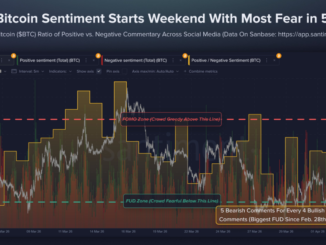
This identity crisis is currently playing out in a volatile tug-of-war between retail sentiment and institutional accumulation. Data from Santiment reveals a whiplash in crowd psychology; the market swung from extreme pessimism early in the week to “ultra FOMO” by Thursday.

 
After a rejection at the $80,000 level fueled fears of a freefall, prices rebounded to roughly $78,700. Experts warn that while a $80,000 breach would be a massive psychological victory, markets often move in the opposite direction of the crowd’s exuberant expectations.
Despite the retail noise, the institutional “bedrock” is firming up.
Bitcoin is currently trading at $78,267, supported by a significant shift in spot ETF flows. Institutional demand has pushed Bitcoin’s market dominance to 60%, confirming its position as the primary crypto bet for Wall Street.
That said, the asset’s trajectory depends on a combination of regulatory clarity and holder behavior. A recent $223 million inflow highlights sustained buying pressure, while the mid-April SEC roundtable on the CLARITY Act is expected to resolve lingering legal uncertainties.
With “whales” continuing to accumulate and reduce liquid supply, the stage is set for a breakout, provided the asset can eventually outgrow its reputation as a mere proxy for tech stocks.





Be the first to comment