



Bitcoin price remained trapped near $64,600 on July 30 as renewed US-Iran fighting, a hawkish Federal Reserve, and another CLARITY Act delay prevented buyers from extending the recovery.
Summary
- Bitcoin price recovered from $62,383, but it remains inside a range capped near $66,500.
- The Fed held rates at 3.5%–3.75%, while three policymakers favored a rate increase.
- US-Iran fighting and a 6.6% oil surge revived inflation and risk-off concerns.
- Gold held near $4,062, but available data does not confirm a broad crypto-to-gold rotation.
Bitcoin price struggles to leave its consolidation range
According to data from crypto.news, Bitcoin (BTC) price traded near $64,600 at the time of writing after briefly falling to $62,383 following the Federal Open Market Committee meeting. The rebound returned BTC above $64,000, but the asset has yet to break the range that has controlled its price for several days.

The daily chart shows Bitcoin trading almost directly above the Bollinger Band midpoint at $64,512. The upper band near $66,348 remains the immediate ceiling, while the lower band around $62,676 marks the first major support area.
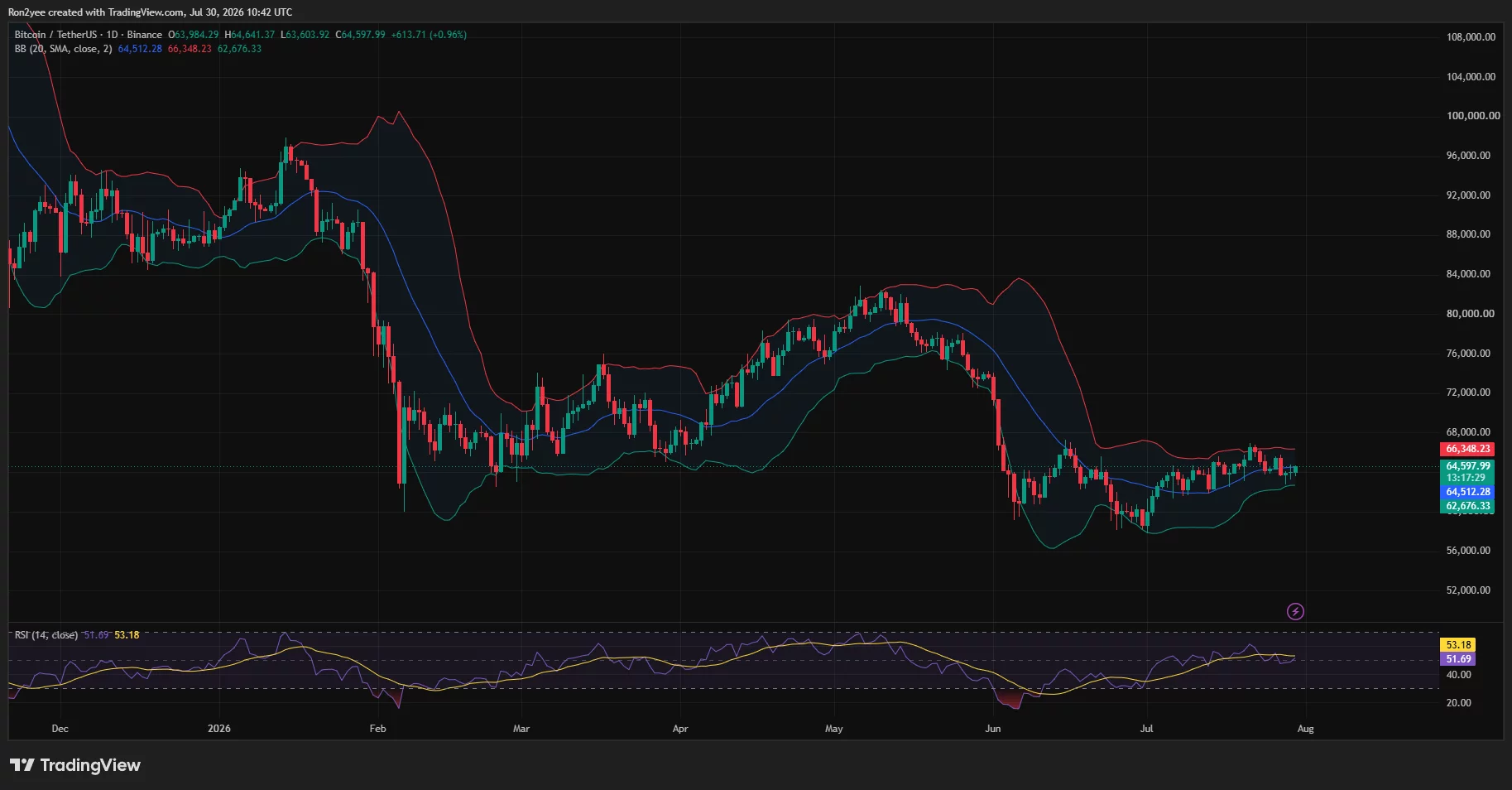
Momentum also remains neutral. The daily relative strength index stood at 51.69, slightly below its signal average of 53.18. That setup suggests buyers have stabilized the market but have not gained enough strength to confirm a breakout.
Bitcoin’s resistance to the wider risk-off move remains notable. US stocks fell sharply on Wednesday, with the Dow losing 2.2%, the S&P 500 dropping 1.5% and the Nasdaq sliding 1.7%. BTC, by comparison, recovered most of its post-FOMC decline instead of extending losses below $62,000.
However, the repeated inability to clear $65,000–$66,500 shows that defensive buying has been enough to prevent a breakdown, not enough to restart the broader rally.
War and Fed policy weigh on Bitcoin momentum
Renewed fighting between the United States and Iran has added another source of pressure. US forces launched a fresh wave of strikes against Islamic Revolutionary Guard Corps targets after Iran fired missiles toward a US base in Jordan.
Jordanian air defenses intercepted five Iranian missiles on Thursday, while concerns grew that the conflict could threaten Persian Gulf energy supplies and shipping through the Red Sea.
Crude oil held above $84 after surging 6.6% in the previous session. Higher energy prices can raise inflation expectations, keep Treasury yields elevated and reduce the appeal of speculative assets, including cryptocurrencies.
That problem was reinforced by the Fed’s July meeting. Policymakers maintained the federal funds rate at 3.5%–3.75%, as expected, but Chair Kevin Warsh rejected the idea of a flexible inflation objective.
Warsh said there was no “soft target” for inflation and reaffirmed that the central bank remained committed to 2%. Three FOMC members voted for a quarter-point rate increase, leaving another hike possible if oil-driven inflation persists. The Federal Reserve’s statement confirmed the 9–3 decision.
For Bitcoin, steady rates provided little relief because the accompanying message reduced expectations of easier financial conditions. Higher-for-longer borrowing costs could continue limiting demand for risk assets ahead of the next inflation readings.
CLARITY Act delay removes another potential catalyst
The US Senate’s decision to postpone action on the Digital Asset Market Clarity Act has added regulatory uncertainty to the macro pressure.
Lawmakers shifted their attention toward a Russia sanctions package and federal nominations, narrowing the time available to advance the crypto market structure bill before the Aug. 8 recess. The delay does not create an immediate operational change for Bitcoin, but it removes a potential catalyst that could have improved institutional confidence.
The legislation is intended to divide oversight responsibilities between the Securities and Exchange Commission and Commodity Futures Trading Commission. Its passage could give US exchanges, token issuers and investors clearer federal rules.
Senate Republicans released updated text on July 22, combining Banking and Agriculture Committee proposals into a single framework. However, unresolved ethics language and the need for Democratic support remain obstacles.
The delay alone did not cause Bitcoin’s decline, but it left the market without a policy-driven reason to challenge resistance while geopolitical and monetary risks increased.
Is capital rotating from crypto into gold?
Cross-asset performance shows defensive positioning, but there is not enough evidence to conclude that investors are directly moving capital from cryptocurrencies into gold.
Spot gold held near $4,062 an ounce on Thursday, while US gold futures gained 0.7%. Gold had also risen about 2% following the Fed announcement. However, investment demand remained subdued, and silver traded slightly lower.
That mixed performance weakens the argument for a broad flight into precious metals. Gold has retained safe-haven demand, but rising Treasury yields and expectations of another rate increase are limiting its upside because bullion does not pay interest.
The clearer defensive move has been into oil-linked exposure and away from equities sensitive to interest rates and economic growth. Bitcoin’s recovery toward $64,600 also suggests capital has not abandoned the asset entirely.
US spot Bitcoin ETFs recorded approximately $32.1 million in net inflows on July 29, with BlackRock’s IBIT attracting $89.8 million, according to Farside Investors. That inflow is modest, but it shows institutional demand continued during the sell-off rather than moving entirely toward traditional havens.
Crypto sentiment nevertheless remains weak. The Fear and Greed Index stood at 28, down from 29 and still inside the “fear” category.
Bitcoin downside targets remain near $63K and $60K
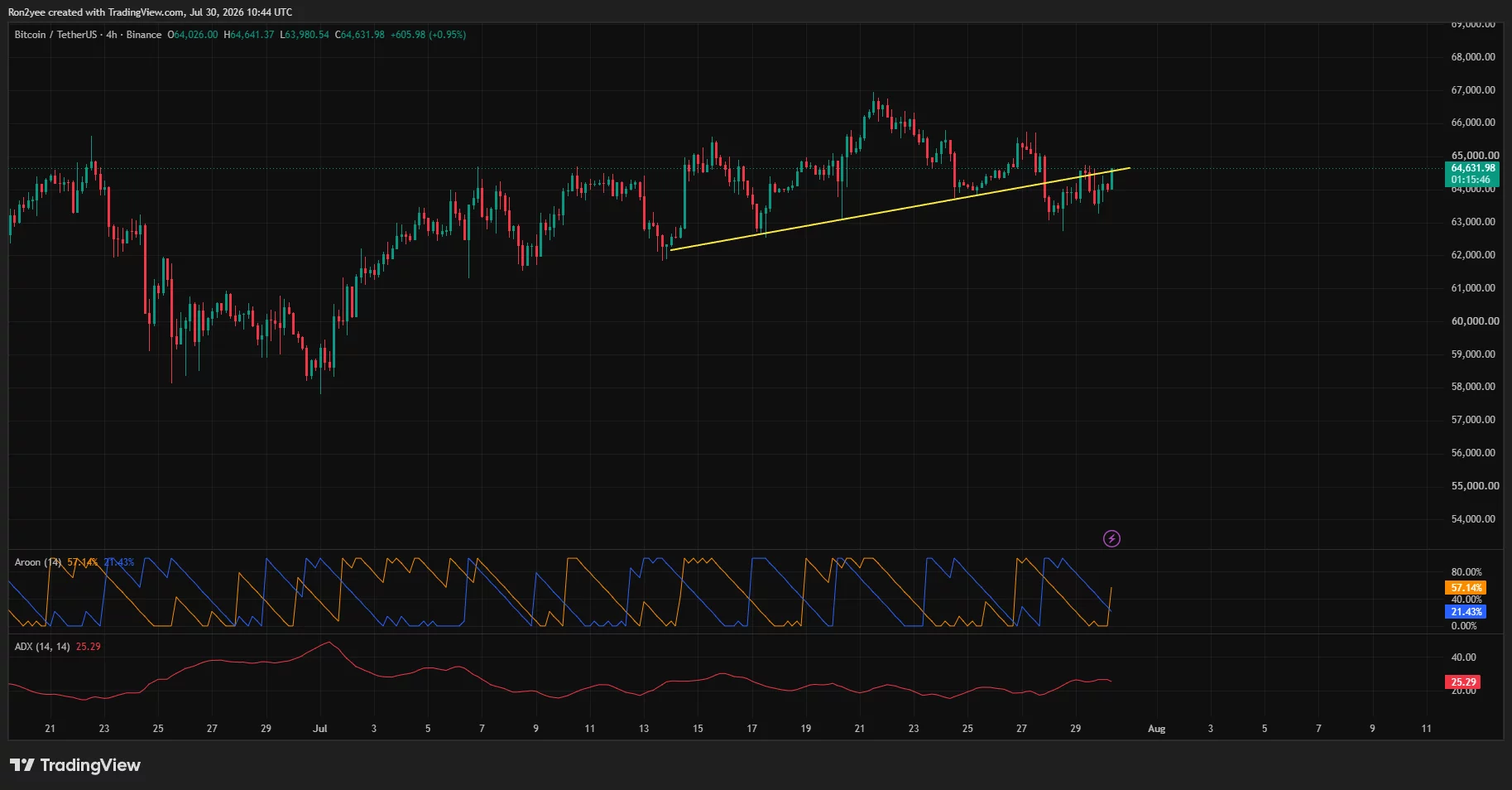
The 4-hour chart places Bitcoin against a rising trendline near $64,600. A confirmed move above this area could open a retest of $65,000, followed by the upper daily Bollinger Band between $66,300 and $66,500.
The 24-hour liquidation heatmap shows concentrated leverage around $64,900–$65,200. A move into that zone could trigger short liquidations and briefly accelerate the recovery. Further liquidity sits near $66,000 and $67,000.
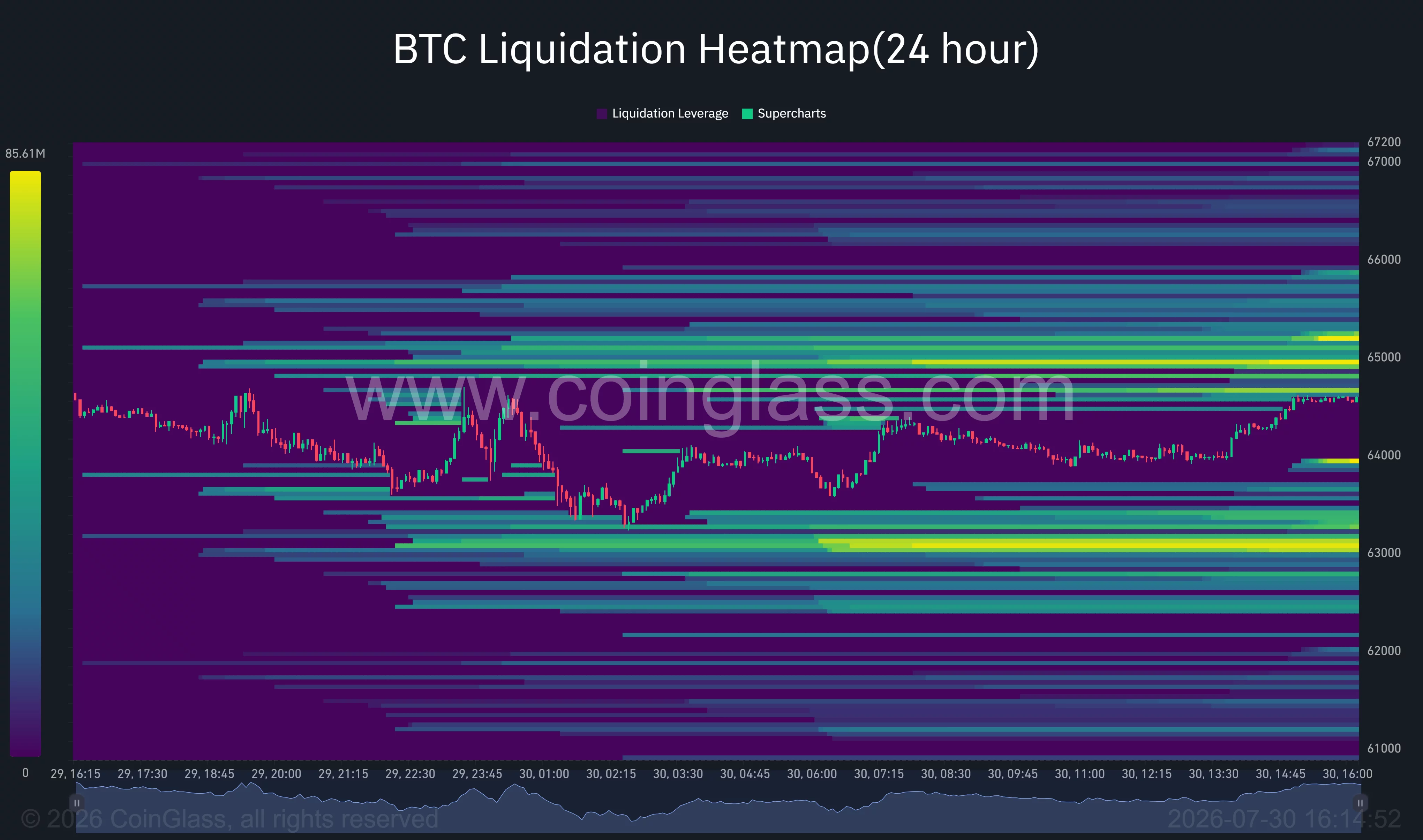
On the downside, another large concentration appears around $63,000–$63,300. Losing the 4-hour trendline could attract price toward that liquidity before opening the way to $62,000 and the psychological $60,000 level.
Crypto trader Lennaert Snyder said Bitcoin was attempting to hold $64,000 following the FOMC meeting but remained vulnerable after generating substantial liquidity below Tuesday’s $62,800 low. He identified $64,800 and $65,800 as possible areas for renewed short positions.
Ali Charts offered a longer-term bullish interpretation, arguing that a decline toward $60,000 could complete an inverse head-and-shoulders pattern. Under that scenario, a confirmed break above $66,500 would place $74,000 in play.
For now, the Aroon Up reading of 57.14 remains above Aroon Down at 21.43, while the 4-hour ADX of 25.29 points to a developing but only moderate trend. Bitcoin must hold above $64,000 and clear $66,500 to turn its resilience into a confirmed breakout. Failure to do so would leave the market exposed to another liquidity sweep as war risks, inflation concerns, and regulatory delays continue to weigh on sentiment.
Disclosure: This article does not represent investment advice. The content and materials featured on this page are for educational purposes only.


Be the first to comment