


Bitcoin reclaimed $64,000 after U.S. inflation eased to 3.4% in July, while market leaders said the in-line reading left the Federal Reserve’s policy outlook largely unchanged.
Summary
- U.S. CPI rose 3.4% annually in July, easing from 3.5% in June.
- Bitcoin recovered from roughly $63,400 to $64,100 after the inflation report.
- Polymarket traders assigned a 67% probability to no rate change in September.
- Analysts said ETF flows, liquidity, and derivatives positioning may now regain influence.
The U.S. Bureau of Labor Statistics reported on Aug. 12 that the Consumer Price Index rose 0.1% month over month in July and 3.4% from a year earlier. Both readings matched market expectations.

Core CPI, which removes volatile food and energy prices, increased 0.2% during the month and 2.5% annually. The yearly core rate slowed from 2.6% in June, while headline inflation eased from 3.5%.
Bitcoin rebounds after in-line CPI report
Bitcoin (BTC) rose to around $64,100 following the release, recovering from an intraday low near $63,400, according to data from crypto.news.
The move offered some relief after uncertainty over the U.S.-Iran conflict and the Strait of Hormuz pressured crypto and other risk assets. Renewed disruption to energy supplies could lift oil prices and complicate the inflation outlook, limiting the market’s response to July’s softer figures.
Gadi Chait, investment manager at Xapo Bank, told crypto.news that Bitcoin’s reaction to inflation data largely depends on how the figures affect expected interest rates and financial conditions.
“Fundamentally, Bitcoin is a liquidity-sensitive asset. Historically, it has performed strongly when liquidity is abundant, and interest rates are low, while higher rates and tighter financial conditions have put it under pressure.”
Chait said long-term holders would focus more on the direction of monetary policy than on one inflation report. A path toward looser policy would support Bitcoin, while a higher-for-longer rate outlook would remain a headwind, he added.
Fed rate expectations remain broadly stable
The in-line report reduced the immediate prospect of an inflation-driven policy shift, but inflation remained above the Federal Reserve’s 2% target.
Polymarket data showed traders assigning a 67% probability to no change at the September meeting and a 34% chance of a 25-basis-point increase. A separate market placed the probability of at least one rate hike in 2026 near 55%.
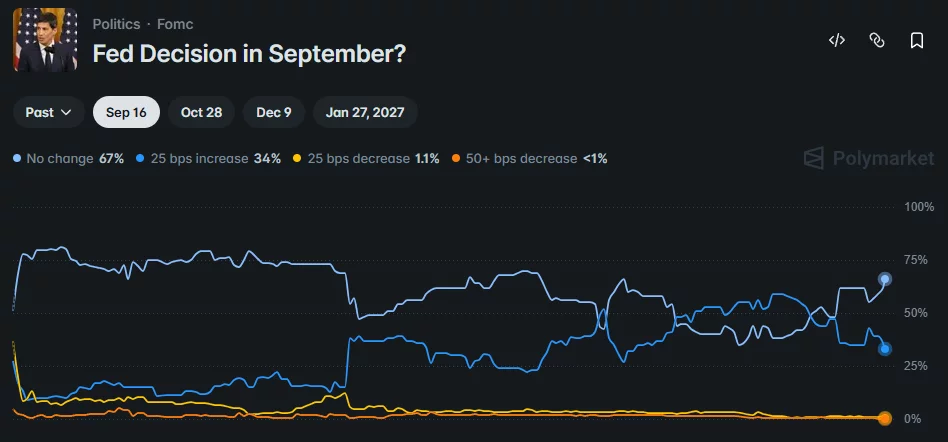
Ryan Lee, chief analyst at Bitget Research, said the CPI reading did not provide a decisive signal in either direction after the softer July employment report.
“An in-line CPI reading neither forces a hawkish re-pricing nor delivers a clear dovish catalyst after Friday’s soft jobs data. It largely preserves current September expectations and leaves the focus on Jackson Hole and the next round of inflation numbers.”
Lee described the result as relatively constructive for Bitcoin because it removed the immediate threat of an inflation-led selloff. Without a stronger monetary-policy catalyst, he expects ETF flows, market liquidity, and derivatives positioning to play a larger role in crypto prices.
Fabian Dori, chief investment officer at Sygnum Bank, also said the figures left the medium-term liquidity outlook mostly unchanged. Dori identified Treasury cash balances, changes related to the enhanced supplementary leverage ratio, private credit creation, and stablecoin adoption as the structural factors to watch.
Bitcoin options retain defensive pricing
Derivatives traders continued to pay more for downside protection despite the CPI figures matching forecasts, according to Andrei Grachev, managing partner at DWF Labs.
“On the end-August expiry, downside strikes near $60,000 have been costing more than equivalent upside strikes near $70,000,” Grachev told crypto.news.
Grachev said the pricing gap suggested caution about the broader policy path rather than concern over one report. Demand for exposure around $70,000 had also recovered, creating a market that remained constructive in positioning while defensive in pricing.
Bitfinex analysts identified ETF flows as the first signal to monitor after the release, followed by holder behavior if Bitcoin revisits the $62,000–$63,000 area. Their pre-release assessment placed the first major upside barrier between $65,021 and $65,510 on a daily closing basis.
According to the analysts, two daily closes above $68,300 would invalidate the existing range structure. The level combines the short-term holder’s cost basis with April’s monthly opening price.
PPI becomes the next inflation test
Markets will turn to the July Producer Price Index on Aug. 13 for evidence of inflation developing earlier in the supply chain. A softer reading could reduce demand for options protection, while an upside surprise may revive concerns about another Fed rate increase.
Iggy Ioppe, chief investment officer at Theo, said the CPI result neither forced a hike nor gave markets a clear dovish catalyst. He expects short-term attention to remain on yield opportunities, with gold serving as a defensive asset while Bitcoin remains sensitive to institutional ETF flows.
Bitcoin must now hold above $64,000 and secure acceptance beyond the $65,021–$65,510 band to strengthen its rebound. Failure to do so would leave the $62,000–$63,000 area exposed as traders assess PPI, energy prices, and the next change in Fed expectations.



Be the first to comment