



Key Takeaways
- Bitcoin plunged below $60,000 on Friday, June 5, 2026, a sharp 4% decline in just 24 hours.
- The flash crash triggered $1.57 billion in leveraged liquidations across the broader crypto market.
- Michael Saylor outlined 4 core ideologies to navigate bitcoin’s structural transition into a global asset.
Liquidations Pass the Billion-Dollar Mark
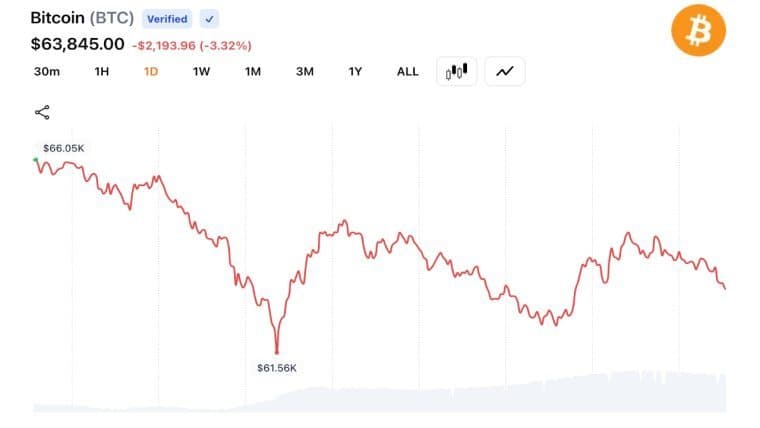
Bitcoin plunged below $60,000 on Friday amid a market-wide sell-off that shaved approximately $200 billion from the crypto economy. According to Bitstamp data, the cryptocurrency nosedived to $59,743, briefly widening its losses since June 1 to more than $14,000—a decline of nearly 20% in five days.
While it bounced back to $61,000 shortly after tapping the new year-to-date low, the cryptocurrency was still down by nearly 4% in 24 hours. The drop widened bitcoin’s year-to-date losses to 30% and briefly pushed its market capitalization below $1.2 trillion, a level last seen in October 2024. The bearish sentiment extended to altcoins, some of which logged double-digit losses, driving the crypto economy’s aggregate market cap down to $2.23 trillion.
Meanwhile, the market mayhem pushed liquidations past the $1 billion mark for the fourth time in five days. As expected in a declining market, long bets accounted for a disproportionate share of the leveraged positions erased, making up $1.28 billion of the $1.57 billion total. Bitcoin alone saw $381 million in long positions wiped out, compared with $111 million in shorts.

While a handful of critics attribute bitcoin’s downward spiral to Strategy’s disposal of a mere 32 bitcoins, market analysts argue the scale of the capitulation points to deeper structural vulnerabilities. The sheer velocity of the sell-off suggests a broader institutional exit and systemic liquidations that far outweigh the ripple effects of an otherwise negligible corporate divestment.
However, this alternative view did not stop “Mad Money” host Jim Cramer from accusing Strategy Executive Chairman Michael Saylor of “murdering bitcoin.” Saylor, facing criticism stemming from the sale, responded by publishing a comprehensive essay on X detailing what he calls the “Four Ideologies of Bitcoin.” In the essay, Saylor argues that as bitcoin transitions from a technical experiment to a global asset, its community is dividing into four distinct yet overlapping schools of thought that define its future.
The Four Ideologies of Bitcoin
The first school of thought, championed by maximalists, views bitcoin as a moral and civilizational advance. They emphasize its role as the dominant, incorruptible digital monetary network that provides superior property rights and economic hope to those facing financial misery.
Capitalists, on the other hand, focus on scaling bitcoin by integrating it as “digital capital” into global financial systems. This group advocates for corporate treasuries, institutional custody, and bitcoin-backed credit and securities, arguing that market incentives will ultimately drive the network’s growth and defense.
Saylor identifies technologists as a group that believes the protocol must responsibly and continuously evolve to address future technical threats, such as quantum computing, while improving base-layer privacy, scalability, and usability.
Lastly, the Strategy chairman sees fundamentalists as the guardians of bitcoin’s first principles, such as absolute decentralization, self-custody, running personal nodes, and censorship resistance, aiming to protect the protocol from institutional capture or dilution.
Saylor concluded his essay by arguing that a healthy bitcoin ecosystem requires a synthesis of all four groups. Rather than choosing between purity and adoption, Saylor noted that the network’s ultimate path forward relies on keeping the core protocol sacred and stable while allowing the global economy to build on top of it.








Be the first to comment