



Bitcoin’s drop below $60,000 has triggered nearly $1.48 billion in crypto liquidations after fresh U.S. inflation data reinforced expectations that interest rates could remain higher for longer.
Summary
- Bitcoin’s drop below $60,000 triggered $1.48 billion in crypto liquidations, with long traders suffering the biggest losses.
- A $9.33 billion Bitcoin options expiry and rising inflation concerns have added to volatility across crypto markets.
- Stronger U.S. inflation, ETF outflows, and Strategy’s stock decline have reinforced expectations of higher interest rates.
According to data from crypto.news, Bitcoin (BTC) fell 3.3% to an intraday low of $58,188 on June 25 before recovering to around $59,200 at press time. Ethereum (ETH) declined 4.7% to $1,567, while XRP dropped 3.7% to $1.03. The total cryptocurrency market capitalization also fell 2.2% to $2.13 trillion.

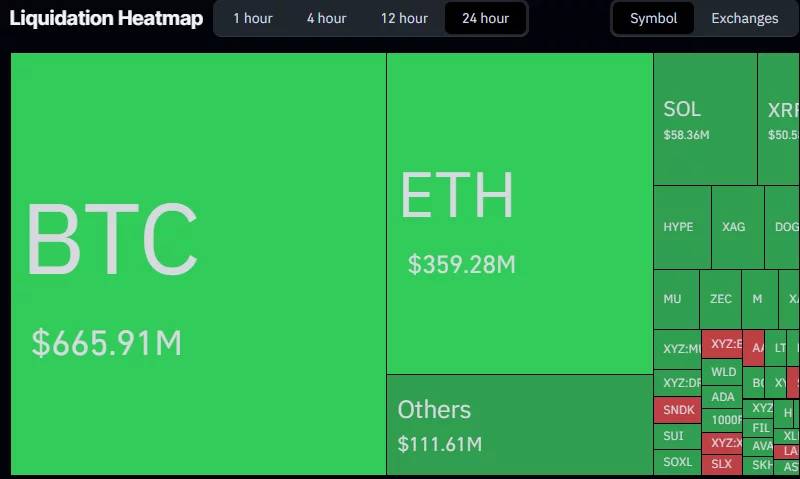
According to CoinGlass, more than 217,700 traders were liquidated over the past 24 hours, with total losses reaching approximately $1.48 billion. Long positions accounted for $1.21 billion of those liquidations, while short traders lost about $270 million. Bitcoin led the selloff with roughly $665 million in liquidations, followed by Ethereum at $359 million and XRP at $50.5 million.
Derivatives positioning keeps volatility elevated
Alongside the spot market decline, traders are preparing for one of the largest Bitcoin options expiries of the year. Data from Deribit shows roughly $9.33 billion in Bitcoin options, representing 157,611 open contracts, are scheduled to expire on Friday.
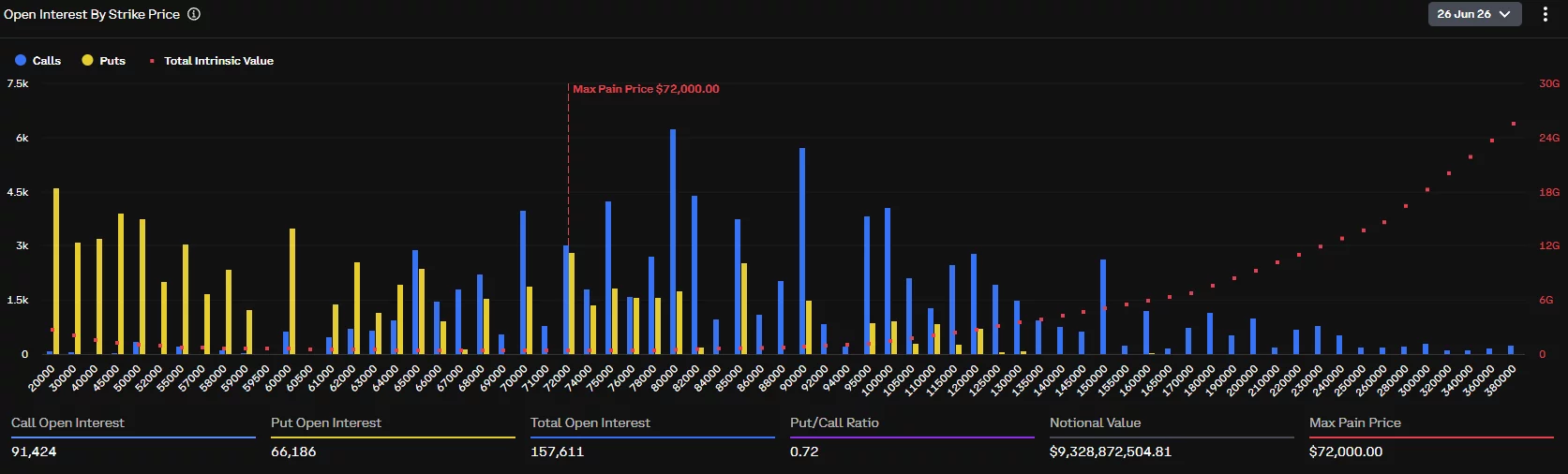
Call open interest is concentrated between the $75,000 and $90,000 strike prices, while put positioning is clustered across the $20,000 to $70,000 range. Deribit’s max pain price stands at $72,000, well above Bitcoin’s current market price. With Bitcoin trading far below the largest call positions, options traders could continue adjusting hedges into expiry, increasing short-term price swings.
Meanwhile, XRP derivatives remain tilted toward bullish positioning despite the broader selloff. CoinGlass data shows Binance XRP traders maintained a 2.53 long-to-short ratio, while OKX traders posted a 2.68 ratio, suggesting many participants are still positioned for a rebound. However, such crowded long positioning can increase liquidation risk if selling pressure persists.
Offering a longer-term perspective, analyst Daan Crypto Trades said he sees the green support zone on his chart as an area to gradually accumulate Bitcoin rather than trying to identify the exact market bottom.
He added that the weekly 200-week moving average has historically provided attractive value and said he remains comfortable accumulating in the $60,000 region, even though he believes lower prices remain possible during 2026.
Meanwhile, fellow analyst Lennaert Snyder said he had already taken profits on most of his Bitcoin short position following the latest breakdown.
“If we’re printing new lows I’m eyeing 55K for a reaction, but even the 40s are fine with me.”
Inflation data reinforces higher-for-longer outlook
According to the U.S. Bureau of Economic Analysis, the Personal Consumption Expenditures (PCE) price index increased 4.1% year over year in May, up from 3.8% in April, while headline PCE rose 0.4% on a monthly basis.
Although both readings came in slightly below economists’ expectations of 4.2% annually and 0.5% monthly, inflation remained more than double the Federal Reserve’s 2% target.
The report also showed core PCE increased 0.3% during the month and 3.4% from a year earlier. At the same time, the BEA reported that personal income rose 0.7%, while real consumer spending increased 0.3%, suggesting the U.S. economy remains resilient despite elevated borrowing costs. First-quarter GDP growth was also revised upward to 2.1%.
The inflation data arrived as institutional demand for Bitcoin continued to soften. U.S. spot Bitcoin exchange-traded funds have recorded roughly $6.4 billion in net outflows over the past 30 days, the largest monthly redemption period since the products launched. Pressure has also spread to equities, with Strategy shares falling more than 12% below $100, coinciding with Bitcoin’s break under $60,000.
Prediction markets have also turned increasingly cautious. According to Polymarket, traders are assigning a 66% probability that Bitcoin falls below $50,000, while the odds of a decline below $45,000 have risen to 46%.
Adding to those concerns, Bank of America recently revised its outlook and now expects three Federal Reserve rate hikes this year, replacing its earlier expectation that policymakers would keep rates unchanged.
Disclosure: This article does not represent investment advice. The content and materials featured on this page are for educational purposes only.


Be the first to comment