

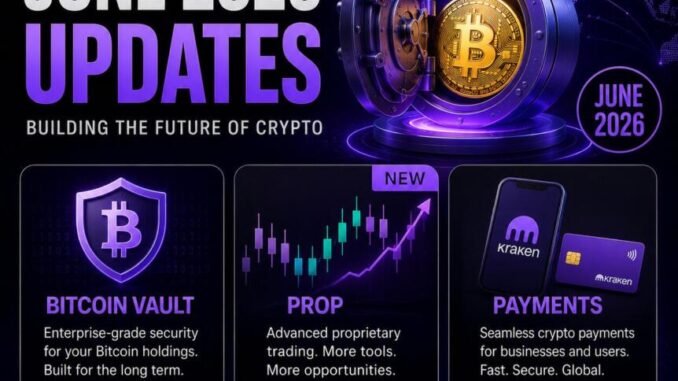

Kraken has outlined a broad set of product and partnership updates for June 2026, spanning retail trading tools, “earn” features denominated in crypto, and new infrastructure links for payments and stablecoins. The announcements arrive as exchanges continue to compete on usability, distribution, and regulated access to higher-risk trading products.
Bitcoin-denominated rewards move in-house
One of Kraken’s headline offerings is Bitcoin Vault, described as a way for long-term BTC holders to earn BTC-denominated rewards directly from their Kraken accounts. The announcement positions the product as designed to avoid external wallet usage and to require no DeFi knowledge, with a stated 1-day lockup period.
For market participants, “earn” products that settle in the same asset they advertise can be attractive because they reduce day-to-day operational friction. At the same time, investors typically need to evaluate how rewards are sourced and how staking or custody terms affect liquidity and risk. Kraken’s framing suggests a tighter integration with the exchange account experience, which may broaden participation among users who do not want to navigate separate protocols.
Kraken Prop expands access to funded trading
Kraken also introduced Kraken Prop, characterized in the update as a funded trading program. According to the details shared in the announcement, participants access wallets after an evaluation process, with capital of up to $200,000 available. The profit split is described as up to 90% of eligible profits, and the program includes 60-plus crypto trading pairs, including BTC and ETH.

The program’s structure is notable in how it mirrors a broader trend across crypto trading education and “pro” funding models. These programs are often marketed to traders who want exposure to larger size without directly funding the full risk capital. For the exchange, they can also increase trading activity density if funded participants become repeat users.
As always, prospective traders typically need to review evaluation rules, eligibility criteria, withdrawal mechanics, and any restrictions on trading strategy, since these factors determine whether the product functions as a path to consistent returns or as a short-term contest with performance filters.
Spot margin and trading availability for US users
On the US trading side, Kraken said that Spot Margin is now available on Kraken Pro for CFTC-regulated spot margin trading to US retail traders. Separately, Kraken referenced additional spot margin availability through six new pairs for US spot margin traders.
The shift matters because margin offerings can change how retail participants construct portfolios, manage exposure, and respond to volatility. While spot margin does not introduce derivatives in the same way perps do, it still increases leverage and liquidation risk. Market observers generally look for how exchanges operationalize risk controls, including margin requirements, liquidation processes, and product eligibility by jurisdiction.
Perpetual futures, CFTC framing, and regulatory segmentation
Kraken also said it is set to launch what it describes as its first CFTC-regulated perpetual futures for US traders. The announcement does not provide trading terms, dates beyond “set to launch,” or additional specification details in the email text provided, but it signals continued expansion of regulated derivatives access.
For exchanges, regulated perpetual offerings can be a balancing act. They require compliance scaffolding and clear risk disclosures, while still competing with offshore venues that often offer broader product flexibility. For traders, the availability of regulated perps can impact execution quality, reporting expectations, and how institutions or compliance-conscious users evaluate venue selection.
Payments and stablecoin infrastructure partnership
Beyond trading, Kraken highlighted a partnership with Tempo focused on global payments and stablecoin infrastructure. The update also stated that USDT0 deposits and withdrawals are now available on Tempo, and that Tempo supports those transfers.
Stablecoin settlement and payment rails are increasingly important for exchanges, particularly where user demand includes faster cross-border movement and more predictable operational workflows. Still, users generally need to distinguish between stablecoin availability, network routes, settlement timelines, and withdrawal finality, since those operational details can vary by infrastructure provider and jurisdiction.
Additional retail features: staking and “Auto Earn”
Kraken’s June update package also includes further staking and earn-style product additions. The email references HYPE staking and Auto Earn as a way to put idle HYPE to work, alongside AVAX staking and Auto Earn for AVAX holders.
These features reflect a pattern common across large exchanges: integrating staking or reward logic into the main account experience rather than forcing users to interact with external staking contracts. The practical value is typically convenience, but the key for users is understanding lockups, reward frequency, and any conditions that affect how assets can be moved or sold.
Tokenized IPO access and other product additions
Kraken also referenced access to the SpaceX IPO via xStocks. In addition, it listed other product and listing-related items, including new asset listings and additional features tied to deposits and withdrawals across supported networks.
Tokenized IPO access is an area where marketing claims can outpace details, so investors usually look for disclosures around underlying issuers, instrument structure, custody, redemption or transferability, and regulatory constraints. The email text provided notes availability, but it does not include instrument terms in a way that would allow full verification of those mechanics.
What these updates signal for the market
Taken together, Kraken’s June 2026 announcements point to three strategic priorities for the exchange and, by extension, the broader market.
- Account-based “earn” products. Bitcoin Vault and Auto Earn features aim to keep rewards within the exchange workflow, reducing friction for users who prefer not to interact with separate protocols.
- Growing regulated trading depth. Spot margin availability and planned CFTC-regulated perpetual futures suggest Kraken is continuing to broaden the range of regulated trading tools available to US retail participants.
- Infrastructure partnerships tied to stablecoin payments. The Tempo collaboration indicates continuing investment in settlement and cross-border payment functionality, which can influence how quickly and reliably users move assets.
For users, the immediate relevance is practical: new products can alter trading options, liquidity planning, and how returns are realized. For the industry, the bigger takeaway is that exchange competition is increasingly about integration quality, regulatory scope, and how well products match user expectations for convenience and speed.


Be the first to comment