



Key Takeaways
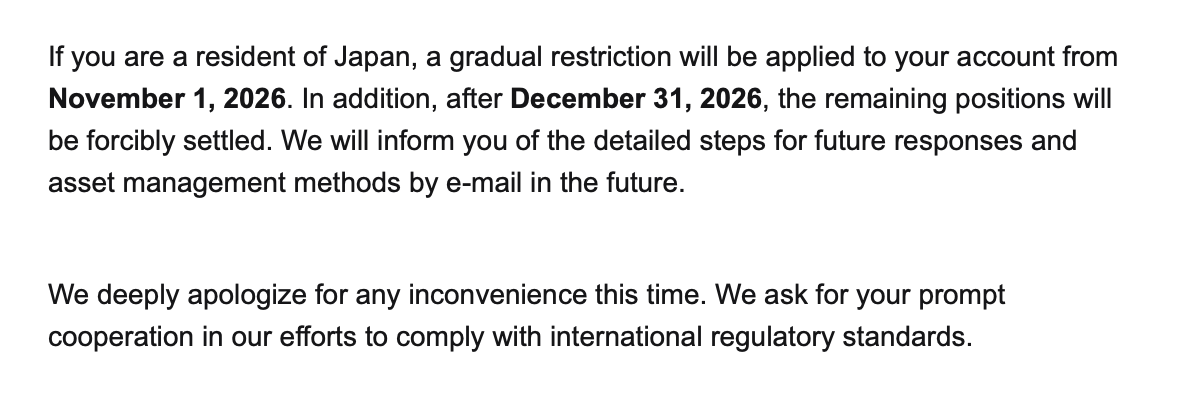
- Bitget will force-close all Japan positions by Dec. 31, 2026, per an Aug. 2 notice.
- Japan’s FSA warned Bitget in 2023 and 2024 over unregistered operations targeting residents.
- Watch the Nov. 1, 2026 deadline, when flagged accounts shift to close-only trading mode.
The company disclosed the phased shutdown in official notices posted Aug. 2, 2026. As of Aug. 3, Japanese residents can no longer open new accounts on the platform.
Bitget said the decision reflects its “ongoing commitment to regulatory compliance” in Japan. The exchange primarily offers derivatives trading, a form of trading based on contracts tied to an asset’s price rather than the asset itself, along with copy-trading tools that let users automatically mirror other traders’ moves.
Japan’s Financial Services Agency, the country’s top financial regulator, had warned Bitget in March 2023 and again in November 2024 for allegedly serving Japanese residents without proper registration. By 2025, the pressure had escalated when regulators asked Apple and Google to remove Bitget’s app, along with several other offshore exchange apps, from Japan’s app stores. That progression left little room for anything but an orderly withdrawal.
Locking Accounts Before the Deadline
The shutdown will happen in stages. Starting Nov. 1, accounts flagged as belonging to Japanese residents will move into what Bitget calls “Close-Only” mode. Users in that mode cannot open new trades, though they can still withdraw funds. Nearly all other services, including spot trading, futures and yield-generating products, will be turned off.

Anyone who believes they were wrongly flagged as a Japanese resident can prove otherwise through identity verification, ideally before the Nov. 1 cutoff. Miss that date, and the account gets treated as Japan-based regardless.
By Dec. 31, any positions still open will be forcibly closed, meaning traders who wait too long could see their holdings sold at whatever price the market offers at that moment, not necessarily a price they’d choose. Forced closures rarely favor the trader, which is why exchanges typically encourage users to unwind positions themselves and move funds well before the deadline.
Following a Familiar Regulatory Playbook
This is not the first time an offshore exchange has left Japan under regulatory pressure. Bybit, a similarly sized platform, went through the same sequence last year: warnings from regulators, a halt on new signups, a shift to close-only trading and, eventually, forced liquidations.
Japan requires crypto platforms to register under its Payment Services Act, a law designed to protect investors by requiring exchanges to separate customer funds from company funds and follow strict anti-money-laundering rules. Those obligations extend well beyond filing paperwork, requiring compliance systems, reporting procedures and ongoing oversight that many offshore exchanges ultimately decide are not worth building.
Weighing Fewer Choices Against Stronger Protections
For everyday crypto users in Japan, the exit narrows their options. Domestic, licensed exchanges tend to offer fewer products and less leverage, the ability to trade with borrowed money, but they come with stronger legal protections. Some traders may shift to other offshore platforms that haven’t yet announced an exit, though those carry the same regulatory risk that pushed Bitget out.
Bitget has given no indication it plans to register in Japan or return later. The company says it will continue emailing affected users with account-specific instructions.
The next signal to watch is whether other offshore exchanges reach the same conclusion as regulatory scrutiny continues to tighten. The Nov. 1 and Dec. 31 deadlines will also provide a practical test of how efficiently Bitget manages a wind-down that has already entered its final stages.






Be the first to comment