



BitMart, a crypto exchange platform, has announced a wind-down of its trading platform after years of declining market performance. The exchange once ranked among the top 10 by trading volume before slipping to the high-teen positions.
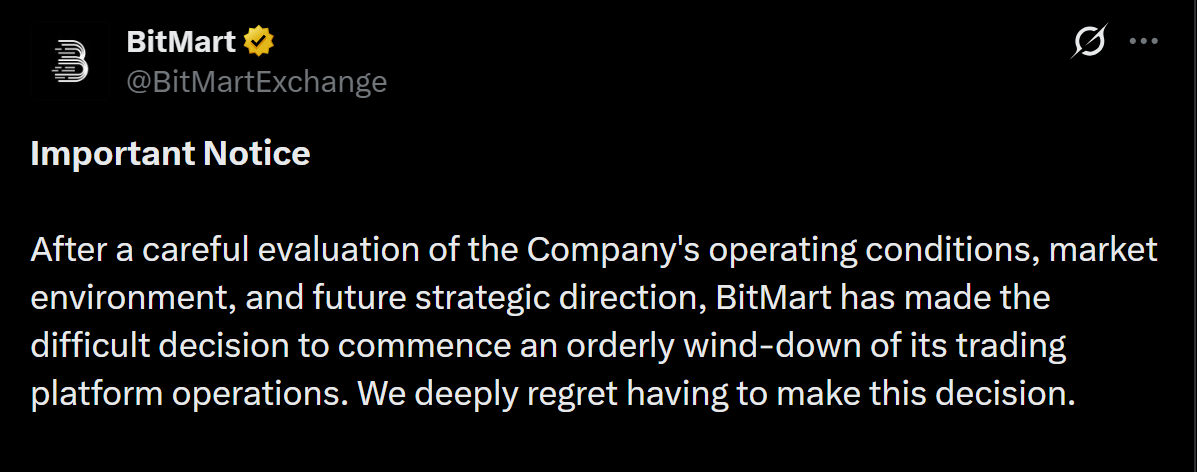
BitMart announced that it began winding down operations on the 26th of July. This included halting registrations, deposits, and new trading activity.
Ultimately, BitMart’s exit shows how sustained competitive pressure can steadily erode an exchange’s market position until operations become difficult to sustain.
The effects of the 2021 hack
That prolonged decline also became increasingly visible in BitMart’s on-chain metrics. Although the exchange promised to reimburse nearly $200 million after the 2021 security breach and resumed operations, user confidence and liquidity never fully recovered.

Instead, capital gradually shifted toward larger exchanges with stronger security records and deeper markets. At its peak, BitMart’s market capitalization neared $210 million in April 2024. This figure illustrated the scale of the platform’s operations.
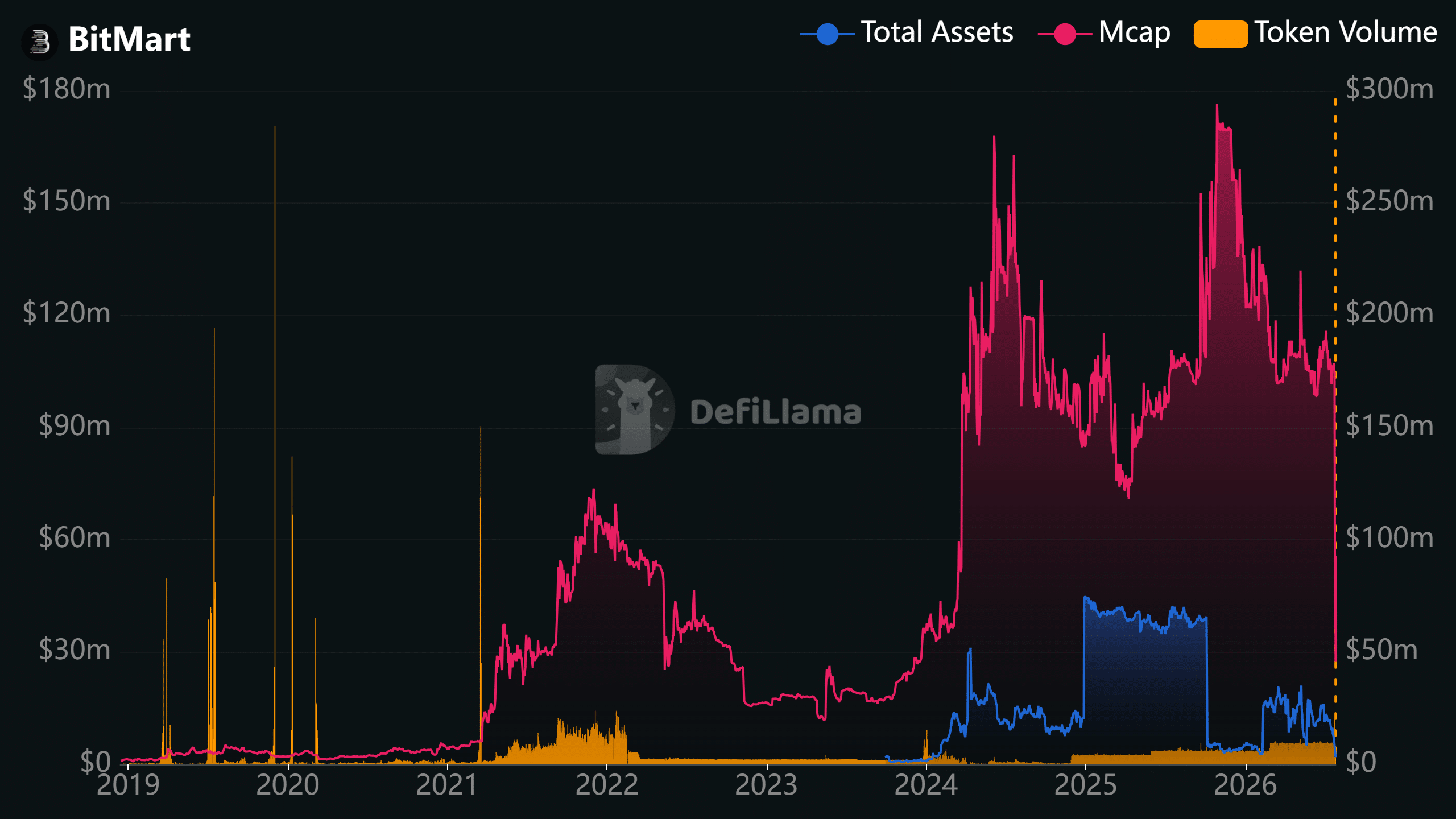
By press time, that figure had dropped to just $55.68 million. Daily token volume also stood at $6.16 million, reflecting a much smaller operating footprint.
Meanwhile, years of weaker liquidity pushed BitMart from the industry’s higher ranks into the high teens. That shift reinforced a steady migration of traders and capital toward dominant exchanges such as Binance, OKX, and Bybit.
The liquidity shift
BitMart’s closure also highlights how centralized exchange liquidity dynamics are becoming increasingly concentrated. According to CoinMarketCap data, the top five exchanges control roughly 55–70% of global trading activity.
In that pool, Binance alone accounts for around 25–35%. This level of concentration creates larger volumes, tighter spreads, and greater network effects for the larger players, which attract more users, investors, and institutional participants.
Meanwhile, this trend tends to challenge smaller exchanges, which face growing challenges as capital increasingly flows toward the largest venues. Rather than spreading across remaining mid-tier platforms, liquidity typically reinforces the leaders’ positions.
Smaller exchanges have become increasingly challenged by this trend as there appears to be less incentive for liquidity to flow from large exchanges into mid-tier exchanges.
This pattern raises the competitive scale for new entrants and recovering exchanges together. Ultimately, BitMart’s exit illustrates how industry consolidation now favors scale, making sustained competition increasingly challenging for smaller centralized exchanges.





Be the first to comment