



Michaël van de Poppe shared his view on Bittensor in a recent commentary, positioning the protocol as one of two infrastructure layer plays within AI that he considers worth attention at current valuations.
- Van de Poppe: Bittensor unique AI infrastructure play, target $1,000-$2,000.
- Token down 70-80% from peak while ecosystem expanded: valuation gap thesis.
- TAO trading at $271.6, attempting to reclaim SMA50 at $276: 1.6% gap.
- SMA100 at $254.5 held the most recent price drop: next support if SMA50 fails.
What Bittensor Actually Is
Based on publicly available information about the protocol, Bittensor is a decentralized machine learning network that operates through a system of sub-networks, each functioning as an independent AI marketplace where models compete to provide the most valuable outputs.
Participants stake TAO tokens to validate and reward useful intelligence across these sub-nets. Van de Poppe describes the architecture as genuinely unique among AI infrastructure protocols, citing the sub-net system as the feature that distinguishes Bittensor from simpler AI layer plays.
That architecture became a liability in April when one sub-net departed, triggering what van de Poppe describes as questions around governance protocols within Bittensor that required review and updates. Analytically, van de Poppe’s continued endorsement of Bittensor after that event suggests he read the governance response as adequate rather than as evidence of structural fragility, though he does not state this assessment explicitly in the commentary.
The Valuation Argument
Van de Poppe’s valuation argument is not technical: it is structural, built on the observation that a 70-80% token price decline while the protocol’s ecosystem expanded creates a gap between what Bittensor has built and what the market currently values it at.
He states the target directly: $1,000 or $2,000 from current levels would represent “fair value compared to the growth that it has seen.” Framing a $1,000-$2,000 price target as fair value rather than speculation is a specific analytical claim: it means van de Poppe believes the protocol’s ecosystem growth alone justifies a 10-20x move from current levels, independent of any broader market conditions. He applies the same framework to NIRS, which he identifies alongside Bittensor as the two infrastructure layer plays worth holding in the AI category.
.@CryptoMichNL shares thoughts on Bittensor ($TAO):
“I’m not surprised if for instance Bittensor goes to $1,000 or $2,000 from here.” pic.twitter.com/DuLCgkSKyT
— CoinDesk (@CoinDesk) May 22, 2026
What the Chart Shows Right Now
TAO is trading at $271.6 at the time of writing, up 2.41% on the session and attempting to reclaim the SMA50 at $276.0. The gap between current price and the SMA50 is $4.4, approximately 1.6% of current price. Analytically, whether the session closes above $276 will indicate whether the most recent recovery attempt has cleared its first moving average obstacle or stalled below it, though a single session close is not sufficient to confirm a structural change.
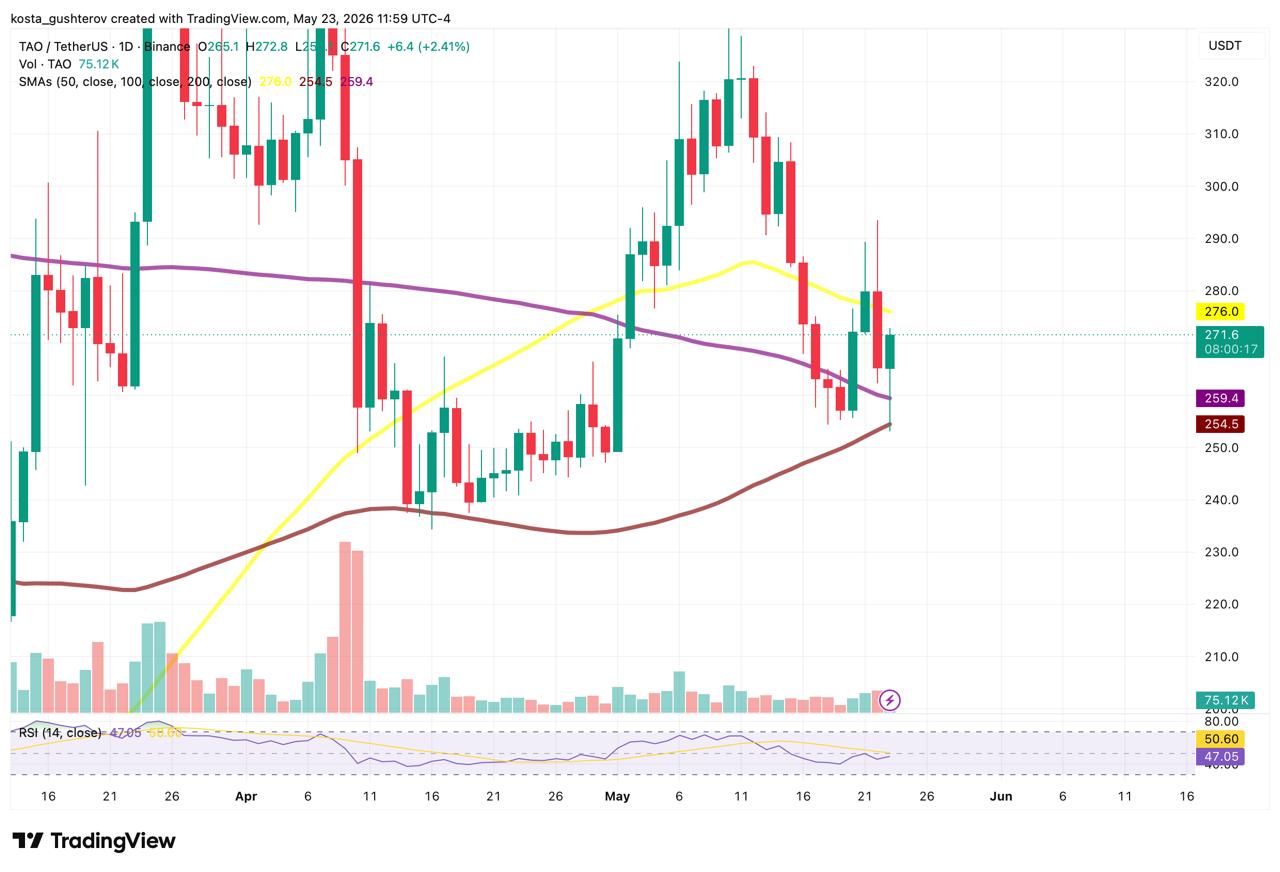
The SMA50 is declining from above while the SMA100 at $254.5 is rising from below. The most recent price drop found support at the SMA100 zone, with lows reaching approximately $254-255 before price recovered.
Between the SMA50 at $276 and the SMA100 at $254.5 sits the SMA200 at $259.4, declining and currently clustered near the SMA100. Analytically, if TAO fails to close above the SMA50 and pulls back, the SMA200 at $259.4 and SMA100 at $254.5 form a combined support zone separated by only $4.9. A rejection from the SMA50 would need to breach both MAs in that $254-259 cluster to extend the decline meaningfully below the recent structural low.
RSI at 47.05 with signal at 50.60 sits just below the 50 line with a 3.55-point spread. Momentum is neutral to slightly negative, consistent with a price attempting a recovery without yet having confirmed it.
If Bittensor’s sub-net count and network activity continue expanding through Q2 2026 without a further governance disruption, the valuation gap van de Poppe identifies will have persisted long enough to represent a structural condition rather than a temporary dislocation. If network activity stalls or another governance event triggers a further sub-net exodus, the ecosystem growth argument loses the evidence it depends on.
The information provided in this article is for educational purposes only and does not constitute financial, investment, or trading advice. Coindoo.com does not endorse or recommend any specific investment strategy or cryptocurrency. Always conduct your own research and consult with a licensed financial advisor before making any investment decisions.


Be the first to comment