


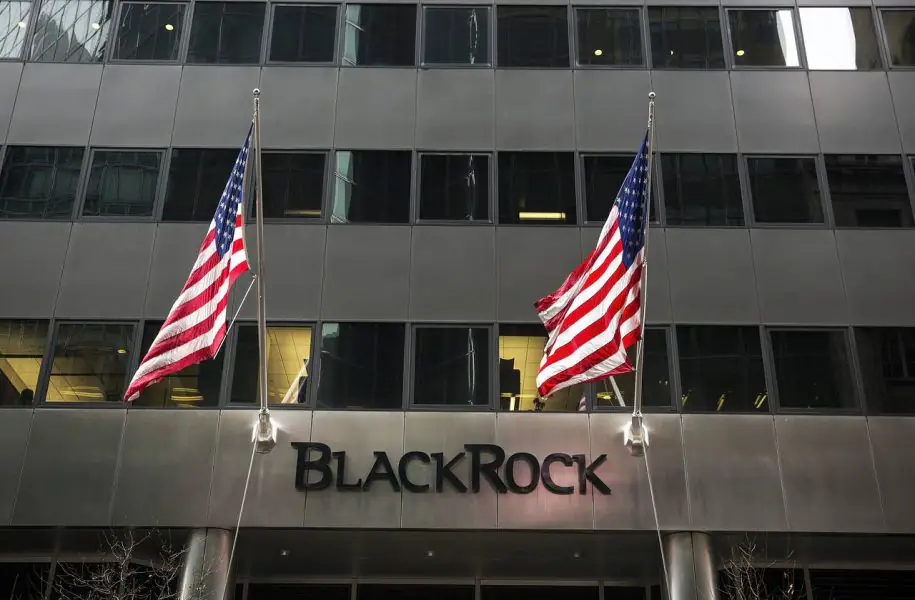
BlackRock’s tokenized funds already work as collateral on crypto exchanges, but Bloomberg reports that bank acceptance, market infrastructure and regulatory certainty still limit wider use.
Key Takeaways
- Crypto exchanges already accept BUIDL as collateral.
- Banks and regulators still limit wider use.
- A CFTC rule widened eligible fund collateral.
- Bank capital charges may deter acceptance.
Bloomberg’s report, carried by Moneycontrol, quotes Dan Maley, who oversees BlackRock’s Asia-Pacific cash business, on extending tokenized collateral beyond digital-asset markets, and PANews’s summary attributes the three constraints to him.
BUIDL, BlackRock’s first tokenized money-market fund, has grown to about $2.3 billion since its 2024 launch, PANews reports, but its holder base is small. On October 6, RWA.xyz data compiled by Eco showed $2.25 billion, third among tokenized Treasury funds behind Circle’s USYC at $2.41 billion and Ondo’s USDY at $2.30 billion, with 106 holders and a $5 million minimum.
Using a money fund as collateral takes four steps today
ISDA’s October 6 paper says using a money-market fund as collateral today means selling it for cash first. A tokenized fund could be pledged directly instead, if the receiver agrees to take it.
TODAY
1 Redeem fund shares
→
2 Receive cash
→
3 Post the cash
→
4 Receiver reinvests
TOKENIZED
1 Pledge the shares directly, if the receiver accepts them
Returning the collateral reverses the four steps. Source: ISDA, “Assessing Tokenized Money Market Funds as Eligible Collateral Under the ISDA CSA.”
Crypto venues already say yes
Securitize, which tokenizes BUIDL and acts as its transfer agent, announced in June 2025 that Crypto.com and Deribit would accept BUIDL as collateral. Binance has said it accepts it too, and OKX followed in April 2026. Securitize’s July 2026 release on BUIDL discloses that its broker-dealer arm is paid by BlackRock as the fund’s placement agent.
Acceptance comes with a discount. On March 25, 2026, Crypto.com cut its haircut on BUIDL from 2% to 1%, so a larger share of deposited BUIDL counts toward margin. It says availability, haircuts and eligibility vary by jurisdiction and can change.
What $100 million of BUIDL counts for, by haircut
The axis starts at $97 million, so the differences look larger than they are.
Crypto.com, before: 2%
$98.0M
Crypto.com, now: 1%
$99.0M
CFTC swap schedule: 0.5%
$99.5M
The CFTC’s 0.5% is for swap initial margin on a fund holding only securities under one year, so it isn’t like-for-like. Sources: Crypto.com; Chapman and Cutler.
One bank has done it, and another offers custody
The bank precedent dates from October 2023. JPMorgan’s Tokenized Collateral Network settled a live OTC derivatives trade in which BlackRock tokenized shares in one of its money-market funds and transferred them to Barclays as collateral. JPMorgan said the documentation was amended to support it.
In an April 28 joint release, OKX, BlackRock and Standard Chartered said OKX VIP and institutional clients can post BUIDL as collateral held off-exchange in regulated custody at the bank while trading on OKX Middle East. The release calls it the first time a globally systemically important bank has acted as custodian in such an arrangement, and says the collateral is segregated from OKX’s own assets. It gives no amounts, and it doesn’t say Standard Chartered lends against BUIDL.
The bank is also central to the fund Maley’s unit is bringing to Asia. BlackRock’s HKD Digital Liquidity Fund, authorised in Hong Kong in September, has Standard Chartered as trustee, custodian and administrator, and investors will be able to subscribe and redeem with fiat or HKDAP, a regulated Hong Kong dollar stablecoin issued by Standard Chartered-led Anchorpoint Financial.
What regulated banks still need
On July 13 the CFTC approved a final rule, effective August 17, that removes a restriction which had disqualified most money-market fund shares as initial-margin collateral for uncleared swaps. Law firm Chapman and Cutler says the change could widen the pool to about 72 Treasury funds, from as few as four, and sets fixed haircuts of 0.5%, 2% and 4% by portfolio maturity. It applies only to swap dealers outside the prudential regulators’ margin rules, and as of its August 3 alert the prudential regulators had not adopted parallel changes.
Capital is the other brake. A March 5 interagency FAQ from the Fed, OCC and FDIC gives tokenized securities the same capital treatment as untokenized ones, according to a July report from ISDA and Global Digital Finance. For a bank holding a money-market fund in its banking book, that can mean a minimum 20% risk weight, which the report says may make bank treasuries and smaller banks less willing to receive them. A survey by The ValueExchange, cited in the same report, found 44% of firms expect to accept tokenized money-market funds as collateral by the end of 2027.
The documents aren’t finished either. ISDA’s October paper says it is not a final statement and asks market participants for feedback on standard amendments, their format and their timeline. It doesn’t address commercial appetite, regulatory consistency or the enforceability of the tokenization structures on the market. Which record counts as the legal one, the token, a transfer agent’s register or a custodian’s books, changes how a counterparty takes control.
The July report tested collateral workflows in a sandbox with 48 firms and found existing US frameworks fit all three tokenization models on eight of ten legal and regulatory dimensions. The two exceptions were cleared variation margin, where money-market funds are excluded, and SEC initial margin, where there is no explicit guidance.
That analysis covers money-market funds registered under the Investment Company Act. BUIDL’s disclosures describe a privately offered fund that isn’t registered under that law, so the conclusions may not read across to it. The disclosures add that its shares aren’t bank deposits, carry transfer restrictions and give holders an interest in the fund rather than a claim on any particular asset in it. Moody’s gave BUIDL an Aaa-mf money market fund assessment on May 13, 2026, which Moody’s says is not a credit rating.
A token moves at night, but cash follows bank hours
A transfer can settle in minutes on a Sunday, but ISDA notes the standard collateral terms define business days around banks and settlement systems. Parties would need to amend them and confirm that transfers can happen when commercial banks are closed.
Circle added a smart contract in April 2024 that lets BUIDL holders swap shares for USDC, a digital-dollar exit. Dollars in a bank account take another conversion, and Circle now runs its own tokenized fund, USYC, which the Eco data rank first. Liquidity in tokenized markets is also a concern the IMF has raised.
What to watch
WHERE TOKENIZED BLACKROCK COLLATERAL STANDS
● Crypto exchanges · Accepted
Watch: whether haircuts keep falling after Crypto.com’s cut to 1%.
● Bank custody · Live framework
Watch: any amounts disclosed at Standard Chartered.
● Bank derivatives · 2023 pilot
Watch: a second named bank after Barclays.
● Swap dealers outside prudential rules · Eligibility widened August 17
Watch: whether a private fund like BUIDL qualifies. I found nothing saying it does.
● Banks under prudential regulators · Not yet
Watch: a parallel rule. None had been adopted as of early August.
● ISDA collateral documents · Consultation
Watch: standard amendments and a timeline.
For now the evidence comes mostly from crypto markets, with banks at the edges.
This article is provided for informational purposes only and does not constitute financial, legal or investment advice.



Be the first to comment