



In brief
- Brazil’s crypto market hit a record R$505.5 billion ($98.7 billion) in 2025, up more than fivefold from R$94.9 billion in 2020, according to Receita Federal data.
- Itaú now offers 15 cryptoassets and Nubank lists 28, while Banco do Brasil says its bitcoin and Ethereum service has moved more than R$11 million ($2.1 million) since January.
- Central Bank filings reviewed by Folha show zero proprietary crypto holdings at Brazilian banks as of March 2026, even as client-facing crypto shelves keep growing.
Itaú, Brazil’s largest bank by assets under management, now sells clients 15 different crypto assets through its investment app, including Bitcoin, Ethereum, and the dollar-pegged stablecoin USDC.
Nubank, Brazil’s largest fintech, lists 28. Banco do Brasil, Brazil’s most lucrative public bank, which started letting customers buy Bitcoin and Ethereum directly in January, told Folha de S.Paulo the service has already moved more than $11 million reals ($2.1 million) in transactions.
None of that money touches the banks’ own balance sheets. Central Bank filings dated March 2026 and reviewed by Folha show zero holdings of virtual assets on the books of Brazilian banks, even though institutions can custody and process crypto on clients’ behalf.
The shelf-stocking is recent. Since last year, Itaú, Bradesco, Santander, Banco do Brasil and Nubank have all expanded their crypto lineups, tracking a record run in the underlying market. Brazilians moved R$505.5 billion ($98.7 billion) through crypto in 2025, according to Receita Federal data, Brazil’s federal tax authority—more than five times the amount recorded in 2020.

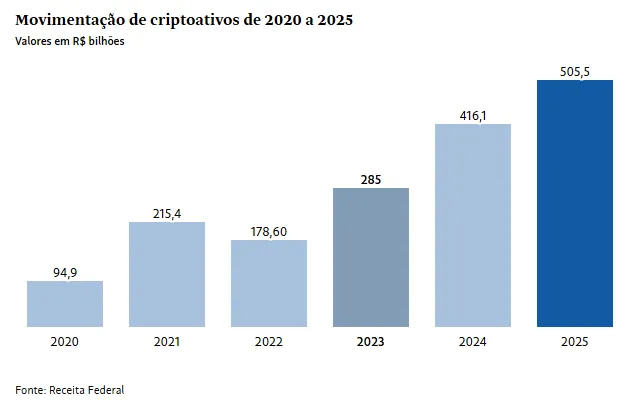
Companies did most of the moving. Corporate crypto transactions totaled R$497 billion ($97 billion) last year—98.3% of the volume Receita Federal tracked—with individual investors accounting for the rest.
Regulation clears the runway
The expansion tracks a regulatory shift. Brazil passed its Legal Framework for Virtual Assets in 2022, handing the Central Bank authority over the sector, and three resolutions the bank published in November 2025 gave that authority teeth. Any firm that lets customers trade, hold, or send crypto now needs a license, a minimum capital cushion, and segregated client accounts, with an October 30 deadline to comply.
One of those rules, Resolution 521, treats any purchase or exchange of a dollar-pegged token as a foreign exchange operation, the same reporting bar applied to sending money abroad. That change pulled stablecoins, crypto’s dollar substitutes, squarely into the Central Bank’s line of sight.
That clarity is what convinced banks to move, Carlos Akira Sato, co-founder of consultancy Syscapital, told Folha. Brazilian banks are typically conservative about new markets, he said, and clearer rules left them “more secure to launch their products.”

BitcoinBTC · USD
$79,236−0.9%
08:45 PM02:45 AM08:45 AM02:30 PM08:30 PM
$80.4k$79.8k$79.3k$78.8k
24h HighHigh$80,494
24h LowLow$78,707
VolVol$906.5M
Market projectionsOdds by Myriad
Banco Safra, a smaller bank known for focusing on high net worth clients, took the boldest swing, issuing its own dollar-pegged stablecoin, Safra Dólar, in September 2025 and keeping full custody in-house. The bank markets it as a way for clients to hold dollar exposure without opening an account abroad. It fits a broader pattern of banks building stablecoin rails themselves rather than handing that business to crypto-native firms.
Proprietary exposure only exists, he said, when a bank buys crypto with its own money and absorbs the price, liquidity, and credit risk that comes with it. By that standard, none of Brazil’s banks have crossed into ownership yet.
Selling crypto to clients who ask for it is different from betting the bank’s own money on it. With roughly 120 crypto firms operating in Brazil, most still without a license, racing to meet that October 30, 2026 deadline, the banks that already cleared the compliance bar are the ones with room left to keep adding to the menu.
Daily Debrief Newsletter
Start every day with the top news stories right now, plus original features, a podcast, videos and more.



Be the first to comment