


The supply of Ethereum [ETH] was reduced when a whale removed 5,300 ETH valued at $9.98 million from Kraken. The transaction prolonged the accumulation activity of the wallet while shifting another large ETH position off an exchange.
Historically, such withdrawals decrease ready exchange balances whenever holders keep their assets out of trading platforms. Notably, the 9.98 million transfer was consistent with a larger demand signal and not a single transfer.
However, the withdrawals alone did not ensure an immediate price reaction since the accumulated ETH might be inactive over a long period of time.
Spot buyers reinforce the demand argument
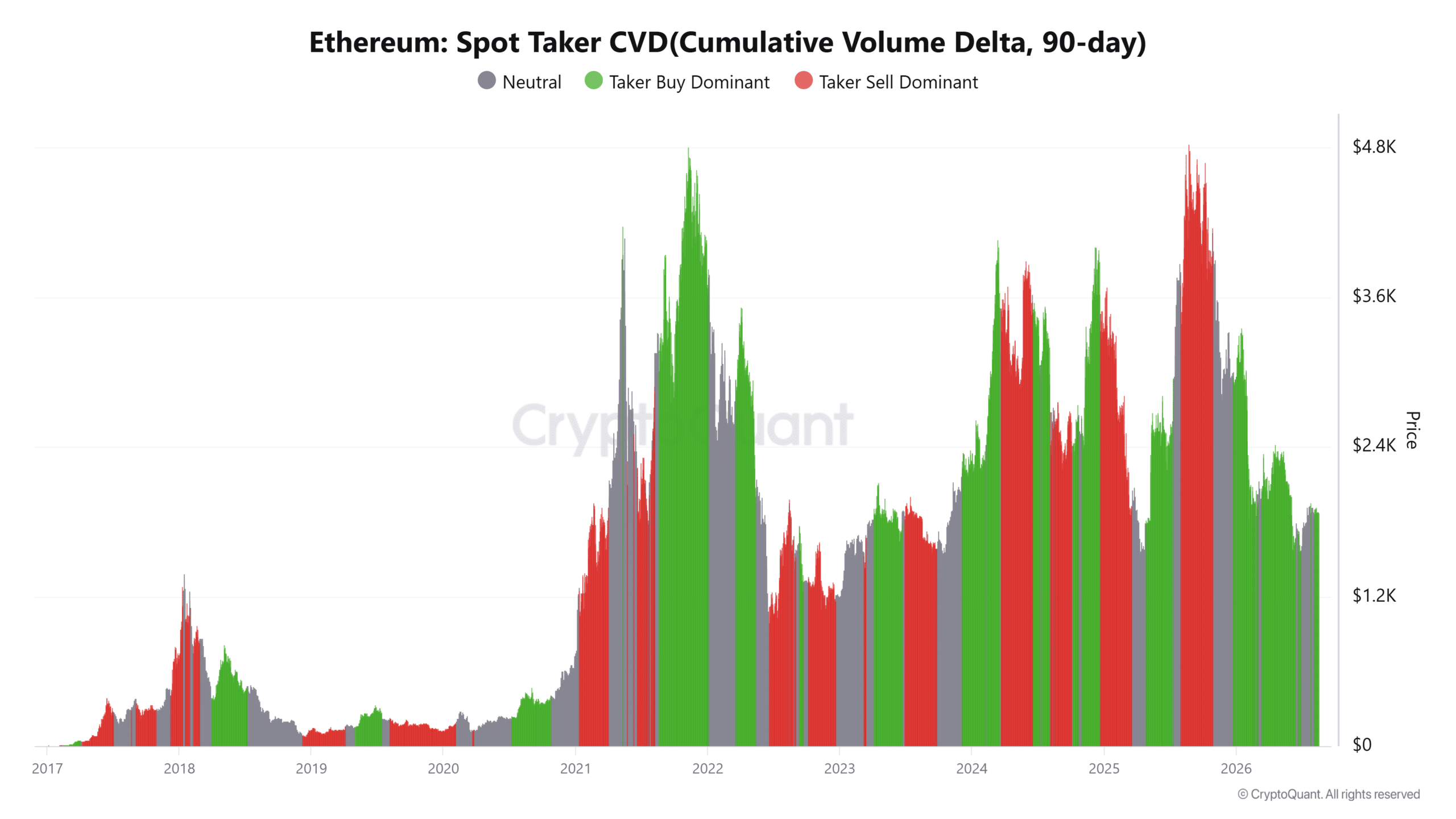
Spot Taker CVD had turned buyer-dominant after spending some time in the neutral territory throughout the three-month period, further strengthening Ethereum’s accumulation narrative. Buyer dominance meant that takers had crossed the spread more aggressively to buy ETH than sellers had to leave.

Importantly, this activity was complementary to the whale withdrawal since both measures were directed towards demand, rather than exchange-side distribution.
Exchange withdrawals usually limit tradable holdings, as aggressive purchases by takers compete with liquidity already available in the spot markets. Therefore, continued buyer dominance could amplify the effect of shrinking accessible supply during stronger trading periods.
However, the market still needed sufficient demand to take in sellers close to established resistance. Prolonged taker control would definitely enhance the likelihood of accumulation translating into significant price growth.
Record staking constrains the ETH supply
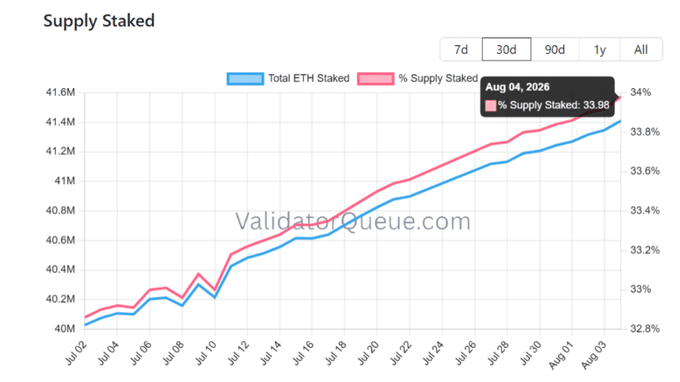
Ethereum’s staking total climbed beyond 41 million ETH, reaching a record while absorbing more than one-third of Ethereum’s circulating supply. The staking data placed the share of staked ETH around 33.8%, following a persistent climb throughout July.
In contrast to normal wallet accumulation, staking directly pledged large amounts of holdings towards network participation as opposed to direct market trading. Therefore, the staking surge introduced structural weight to the supply terms produced by huge withdrawals of exchanges.
Meanwhile, whale accumulation added another source of reduced exchange accessibility. These forces did not necessarily lead to an increase in prices, as the demand still dictated the impact of scarcity on valuation.
Will buyers finally break Ethereum above 1,950?
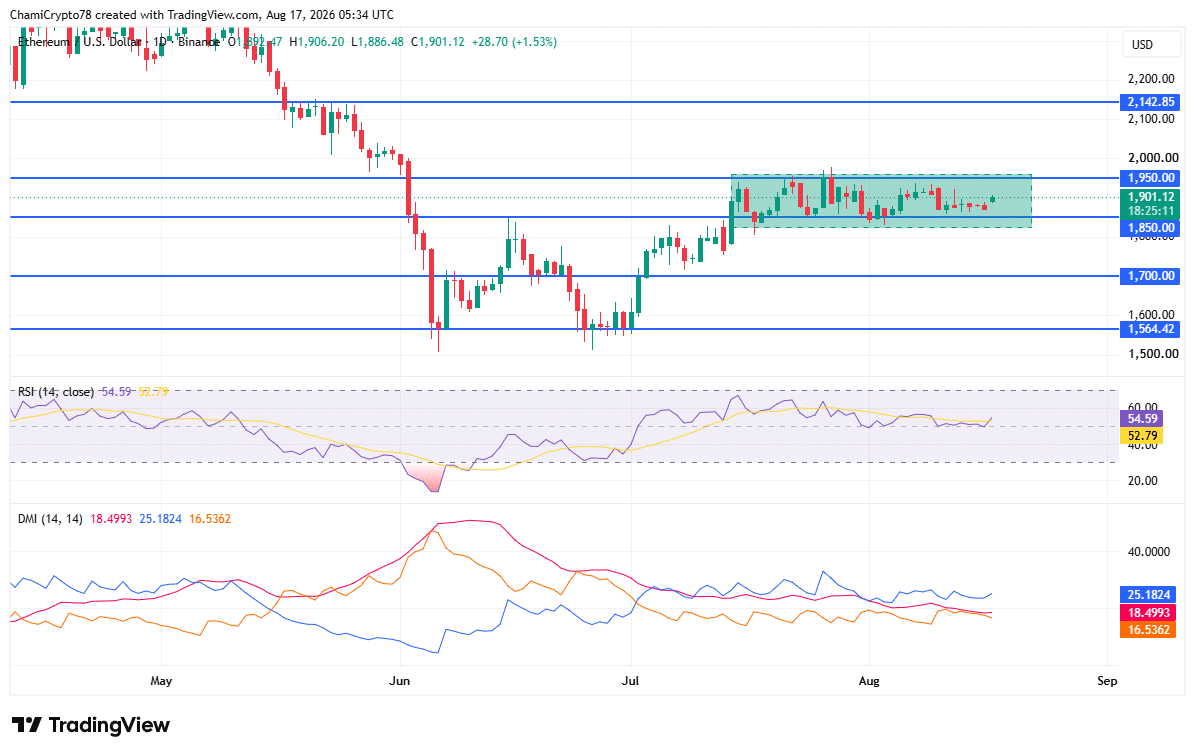
At the time of analysis, Ethereum [ETH] was trading at approximately $1,901 following several attempts to consolidate in the 1,850-1,950 range.
Price was close to the upper half of the range, with buyers being closer to resistance than the bottom. Notably, +DI reached 25.18, exceeding the 16.54 -DI reading and giving buyers the directional advantage as of writing.
However, ADX was close to 18.50, which means that directional strength was not strong enough to have a convincing trend expansion. Besides, RSI provided another positive indication at 54.59, which is above its 52.79 average and neutral zone.
Ultimately, the underlying supply dynamics are increasingly having an impact on this technical structure. The fact that whales are pulling out of exchanges and adding to staking contracts indicates a constrained circulating supply.
The condition may increase upside moves in case demand remains strong. In a case where this supply squeeze is coupled with a confirmed breakout above 1,950, price discovery may occur at a faster pace than the current momentum readings suggest.
Eventually, the likelihood of Ethereum challenging the 2,100-2,200 area will increase. On the other hand, should whale distribution return or inflows revert to exchanges, the increased supply may limit upside efforts and support the current range, postponing any significant breakout.
Final Summary
- Whale withdrawals and record staking continue reducing ETH available across the liquid market.
- Buyer-dominant taker activity could strengthen ETH’s chances of breaking above $1,950.



Be the first to comment