



The US Strategic Bitcoin Reserve already exists as an executive-order framework for retaining government-held Bitcoin. ARMA would seek to codify it in law and potentially extend it into an active accumulation strategy — with major implications for Bitcoin’s supply dynamics, reserve-asset status and the next phase of sovereign adoption.
The US Strategic Bitcoin Reserve (SBR) returned to the headlines on April 27, 2026 after Congressman Nick Begich (R-Alaska) announced imminent plans to reintroduce the BITCOIN Act under a new name: the American Reserves Modernization Act, or ARMA.
The news came on the same day Patrick Witt, executive director of the President’s Council of Advisors for Digital Assets, said the White House is set to make a “major announcement” on the reserve within a similar timeframe.
Together, the comments return attention to the gap between the reserve in its current form and what supporters hope it will soon become: something far more structured and durable under law, rather than an administrative framework around Bitcoin already in government possession, with only vague plans to acquire more.

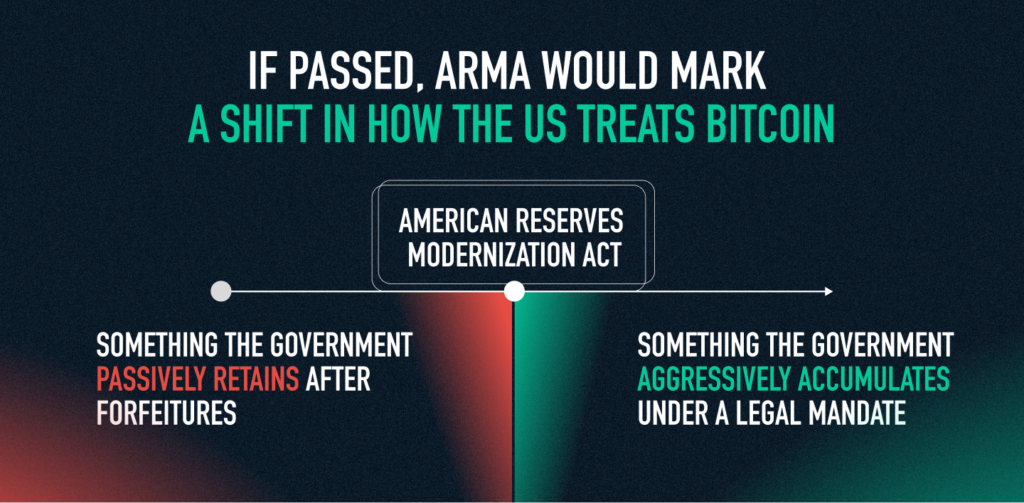
Should ARMA pass, it would mark a significant shift in how the US treats Bitcoin, transforming it from something the government passively retains after forfeitures, to something it aggressively accumulates under a congressionally approved legal mandate — with major consequences for Bitcoin as a reserve asset and global supply dynamics.
From Retention to Accumulation
The SBR was created by President Trump in March 2025 with Executive Order 14233. The order essentially allowed Bitcoin accumulated by the US government through criminal and civil forfeiture to be placed into the reserve, although some holdings remain subject to legal dispute and the final size of the reserve has yet to be fully determined. It also allowed officials to explore “budget-neutral” strategies to accumulate more.
The White House’s upcoming announcement could potentially provide an important breakthrough in relation to such strategies, while further clarifying operational and legal details related to managing existing holdings.
Any such announcement would provide a welcome boost to supporters of the SBR. It would not, however, remove the need for legislation to make the reserve a durable element of US policy, capable of surviving a single administration.
First introduced by Senator Cynthia Lummis (R-Wyo) in 2024 and reintroduced in the current Congress with support from Begich, the BITCOIN (Boosting Innovation, Technology and Competitiveness through Optimised Investment Nationwide) Act was designed to codify the reserve and expand it beyond the passive retention of seized Bitcoin. Its core proposal was for the Treasury to acquire up to 200,000 BTC per year for five years, with the acquired Bitcoin held for a minimum of 20 years and non-disposable, except to reduce federal debt. The obvious question is how such a programme could be funded without conventional taxation or new borrowing, an issue the bill tries to address through budget-neutral mechanisms including Federal Reserve remittances and gold-certificate revaluation.
ARMA represents the next attempt to move that framework forward. Set to be reintroduced after consultations with members of the House Financial Services Committee and other influential stakeholders, the revised text of the bill has not yet been published, so it remains unclear which provisions will survive.
If, however, it preserves the core of the BITCOIN Act, the SBR would become something much more ambitious than a stockpile of forfeited coins, transforming into a statutory framework for long-term sovereign accumulation. At a minimum, the rebranding suggests a renewed push to make the proposal more politically legible and, ultimately, more likely to pass if and when it reaches a vote.
The Supply Question
A five-year programme to acquire 1,000,000 BTC would make the US government one of the largest buyers in Bitcoin’s history. More importantly, the annual target of 200,000 BTC would exceed the network’s current total yearly issuance. Since the 2024 halving, Bitcoin produces roughly 3.125 BTC per block, or about 450 BTC per day. Over a full year, that comes to roughly 164,000 BTC, with issuance set to fall again after the next halving expected in 2028.
In other words, the proposed annual purchase target is larger than the amount of new Bitcoin mined each year. Even if purchases were spread evenly, the Treasury would need to source around 550 BTC per day. Mining output alone could not satisfy that demand, meaning any serious acquisition programme would have to draw coins from existing holders, institutional inventories, OTC desks, miners’ reserves and exchange liquidity.
The bullish case for Bitcoin is clear, given that a sovereign buyer of that size would create persistent, price-inelastic demand, while removing the acquired coins from circulation for at least 20 years. It would also strengthen the argument for Bitcoin as a global reserve asset, while potentially creating competitive pressure as governments worldwide seek to acquire Bitcoin for themselves.
The same dynamic, however, would make the programme difficult to execute. If markets believed the US was legally committed to buying more Bitcoin than the network produces each year, holders would have little reason to sell cheaply, making later purchases progressively more expensive — potentially beyond what Congress and the public would be willing to tolerate.
In other words, the clearer the mandate becomes, the harder it may be to fulfil at acceptable cost.
The Funding Problem
How the purchases would be funded is therefore just as important as the size of the target. Both the executive order and the existing BITCOIN Act framework rely on the idea of budget-neutral accumulation, meaning Bitcoin purchases would not be funded through conventional taxation or new government borrowing. The difference is that the executive order leaves those strategies largely undefined, while the BITCOIN Act attempts to specify how such a programme could work.
The first mechanism would draw on Federal Reserve remittances, capped at $6 billion per year for Bitcoin purchases during fiscal years 2025 through 2029. The second relates to gold certificate revaluation. The US Treasury still carries its gold at the statutory price of $42.22 per ounce, far below market value. According to the proposed act, Treasury would reissue gold certificates at market value, with the difference creating accounting capacity that could be used for Bitcoin purchases.
On paper, this avoids a conventional tax increase or new bond issuance. In practice, it is much more complicated. Treasury Secretary Scott Bessent has already said the administration is “not revaluing the gold,” while critics would likely see such a move as more than neutral bookkeeping. Revaluing gold could blur the line between Treasury and Fed balance sheets, raise questions about inflation expectations and confidence in the dollar, and create a precedent for using accounting changes to fund politically contested asset purchases.
Other possible budget-neutral routes are no easier. Ideas such as using the Exchange Stabilization Fund or emergency liquidity facilities have already drawn political pushback, underscoring that the funding issue is not just technical. For ARMA to become more than a statement of intent, supporters will need to show not only that the US should buy Bitcoin, but that it can do so through a funding mechanism that Congress, the Treasury, the Federal Reserve and the public are willing to accept.
Why Legislation Matters
An executive order can be reversed by the next administration without congressional approval, a point made directly by Begich at Bitcoin 2026 as he highlighted the need to “lock in the gains.” Should ARMA pass, it would enshrine the reserve in statute, making it meaningfully harder to unwind.
That durability is what makes the legislative push so important. Gold’s role in the US financial system was never simply a function of its scarcity or its price. It was built on legal architecture, including statutory holding requirements, audit obligations and an explicit place on the sovereign balance sheet. ARMA would begin building that same kind of legal architecture around Bitcoin, not as a loose analogy to gold, but as a deliberate act of institutional design.
That would represent something qualitatively different from an ETF approval or a corporate treasury allocation, prompting central banks, sovereign wealth funds and institutional allocators to reconsider how they think about their own Bitcoin exposure. Not simply because of the price, but because of the central role given to it by the world’s largest economy.



Be the first to comment