


Chainlink price has fallen nearly 5% toward $13.35 as LINK traders weigh cooling momentum against new institutional products and a limited rise in new Ethereum-based addresses.
Summary
- LINK trades near $13.35 after falling 4.74% daily while seven-day losses stand at 7.09% currently.
- Chainlink launched CCIP 2.0 on September 28 with configurable security, compliance, fees and execution controls.
- Santiment found new Ethereum-based LINK addresses rose under 2% despite September’s roughly 24% price increase.
- Analyst Giannis Andreou identifies 15–16 as first resistance, followed by 20–23 and 28–31 resistance zones.
- Chainlink Fulcrum connects institutional financing workflows across public and private blockchains without taking asset custody.
CoinGecko shows LINK near the mid-$13 range on Oct. 7 after the token traded as high as $14.11 during the latest 24-hour period. The supplied CoinGecko snapshot places the decline at 4.74% over 24 hours and 7.09% over seven days, with trading volume near $322.5 million.

The token’s circulating supply stands near 750 million LINK, giving Chainlink a market capitalization close to $10 billion. CoinGecko ranks LINK among the 15 largest cryptocurrencies by market value.
Chainlink price faces 15–16 as first major test
LINK’s short-term indicators have weakened after its latest recovery attempt. The supplied chart places price around $13.38, slightly below the Bollinger Bands middle line near $13.66.
The upper Bollinger Band sits around $15.32, while the lower band is close to $12.00. Price therefore remains between the two outer bands, with $12 serving as the next technical area below the current market level if selling continues.
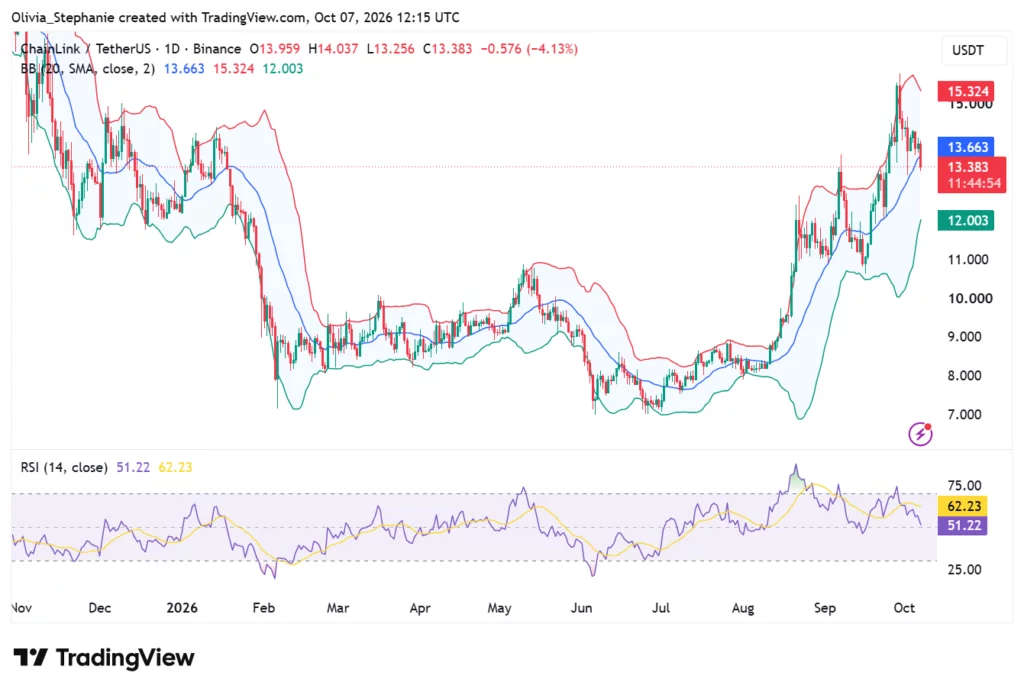
RSI stands near 51.17, slightly above the neutral 50 level but well below its moving average around 62.23. The reading shows that the earlier upward momentum has cooled without pushing RSI into bearish or oversold extremes.
Crypto analyst Giannis Andreou identified 15–16 as the first resistance zone in his weekly setup. He said a weekly close above the area followed by a successful retest could put 20–23 into focus.
His chart places a descending resistance line around the second zone. Above it, Andreou identified 28–31 as another historical resistance area before a hypothetical move toward $40 and LINK’s previous all-time high near $53.
Those levels remain an analyst scenario, not a forecast of confirmed future prices. On the downside, Andreou identified 10–12 as support and said losing that range could expose the earlier 7–8 base.
Michaël van de Poppe offered a more bullish long-term view, saying LINK was still building momentum as established crypto protocols develop products with real users. His comments represent an analyst’s valuation view and do not establish a price target.
LINK wallet growth trails its September price rise
Santiment’s latest network data provide a different reading of LINK’s recent recovery.
Santiment reported that LINK climbed from $11.22 at the Sept. 1 close to $13.96 on Oct. 6, an increase of roughly 24%. New Ethereum-based LINK addresses did not rise at the same pace.
New LINK addresses averaged 1,249 per day during the four weeks through Oct. 6, compared with 1,225 daily during the preceding four-week period. Santiment calculated the increase at less than 2%.
For comparison, the analytics firm said Solana’s new addresses increased 33% during a period when SOL rose approximately 20%. Ethereum’s new-address count was broadly flat while ETH gained around 11%.
Santiment noted an important limitation in its LINK figures: the measurement covers LINK activity on Ethereum mainnet. Tokens bridged through Chainlink CCIP or accessed through other investment products are not captured in that address count.
The data therefore measure one part of Chainlink network participation and do not establish whether total LINK usage across every supported network has risen or fallen.
CCIP 2.0 gives Chainlink new institutional controls
While LINK’s price has weakened, Chainlink has released several infrastructure products aimed at financial institutions.
Chainlink launched CCIP 2.0 on Sept. 28 with optional tools that let institutions and token issuers configure how cross-chain transfers are verified and executed. The upgrade includes Cross-Chain Verifiers, customizable fees and built-in compliance functions.
CCIP 2.0 supports faster-than-finality transfers for users willing to set different confirmation parameters. Chainlink kept full finality as the default setting, while institutions can select execution and verification options based on their own requirements.
The upgrade arrived alongside Chainlink’s work with Swift. In related crypto.news coverage, Chainlink said financial institutions can connect existing systems to Swift’s blockchain ledger using the Chainlink Runtime Environment.
The model lets institutions retain control of transaction-signing keys while CRE coordinates workflows between bank systems and Swift’s ledger. Seventeen banks across six continents are preparing live pilots using tokenized deposits, according to the report.
Chainlink’s institutional work extends beyond payment messaging. The company has partnered with Bottomline, a payments provider serving more than 600 banks and processing over $16 trillion annually. As crypto.news previously reported, CCIP handles interoperability while CRE coordinates blockchain payment workflows with existing banking systems.
Chainlink Fulcrum targets cross-chain financing
Chainlink introduced Fulcrum on Sept. 30 as infrastructure for financing and collateral management across public and private blockchains.
The company said Fulcrum separates the venue where a financing agreement is managed from the networks where cash and collateral settle. Participants can choose collateral, set financing terms and coordinate cross-chain settlement through a common gateway.
Chainlink says Fulcrum does not custody assets, become a counterparty or operate a trading venue. Financing agreements remain between participants and are governed by the venues integrated with the product.
At Sibos 2026, Chainlink and DTCC demonstrated a cross-chain securities financing transaction using the system. Chainlink’s Runtime Environment coordinated the workflow, CCIP connected participating networks, and Data Streams supplied information used to value collateral.
Fulcrum is being integrated with existing financing venues and other traditional finance environments that Chainlink says are preparing to launch. No public data reviewed for this report specify how much transaction volume Fulcrum currently processes.
Institutional collateral work has been developing separately at DTCC. In related crypto.news coverage, Citi reported that 77% of surveyed financial institutions expected to use some form of tokenized collateral during 2026. DTCC’s Collateral AppChain, which is working with Chainlink infrastructure, is expected to enter production in the fourth quarter.
LINK’s current technical setup leaves the 15–16 zone as Andreou’s first resistance area, while the supplied Bollinger Bands place lower support around $12. A move below that level would bring the analyst’s wider 10–12 support range into focus.
Disclosure: This article does not represent investment advice. The content and materials featured on this page are for educational purposes only.


Be the first to comment