



PYUSD went live natively on Polygon as its market cap sits 32% below March’s peak. Why the launch is about payment utility, and what it’s up against.
Key Takeaways
- PYUSD is now minted natively on Polygon by Paxos, not bridged from another chain.
- Polygon has settled over $2.6 trillion in stablecoin transactions at ~$0.002 per transfer.
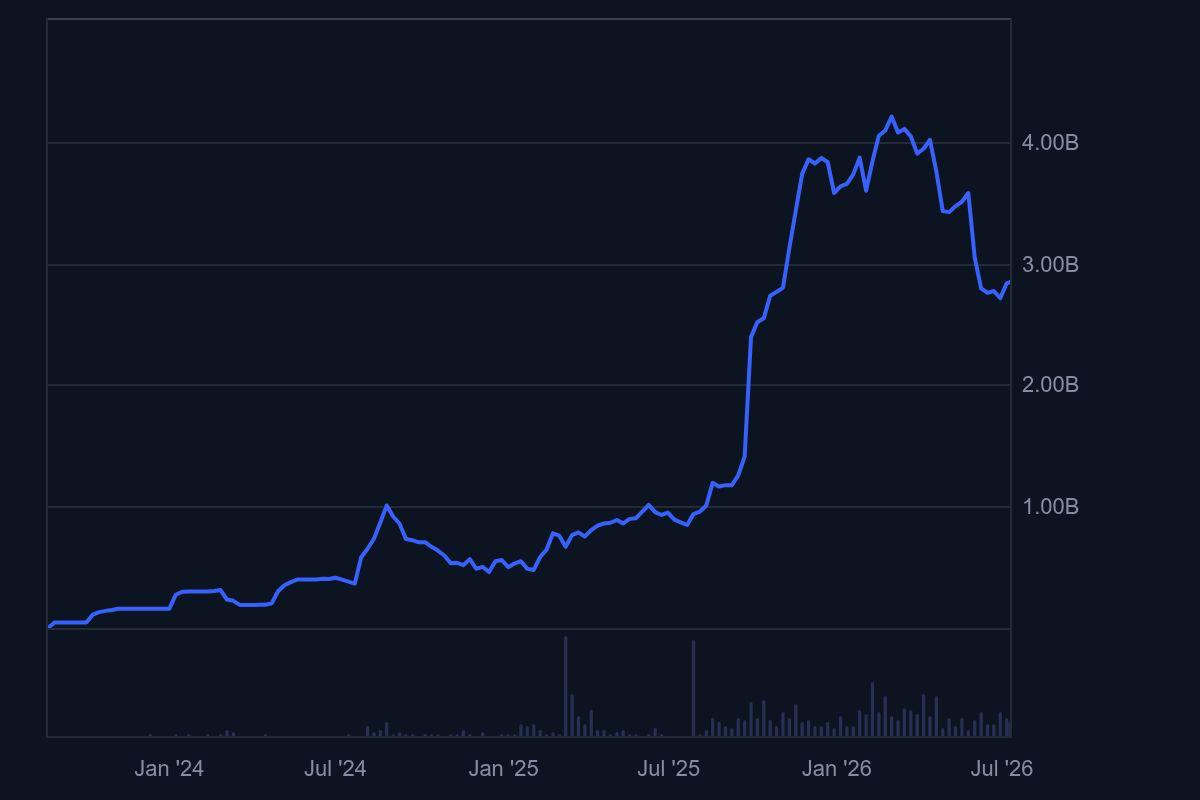
- PYUSD market cap fell from $4.20B in March to $2.84B on July 9.
Native issuance means Paxos mints PYUSD directly on Polygon, as it does on Ethereum and Solana. The alternative, bridging, locks tokens on one chain and issues IOU copies on another, adding infrastructure that has historically been crypto’s biggest hacking target. Native minting removes that risk layer and keeps redemption a one-step claim on Paxos.
The regulatory wrapper is the enterprise selling point. Paxos issues PYUSD under a national trust charter supervised by the Office of the Comptroller of the Currency, the federal regulator of US banks, with reserves in segregated, bankruptcy-remote accounts, legally walled off from Paxos itself. Among major stablecoins, that federal charter puts PYUSD in a smaller club than the market-cap tables suggest.
What Polygon Adds
The integration runs through Polygon’s Open Money Stack, which bundles wallets, regulated fiat on- and off-ramps, compliance tooling, and cross-chain routing into one setup: a business can accept PYUSD, pay across a border, and cash out to a local bank without stitching together separate vendors. Polygon Labs CEO Marc Boiron framed it simply: “A stablecoin is only as useful as the places it can go.” Businesses, he added, get inflows, cross-border movement, and cash-out in one integration with compliance built in.
The economics are where the case stops being marketing. Polygon has settled more than $2.6 trillion in stablecoin transactions, currently processes close to $3 billion in settlements daily, and lands transfers in under two seconds at roughly $0.002 each.
Paxos’s own payments platform provides the benchmark: $1.3 billion in processed volume cost under $700 in total gas fees, against an estimated $32.5 million the same volume would cost in card interchange. That is not a saving; it is a different cost category.
The Gap Between Availability and Adoption
The counter-argument starts with PYUSD’s own trajectory. According to CoinMarketCap, supply peaked near $4.20 billion in early March and has contracted by roughly a third since, even with PayPal paying US holders a reward rate near 4% to hold it. A stablecoin shedding supply while paying for retention has a demand problem that chain expansion alone does not fix. PYUSD has been on Ethereum since 2023 and Solana since 2024; availability was never the binding constraint.
The competitive math is harsher. Tether’s USDT circulates above $180 billion and Circle’s USDC dominates regulated institutional flows, both already entrenched on Polygon itself. PayPal’s real edge, over 400 million accounts, 35 million merchants, and the Xoom remittance rails, has existed since launch and has so far produced a top-five stablecoin, not a top-two one.
And the Open Money Stack cuts both ways: infrastructure that routes any compliant dollar token interchangeably is good for businesses and quietly commoditizing for issuers. If tokens become interchangeable at the point of payment, the winner is the rail, not the coin.
The measurable test is PYUSD transfer volume and supply growth on Polygon over the next two quarters, against a market cap that needs to stop shrinking first. PayPal has now assembled every piece of infrastructure a payments stablecoin needs. What it has not shown is the payment volume, and no chain launch substitutes for it.
The information provided in this article is for educational and informational purposes only and does not constitute financial, investment, or trading advice.



Be the first to comment