



Stablecoins have evolved far beyond their original role as settlement assets for cryptocurrency trading. With the total stablecoin market exceeding $310 billion, growing institutional participation, record on-chain payment activity, and regulatory progress in major jurisdictions, several financial institutions now project the market could expand well beyond its current size over the next decade.
Forecasts vary considerably. While conservative estimates from JPMorgan place the market between $500–600 billion by 2028, to U.S. Treasury Secretary Scott Bessent that suggested stablecoins could reach $3 trillion by 2030. Although these projections differ, they are based on a common assumption: regulatory clarity will encourage broader institutional participation and accelerate real-world adoption.
However, regulation alone is unlikely to produce trillion-dollar growth. The reviewed evidence consistently indicates that long-term expansion depends on several interconnected drivers, including payment utility, banking integration, enterprise treasury adoption, tokenized assets, and continued demand for digital dollar settlement. Regulation provides the legal foundation for these developments but does not create demand independently.
This report evaluates whether current evidence supports the trillion-dollar thesis by examining market data, regulatory developments, institutional adoption, payment infrastructure, and long-term forecasts.

1. Why Has the Trillion-Dollar Stablecoin Narrative Emerged?
The discussion surrounding a trillion-dollar stablecoin market has intensified because several structural trends are developing simultaneously rather than independently. The market has expanded beyond cryptocurrency trading into payments, cross-border settlement, treasury management, and tokenized finance, while governments are beginning to establish dedicated regulatory frameworks.
Unlike previous crypto cycles that relied heavily on speculative trading activity, current growth is increasingly supported by measurable economic usage.
Major Long-Term Market Forecasts
| Organization | Forecast | Timeline |
| Coinbase | $1.2 trillion | End of 2028 |
| JPMorgan | $500–600 billion | 2028 |
| Standard Chartered | $2 trillion | 2028 |
| Citigroup | $1.9 trillion (Base Case), $4 trillion (Bull Case) | 2030 |
| U.S. Treasury Secretary Scott Bessent | $3 trillion | 2030 |
| Morningstar | $1.45 trillion | 2035 |
Although these projections differ substantially, nearly all assume that stablecoins become increasingly integrated into mainstream financial infrastructure rather than remaining limited to digital asset markets.
Importantly, no institution argues that regulation alone will produce this growth. Instead, regulation is viewed as the catalyst that enables broader institutional participation, while payments, commerce, and enterprise adoption determine whether these projections become achievable.
2. Current Market Shows Strong Momentum, But Market Capitalization Tells Only Part of the Story
Current market size alone provides an incomplete picture of stablecoin adoption.
Although DeFiLlama reports total stablecoin supply at approximately $310 billion, Loading profile preview ‘s on-chain data shows that this consists of two distinct categories:
| Stablecoin Category | Supply |
| Fiat-backed Stablecoins | $284.5 billion |
| Crypto-backed & Algorithmic Stablecoins | $25.5 billion |
This distinction is important because fiat-backed stablecoins account for the overwhelming majority of real-world payment activity and institutional adoption.
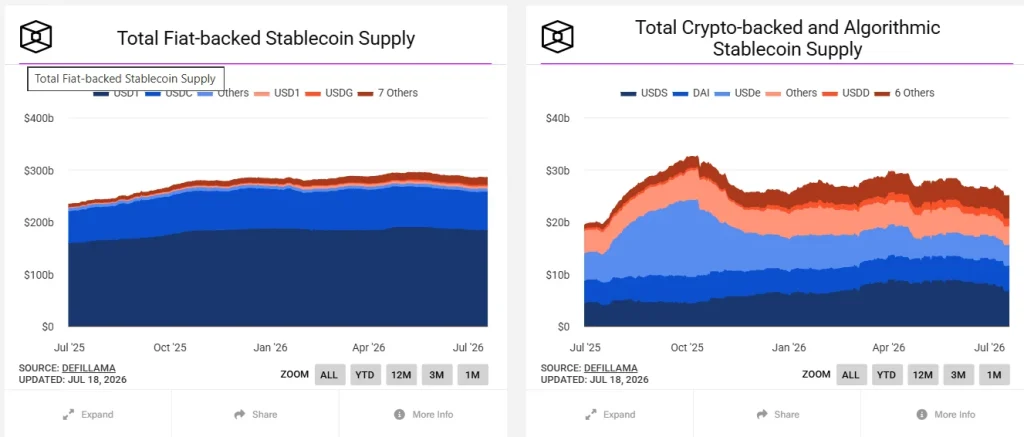
USDT and USDC continue to dominate the market, but their operating structures differ considerably. Circle operates from the United States under a more regulated environment, whereas Tether which is controlling approx 59% of total stablecoin supply is headquartered in El Salvador.
The concentration of offshore issuance is largely a consequence of regulatory arbitrage. Offshore issuers generally face fewer restrictions, greater reserve flexibility, and lower compliance costs than firms operating under US banking regulations.
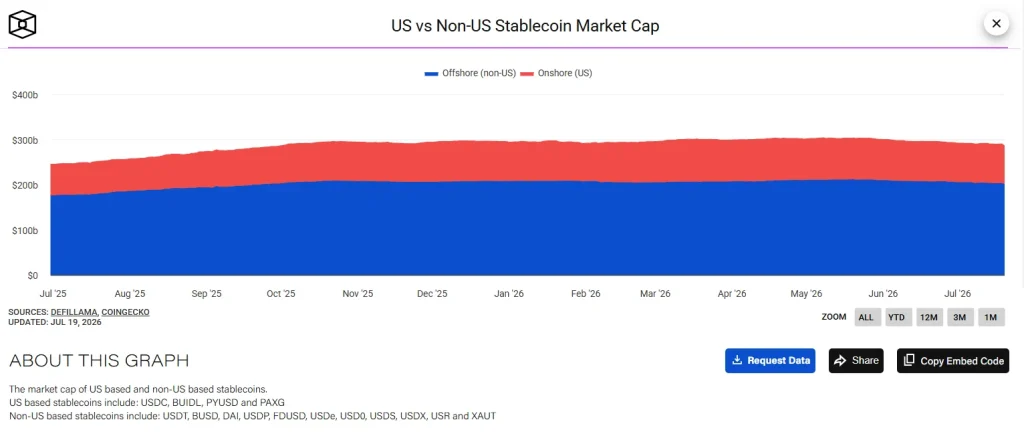
Current distribution illustrates this imbalance:
| Issuance Location | Approximate Supply |
| Offshore | $203.16 billion |
| United States | $86.31 billion |
The market therefore remains predominantly offshore despite increasing regulatory processes in the United States.
This imbalance is structural for stablecoin market that clearly explains why regulation has become central to discussion surrounding future market growth. Greater regulatory certainty may encourage more issuers to establish operations within regulated jurisdictions while enabling broader institutional participation.
3. Payment Activity Provides Stronger Evidence Than Market Capitalization
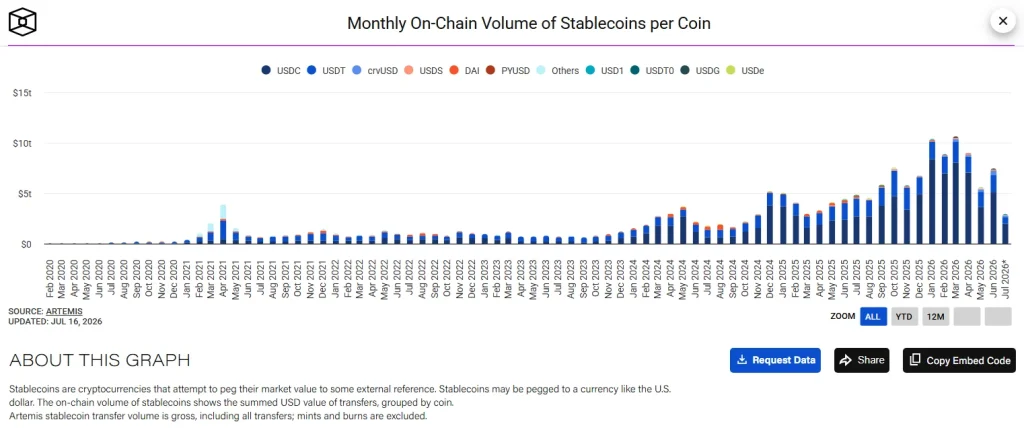
While market capitalization measures circulating supply, transaction volume provides a better indication of actual economic usage. Stablecoin payment activity has accelerated significantly during the past several years.
Monthly onchain volume reached around $3.89 trillion during the highly active crypto markets of 2021. By 2026, monthly volume had increased to around $10.61 trillion, representing a new ATH.
Even more significant is the growth in cumulative transaction volume. The findings shows considerably stronger long-term growth than many market participants recognize.
| Metric | Value |
| Stablecoin Volume (2025) | $28 trillion |
| Stablecoin Volume (H1 2026) | $52 trillion |
| CAGR Since 2023 | 133% |
This suggests that stablecoin adoption is increasingly being driven by real economic activity rather than speculative crypto trading alone.
If this baseline growth continues without additional catalysts, Chainalysis estimates adjusted annual volume could approach approximately $719 trillion by 2035.
However, the report argues that this baseline likely understates future demand.
Two structural developments are expected to significantly accelerate adoption:
- A multi-decade generational wealth transfer.
- Widespread merchant acceptance through point-of-sale (POS) integration.
Together, these factors could increase annual adjusted stablecoin transaction volume toward $1.5 quadrillion by 2035, exceeding today’s estimated global cross-border payment market.
This figure is frequently misunderstood.
The projection refers to annual payment volume, not stablecoin market capitalization.
The distinction is important because payment infrastructure can process transaction values many times larger than the total circulating supply through higher transaction velocity.
4. Regulation Is The Catalyst – Not the Growth Engine
Across all reviewed research, regulation consistently emerges as the single most important enabling factor for future stablecoin adoption.
However, none of the reports conclude that legislation alone will produce a trillion-dollar market.
Instead, regulation primarily reduces uncertainty surrounding issuance, reserve management, consumer protection, reporting standards, and institutional participation.
The most significant regulatory milestone in the United States has been the GENIUS Act, which establishes a dedicated framework governing payment stablecoins.
The legislation defines:
- Eligible issuers.
- Reserve asset requirements.
- Regulatory oversight.
- Reporting obligations.
- Redemption standards.
For financial institutions, these measures provide greater legal certainty regarding stablecoin operations.
The result is growing interest from banks, payment companies, fintech firms, and institutional investors seeking to integrate stablecoins into existing financial infrastructure.
Nevertheless, implementation remains incomplete.
The Treasury Department and four primary federal regulators missed the July 18 rulemaking deadline, leaving several important proposals unresolved, including customer identification standards and anti-money laundering requirements.
Although the legislation still becomes effective in January 2027, the shortened implementation period creates uncertainty for prospective issuers.
This means the next major milestone is no longer legislative approval infact it is the publication of clear implementation rules.
These rules are expected to influence regulatory approaches well beyond the United States, as several jurisdictions may adopt similar frameworks or adapt them to local markets.
5. Regulatory Progress Is Expanding, but Global Adoption Remains Uneven
While the United States has taken a significant step toward establishing a dedicated regulatory framework, global stablecoin regulation remains fragmented. Different jurisdictions are moving at different speeds, creating varying operating environments for issuers and financial institutions.
The GENIUS Act represents the most comprehensive stablecoin legislation introduced by the U.S. so far. By defining reserve requirements, issuer eligibility, reporting obligations, capital standards, and redemption rights, the legislation reduces one of the largest barriers preventing institutional participation which is regulatory uncertainty.
However, implementation is now the market’s primary focus.
Although July 18 marked the statutory deadline for federal agencies to publish implementing rules, regulators failed to finalize several important proposals. Public consultation remains open for customer identification requirements until August 21, while the FDIC’s anti-money laundering proposal remains under review until August 4.
The legislation itself still becomes effective on January 18, 2027, but regulators now face a compressed implementation schedule.
From an institutional perspective, the next catalyst is not additional legislation but regulatory execution. Market participants require clarity on:
- Capital requirements.
- Reserve composition.
- AML obligations.
- Customer identification standards.
- Supervisory expectations.
Because many jurisdictions closely monitor U.S. financial regulation, the final rulebook may also influence stablecoin frameworks beyond the United States.
Europe Is Taking a More Conservative Approach
Unlike the United States, Europe has prioritized regulatory certainty before encouraging broad market participation.
The transition period under the Markets in Crypto-Assets (MiCA) framework officially ended on July 1, leading to one of the largest regulatory changes in the European stablecoin market.
As a consequence:
- Coinbase
- Kraken
- Crypto.com
- Binance’s European entity
Either delisted or restricted USDT spot trading for European users because the asset did not satisfy MiCA’s regulatory requirements.
Meanwhile, regulated alternatives such as:
have received authorization, with approximately 12 euro-denominated electronic money tokens (EMTs) now operating under MiCA across 14 licensed issuers.
Rather than discouraging stablecoins, Europe’s approach reflects a preference for regulated issuance over unrestricted market expansion.
Although this cautious strategy may temporarily slow adoption, it also establishes a more standardized regulatory environment that could support institutional participation over the long term.
6. The Commercial Impact Extends Beyond Crypto Markets
Stablecoin adoption affects multiple participants across the financial system, meaning the benefits and risks are unlikely to be distributed evenly.
Morningstar’s assessment suggests that widespread adoption would create different outcomes for governments, issuers, banks, payment companies, and consumers.
Potential Winners
| Participant | Expected Impact |
| U.S. Government | Higher demand for Treasury securities supporting stablecoin reserves could reduce government borrowing costs. |
| Stablecoin Issuers | Interest earned on reserve assets remains the primary revenue source, making larger circulating supply directly beneficial. |
| Emerging Market Consumers | Greater access to dollar-denominated assets and lower-cost cross-border transfers. |
| Businesses | Faster settlement, lower transaction costs, and improved treasury efficiency. |
Participants Facing Greater Challenges
| Participant | Primary Challenge |
| Commercial Banks | Potential migration of retail deposits toward stablecoins may increase funding costs and reduce net interest margins. |
| Retail Investment Products | Stablecoins compete with money market funds, certificates of deposit, and high-yield savings accounts for idle cash. |
| Traditional Remittance Providers | Lower-cost blockchain transfers could pressure existing remittance business models. |
The banking sector remains one of the most closely watched areas.
Retail deposits represent one of the lowest-cost funding sources for banks. If a meaningful share of these deposits migrates into stablecoins, banks may increasingly rely on higher-cost funding, potentially reducing lending profitability.
Although higher loan pricing could partially offset funding pressures, Morningstar notes that increased borrowing costs may also reduce credit demand, ultimately affecting overall profitability.
This illustrates why stablecoin adoption represents both an opportunity and a structural challenge for traditional finance.
7. Stablecoin Adoption Ultimately Depends on Utility Rather Than Regulation
Regulation may enable adoption, but utility determines whether adoption continues.
The strongest evidence supporting long-term growth comes from increasing real-world payment activity rather than legislation itself.
Chainalysis identifies two structural trends that could significantly increase stablecoin transaction volumes over the coming decade.
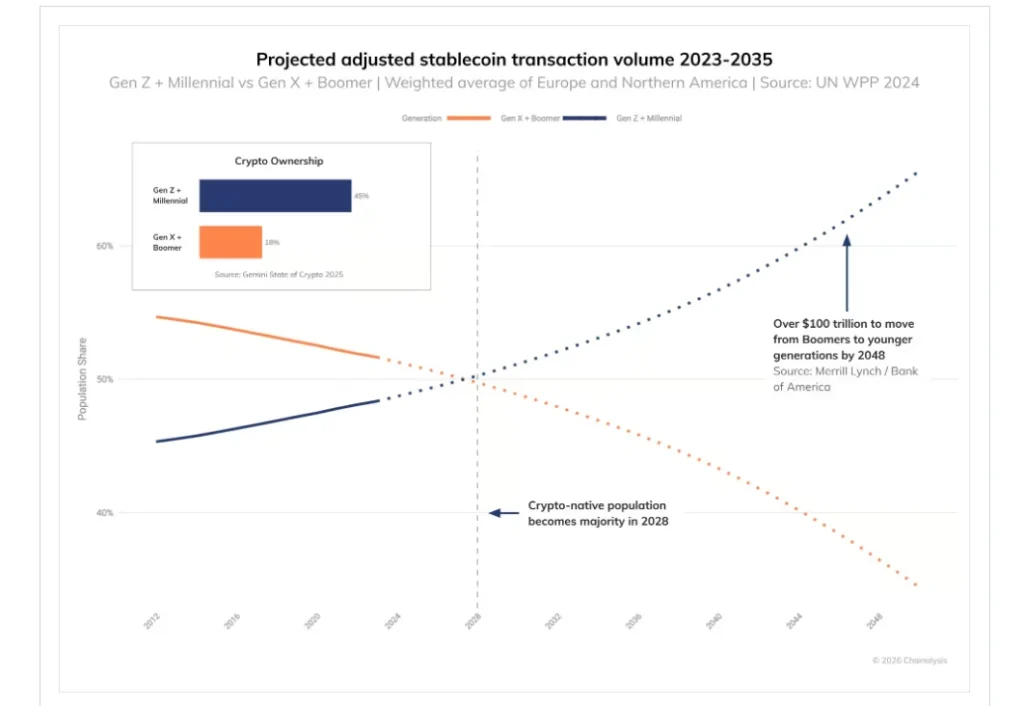
Generational Wealth Transfer
Beginning around 2028, Millennials and Generation Z are expected to become the dominant economic participants across North America and Europe.
According to Gemini’s 2025 survey, nearly half of these generations have owned or currently own cryptocurrency.
At the same time, Merrill Lynch estimates that tens of trillions of dollars in wealth will transfer from Baby Boomers to younger generations over the coming decades.
Chainalysis estimates this demographic transition alone could contribute approximately $508 trillion in additional annual stablecoin transaction volume by 2035.
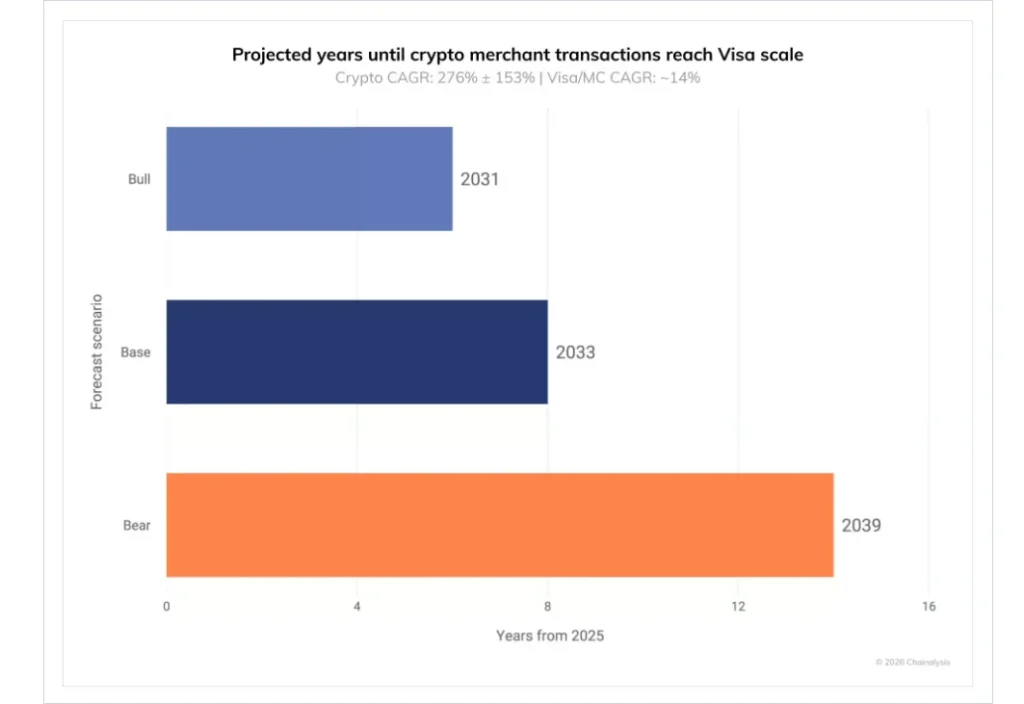
Merchant Adoption Through Point-of-Sale Infrastructure
The second catalyst is widespread merchant acceptance.
Historically, stablecoins have primarily supported transfers between crypto wallets and financial institutions.
As payment infrastructure expands into retail commerce, consumers may increasingly evaluate payment methods using familiar criteria such as:
- Transaction fees.
- Settlement speed.
- Cashback incentives.
- Ease of use.
This mirrors the historical evolution of credit cards from optional payment methods into everyday financial infrastructure.
Loading profile preview estimates widespread point-of-sale adoption could contribute approximately $232 trillion in additional annual stablecoin payment volume by 2035.
Combined with demographic shifts, these structural trends explain why several institutions view payment infrastructure, not speculative trading but as the primary long-term growth engine for stablecoins.
8. Blockchain Competition Is Becoming More Specialized
Stablecoin growth is no longer concentrated on a single blockchain.
Instead, individual networks are increasingly serving specialized market segments.
| Blockchain | Stablecoin Supply | Primary Strength |
| Ethereum | 50%+ | DeFi settlement and tokenized capital markets |
| Tron | $79B | Emerging-market remittances and low-cost transfers |
| Solana | $16B | High-throughput retail payments |
| Arbitrum | $10B | Ethereum Layer-2 DeFi |
| Base | $4.6B | Commerce integrations including Stripe and Shopify |
Ethereum and Tron together account for roughly 84% of global stablecoin supply.
However, newer ecosystems continue expanding through differentiated use cases rather than attempting to compete directly on every front.
This diversification suggests that future stablecoin growth may be distributed across multiple blockchain ecosystems rather than concentrated within a single network.
9. Assessment: Can Regulatory Catalyst Really Be a Catalyst To Drive $1 TrillionAlone?
The collective evidence supports one consistent conclusion: regulation is a necessary catalyst, but not the primary growth engine.
Every major forecast reviewed in this report, whether from Loading profile preview , Citi, Standard Chartered, Morningstar, or Scott Bessent all majorly assumes broader institutional participation and expanding payment utility rather than just regulatory change alone.
Current market data already demonstrates encouraging momentum. Stablecoin supply has surpassed $310 billion, adjusted payment activity continues reaching record levels, and institutional forecasts increasingly project trillion-dollar markets over the coming decade. However, the assumptions underlying those forecasts differ substantially.
Organizations such as Citi and Standard Chartered anticipate rapid institutional adoption supported by regulation, while Loading profile preview argues that transaction velocity may increase much faster than circulating supply, suggesting market capitalization alone is an incomplete measure of adoption.
At the same time, the research consistently highlights several conditions that must be satisfied before trillion-dollar projections become realistic:
- Clear implementation of regulatory frameworks.
- Greater banking participation.
- Continued enterprise adoption.
- Expansion of merchant payment infrastructure.
- Growth in tokenized financial assets.
- Sustained demand for dollar-denominated digital settlement.
These factors reinforce one another. Regulation creates legal certainty, legal certainty encourages institutional participation, institutional participation expands payment infrastructure, and broader commercial usage ultimately drives long-term market growth.
Therefore, the trillion-dollar thesis should not be interpreted as the direct outcome of legislation. Instead, it represents a long-term scenario in which regulation serves as the foundation for broader financial adoption.
Conclusion
Stablecoins are transitioning from crypto-native liquidity instruments into programmable financial infrastructure supporting payments, treasury operations, cross-border settlement, and tokenized assets. Current market growth is increasingly driven by measurable economic activity rather than speculative trading, while regulatory developments are reducing barriers that previously limited institutional participation.
The evidence reviewed suggests that regulatory clarity alone will not expand the stablecoin market from approximately $310 billion to $1 trillion. Rather, regulation enables the broader structural changes like banking integration, enterprise adoption, merchant acceptance, and payment innovation that determine whether such projections become achievable.
As implementation of the GENIUS Act progresses and global frameworks continue to evolve, the pace of real-world adoption will likely become a more meaningful indicator of long-term market health than market capitalization alone. Consequently, future assessments should evaluate stablecoins not only by circulating supply but also by transaction volume, payment utility, and integration into the global financial system.
Loading article prices
Loading article prices






Be the first to comment