



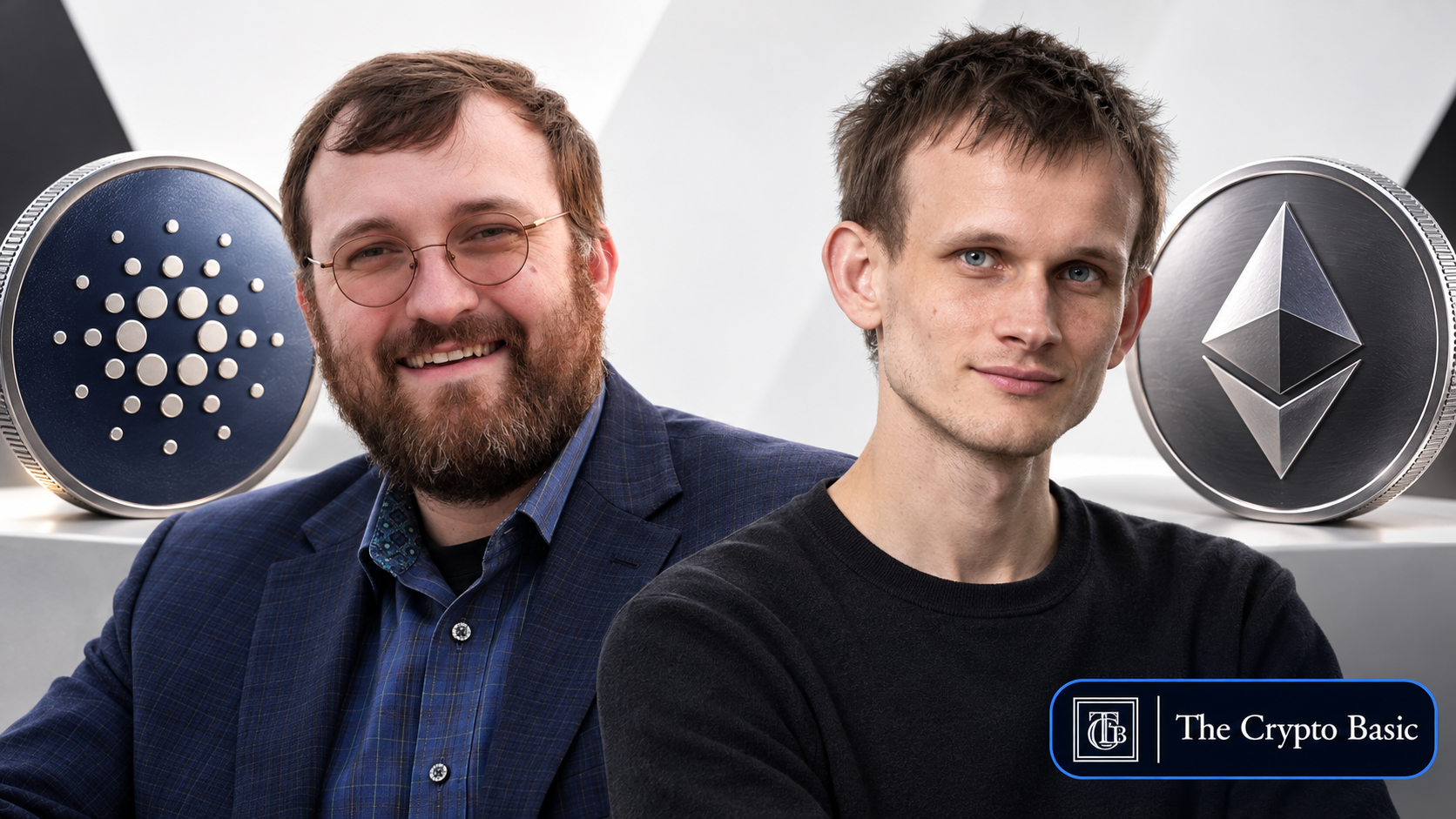
Charles Hoskinson challenges Vitalik Buterin’s warning that AI could weaken lattice cryptography, disputing calls for dramatically larger parameters.
Cardano founder Charles Hoskinson has pushed back sharply against Ethereum co-founder Vitalik Buterin’s warning that rapid advances in AI-driven mathematics could weaken lattice-based cryptography, arguing that the concern is not backed by a concrete attack against today’s leading lattice schemes.
Vitalik is now trying to convince everyone that lattices are bad because he is bag-holding too much hash-based crypto research can’t back out. The case against lattices is the GNFS story, a.k.a. a hunch about “structure,” and a multiplier pulled out of thin air. None of it has… https://t.co/ryeeCwlENo
— Charles Hoskinson (@IOHK_Charles) October 9, 2026
The dispute centers on how blockchains should prepare for a world where AI dramatically accelerates mathematical research.

Buterin said users do not need to rush into new wallets today, but argued that crypto developers should take seriously the possibility that AI could uncover new shortcuts against both elliptic-curve and lattice-based cryptography. His concern extends to schemes such as ML-DSA and other lattice constructions currently viewed as post-quantum options.
Buterin Says AI Could Change Cryptographic Assumptions
Buterin’s argument is based on what happened historically with integer factorization.
I don’t recommend anyone scramble to move their funds to new wallets today. But we should take the risks to cryptography from AI-accelerated math seriously, and minimize our exposure to not just quantum-vulnerable cryptography, but also potentially AI-vulnerable cryptography.…
— vitalik.eth (@VitalikButerin) October 7, 2026
Early estimates treated factoring large numbers as vastly more difficult than later algorithms such as the General Number Field Sieve ultimately made it.
He suggested AI could discover comparable mathematical advances against elliptic curves or lattice problems much faster than human researchers have.
In his personal view, developers relying on lattices should use much more conservative parameters, even floating the idea of multiplying key sizes by 10 for very long-term protection.
That thinking also helps explain Ethereum’s growing interest in hash-based signatures. Ethereum’s Lean Consensus work is developing hash-based schemes such as leanXMSS, while its broader post-quantum roadmap targets major infrastructure milestones around 2029.
Buterin also cautioned against unnecessary wallet migrations, noting that operational mistakes can themselves result in lost funds.
Hoskinson Calls the 10x Proposal “Numerology”
Hoskinson challenged the premise behind that warning.
He argued that lattice cryptography has already gone through decades of attack improvements involving LLL, BKZ, enumeration and increasingly efficient sieving techniques.
In his view, modern parameter sets already account for that history rather than assuming lattice problems have never faced serious cryptanalysis.
His strongest criticism targeted the proposed 10x increase in key sizes. Hoskinson called the figure essentially “numerology,” arguing that parameter changes should follow a defined attack model and security calculation rather than a general fear that AI may discover something new.
He also disputed Buterin’s use of the factoring analogy, saying an unknown future attack on lattices would need an identifiable mathematical mechanism rather than simply an appeal to hidden “structure.”
NIST Currently Backs Both Lattice and Hash-Based Approaches
The wider standards landscape is more mixed than a lattice-versus-hash choice.
NIST finalized ML-KEM, a module-lattice key-encapsulation standard, and ML-DSA, a module-lattice digital-signature standard, in August 2024.
It also standardized SLH-DSA, a hash-based signature scheme derived from SPHINCS+, specifically providing diversity if another family encounters problems.
NIST still describes ML-KEM and ML-DSA as believed secure against adversaries with large-scale quantum computers.
That does not prove they are immune to unknown AI-assisted mathematical breakthroughs, but no such break has been demonstrated in the debate between Buterin and Hoskinson.
Hoskinson also pointed out that hash functions are not automatically structure-free in practice. Ethereum itself funds cryptanalysis of Poseidon and Poseidon2, including Gröbner-basis and other algebraic attacks, showing that hash constructions also undergo active scrutiny.
Cardano Is Also Working on Post-Quantum Security
The disagreement is particularly relevant for Cardano because its 2026 research roadmap includes a dedicated post-quantum workstream covering future cryptographic migration and quantum-secure alternatives.
Cardano research has also explored lattice-based approaches for future zero-knowledge systems.
The two founders therefore agree on one broad point: current cryptography should not be treated as permanently safe.
Where they differ is the response. Buterin favors reducing reliance on structured cryptography wherever hash-based alternatives are practical, while Hoskinson argues that existing lattice systems should not be downgraded without a named attack, measurable cost, and evidence that current parameters are inadequate.


Be the first to comment