



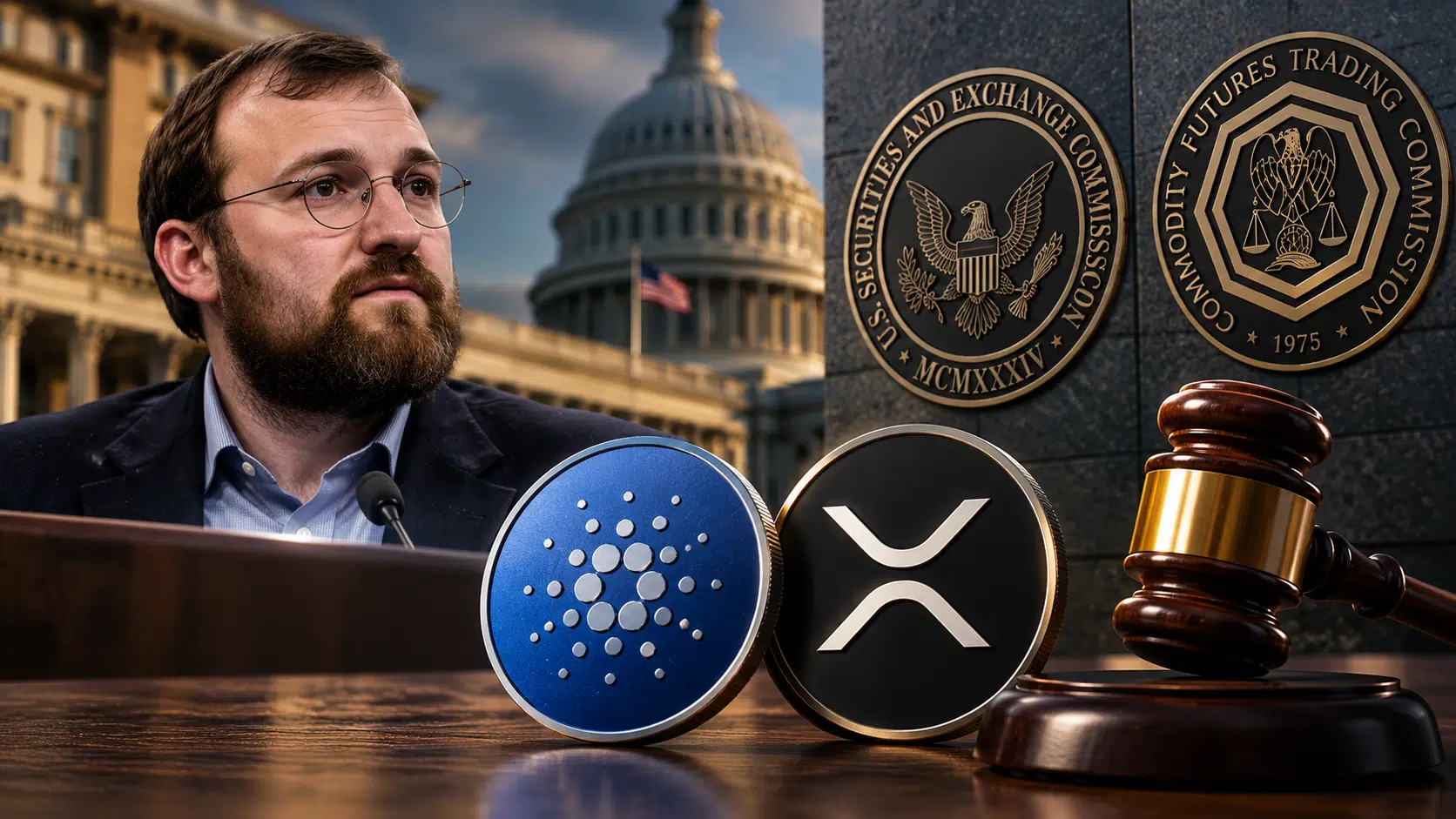
Cardano founder Charles Hoskinson has argued that ADA and XRP should be treated as genuine commodities under U.S. crypto regulation.
Hoskinson made the remarks while explaining why the CLARITY Act failed to advance in the U.S. Senate. He focused on what he sees as a fundamental problem with the legislation’s proposed approach to classifying and regulating digital assets.
Hoskinson Questions Broad Commodity Classification
According to him, one of the fundamental problems was the attempt to treat a wide range of digital assets as commodities and place the CFTC at the center of crypto regulation.
He argued that securities and commodities have fundamentally different characteristics and therefore require different regulatory approaches. In his view, the SEC has a larger workforce and broader tools for disclosure and market oversight, while the CFTC traditionally operates as a principles-based commodities regulator.

However, Hoskinson’s criticism does not appear to be directed at the use of commodity regulation for crypto assets generally. Instead, he argued that lawmakers should first establish which digital assets genuinely qualify as commodities and which belong in a separate digital-security category.
Hoskinson Says Cardano and XRP Are Truly Commodities
He specifically identified Bitcoin, Cardano, and XRP as examples of crypto assets that he considers “truly commodities.”
Hoskinson’s comments also coincide with a significant regulatory development in the United States. Earlier this year, the SEC and CFTC jointly issued an interpretation outlining how different crypto assets could be classified, including as digital commodities, digital securities, or stablecoins. Interestingly, Cardano and XRP were both included in the digital commodities category.
XRP’s Legal Status Adds to Its Distinction
XRP also has a separate legal history that informs its regulatory classification. In July 2023, the U.S. District Court for the Southern District of New York distinguished between XRP itself and the manner in which Ripple sold the token.
The court did not find XRP itself to be inherently a security. However, it determined that certain institutional sales of XRP constituted securities transactions, while Ripple’s programmatic sales on secondary markets did not constitute unregistered securities sales under the circumstances before the court.
The distinction separates the underlying crypto asset from particular transactions involving that asset.
Cardano’s Regulatory History Has Also Changed
Cardano, meanwhile, previously appeared among the crypto assets identified by the SEC in enforcement actions against major cryptocurrency exchanges.
That regulatory environment later began to change. For example, the SEC dismissed its civil enforcement action against Coinbase in February 2025.
The SEC’s March 2026 interpretation subsequently established a broader framework for distinguishing digital commodities from other categories of crypto assets.
Hoskinson Calls for International Regulatory Coordination
Meanwhile, Hoskinson also stressed that cryptocurrency regulation cannot focus exclusively on the United States.
Digital assets operate across borders, meaning that regulatory decisions in one jurisdiction can affect participants and businesses elsewhere. Consequently, he argued that the U.S. should pursue reciprocal agreements with other jurisdictions so that different regulatory frameworks can recognize and work with one another.
His broader argument centers on creating clearer distinctions between digital commodities and digital securities while coordinating those rules across jurisdictions.


Be the first to comment