

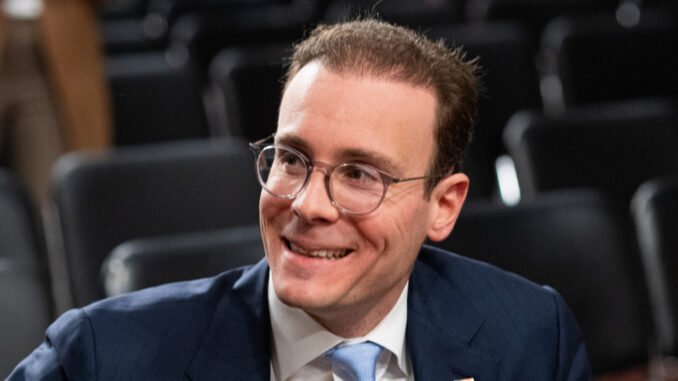

CFTC Chairman Michael Selig used a Fox Business appearance to say the Trump administration will not allow a U.S. central bank digital currency, framing the position as part of a broader digital-asset agenda built around federal crypto rules, private-sector innovation, and regulated market oversight.
Key Takeaways
- Selig said a U.S. CBDC is “not going to happen” under the Trump administration.
- He tied the position to Trump’s digital-assets executive order and the President’s Working Group report.
- The stance gives more political room to private digital-money rails, especially regulated stablecoins.
The important point is not only that CFTC Chairman Michael Selig criticized central bank digital currencies. The bigger signal is that the Trump administration is treating opposition to a U.S. CBDC as a formal part of its digital-asset policy, not just a campaign slogan.
Speaking in an interview clip shared by Bitcoin Magazine, Selig said the administration had made its position clear:
“I’m very concerned about central bank digital currencies. And we, in the Trump administration, have been very clear that that’s not going to happen under our watch.”
That wording matters because Selig connected the anti-CBDC stance to Trump’s executive order and to the President’s Working Group on Digital Asset Markets. In other words, the position is being presented as part of the administration’s broader crypto framework, alongside support for lawful blockchain use, dollar-backed stablecoins, self-custody, and clearer federal rules.
JUST IN: 🇺🇸 CFTC Chairman Mike Selig says there will never be a CBDC under President Trump 👀
“It is a policy of this administration to prevent a central bank digital currency from coming to fruition.” ✊ pic.twitter.com/Lvq9KF4gpl
— Bitcoin Magazine (@BitcoinMagazine) July 8, 2026
From Campaign Pledge to Executive Order
Trump had already made CBDCs a political dividing line before returning to office. In 2024, while still a presidential candidate, he said he would “never allow” the creation of a U.S. central bank digital currency, calling it a threat to financial freedom.
To protect Americans from government tyranny, as your president, I will never allow the creation of a central bank digital currency.
The administration later converted that campaign position into policy. Trump’s January 23, 2025 executive order on digital financial technology included a dedicated section titled “Prohibition of Central Bank Digital Currencies,” barring agencies from actions to establish, issue, or promote CBDCs, except where required by law.
Selig summarized that policy basis in the interview:
We have put out an executive order… prohibiting central bank digital currencies.
He then pointed to the Working Group’s digital-assets report as the second layer of support:
We put out a report that I was part of on the President’s Working Group on Digital Assets that specifically states that it is a policy of this administration to prevent a central bank digital currency coming to fruition.
Selig also contrasted that approach with the previous administration, saying it had been “pushing” CBDC-related actions before the Trump administration moved to withdraw or reverse them.
Why This Matters for Stablecoins
The anti-CBDC stance is not isolated. It sits next to the administration’s support for private digital-asset infrastructure. Trump’s executive order supports lawful use of public blockchain networks, self-custody of digital assets, dollar-backed stablecoins, and clearer regulatory boundaries for digital assets.
That creates a clear policy preference: the administration wants digital dollars to develop through private markets, not through a government-issued retail digital dollar.
For crypto markets, that distinction matters. If the U.S. government is not building a retail CBDC, then stablecoins, tokenized deposits, regulated payment rails, and private blockchain-based settlement tools have more political space to grow. The competition is no longer simply “CBDC versus crypto” inside the administration’s framework. It is regulated private digital money versus a state-issued digital dollar.
The CLARITY Act Fits the Same Strategy
Selig’s Fox Business appearance was also about the CLARITY Act and the need for federal crypto standards. His argument was that the U.S. cannot keep relying on a fragmented state-by-state and agency-by-agency approach to digital assets.
We’re so close. We have to get this done. It’s absolutely critical that we have federal standards for crypto assets.
That connects directly to the CBDC issue. The administration’s preferred model is not a government digital currency replacing private-sector rails. It is private crypto activity operating inside a clearer federal framework, with the CFTC playing a central role in market structure and derivatives oversight.
Selig put the goal in simple terms:
We want to get this done so we have certainty, clarity and consumer protection.
He also warned against loading the bill with unrelated political fights:
There’s certainly some mission creep beyond what’s really critical here.
How This Reframes U.S. Crypto Policy
The clean read is that the Trump administration is drawing a bright line between two models of digital finance. One model is government-issued digital money through a CBDC. The other is privately issued and privately operated digital-asset infrastructure under federal rules.
Selig’s comments place the CFTC inside that second model. His message is not anti-crypto. It is anti-CBDC, pro-federal standards, and supportive of regulated private-market development.
That is why the comments matter for stablecoins. A formal anti-CBDC stance lowers the risk that a future U.S. digital dollar crowds out private payment tokens. At the same time, the push for CLARITY means the administration still wants oversight, especially around market structure, derivatives, consumer protection, and trading venues.
The Limit to the “Never CBDC” Claim
The strongest version of Selig’s point is narrow: there will be no U.S. CBDC under Trump’s current policy framework. That is different from saying CBDCs are permanently impossible in the United States.
An executive order can be reversed by a later administration. Congress could also reopen the issue through legislation. The White House order itself includes the legal qualifier “except to the extent required by law,” which means the policy is strong but not permanent by itself.
That limitation does not weaken the immediate signal. It clarifies it. Under the current administration, CBDCs are being treated as a policy threat, while private digital-asset infrastructure is being treated as the preferred path.
The next test is whether Congress advances the CLARITY Act and whether the administration continues to pair anti-CBDC policy with stablecoin and market-structure legislation.
If that happens, the U.S. crypto framework becomes clearer: no retail CBDC under Trump, more space for regulated stablecoins, and stronger federal oversight of private digital-asset markets.
The information provided in this article is for educational and informational purposes only and should not be construed as financial advice.

Alex is Editor-in-Chief of Coindoo and co-founder of Millennial Media Group, with nearly a decade of experience covering financial markets – crypto first, then everything else.
It started in 2016 with Bitcoin. Like most people at the time, he didn’t fully understand it – so he kept digging. Blockchain, tokenomics, the projects, the cycles. That curiosity never stopped, and eventually pulled him into traditional markets too: equities, commodities, macro. Not because he left crypto behind, but because you can’t properly understand one without the other.
What drives him is straightforward: he wants to know why something is happening, not just that it’s happening. Most market coverage stops at the headline – price up, price down, here’s a chart. Alex finds that kind of reporting actively unhelpful. If you walk away from an article without understanding the mechanism behind the move, what did you actually learn?
He holds a degree in Tourism from New Bulgarian University – not the most obvious path into financial markets, but markets have a way of pulling in people who are simply too curious to stay out. He has authored over 200 in-depth analyses and more than 10,000 articles across crypto and traditional finance. He still thinks every day in markets teaches him something new. That’s probably why he hasn’t stopped.



Be the first to comment