



The U.S. Commodity Futures Trading Commission has expanded regulatory relief for developers of passive trading software, potentially making it easier for users to access regulated derivatives through wallets and other interfaces. The Market Participants Division said on September 17 that it would not recommend enforcement action over introducing-broker registration, subject to specified conditions.
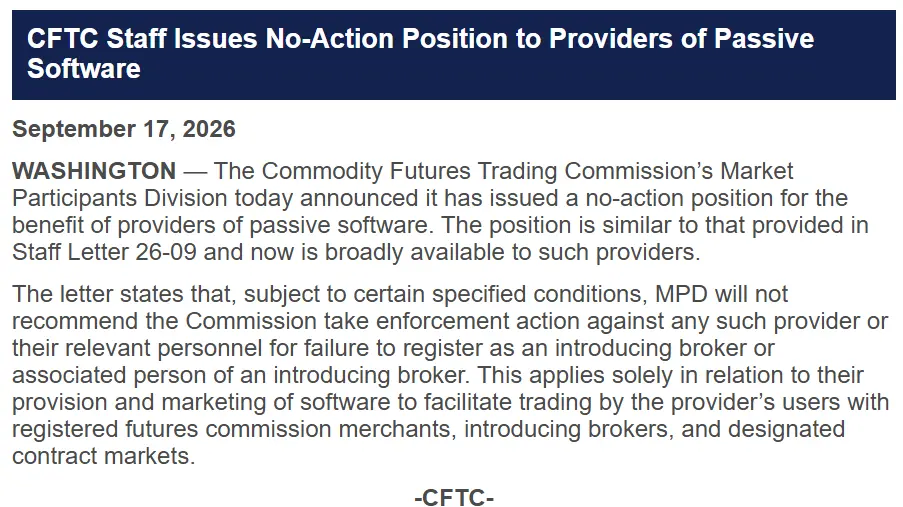
CFTC Letter 26-25 Broadens Relief for Passive Trading Software
The new position builds on Staff Letter 26-09, which was issued in March for Phantom Technologies. That earlier relief covered self-custodial wallet software that could provide users access to CFTC-regulated derivatives through registered futures commission merchants, introducing brokers and designated contract markets.
The new position makes similar relief broadly available to qualifying passive software providers instead of limiting it to the original beneficiary.
The CFTC’s framework specifically covers software that can display market data, provide information about derivatives products and allow users to submit orders to registered entities.

Providers can also market their services and relationships with registered firms under the stated conditions. However, the software provider cannot take custody or control of user assets, exercise discretion over order routing or execution, or generate express buy and sell signals.
Also Read: CFTC and SEC Derivatives Overhaul Begins Amid Growing Perpetual Futures Dispute
Crypto Perpetuals Gain a Wider Software Path Under CFTC Rules
The development is particularly relevant to crypto derivatives because the earlier Phantom framework explicitly contemplated access to perpetual contracts.
The CFTC’s certified-product records also show a growing range of crypto perpetual futures, including contracts linked to Bitcoin, Ether, XRP, Solana, Avalanche and Chainlink. Several of those contracts were certified on September 2, showing that regulated crypto-perpetual infrastructure is already expanding alongside the software framework.
That distinction matters for developers building non-custodial trading interfaces. Instead of becoming the registered intermediary themselves, qualifying developers can potentially provide the front-end while the actual derivatives transaction occurs through a registered market participant.
The change therefore addresses an important regulatory question around the software layer without removing the existing requirements governing the underlying derivatives market.
CFTC Conditions Keep Derivatives Trades on Registered Venues
The relief does not create a blanket exemption for every crypto trading application. Users must trade through a designated contract market directly or through registered futures commission merchants or introducing brokers, while user funds and collateral remain within the regulated clearing and custody structure described by the CFTC. Providers must also satisfy disclosure, recordkeeping, marketing and compliance conditions.
The CFTC position also remains staff-level relief rather than a permanent statutory exemption. The letter says the position can remain effective until a Commission rulemaking or guidance addresses the application of introducing-broker registration requirements to software developers.
This leaves future rulemaking as an important factor for developers deciding how much infrastructure to build around the framework.
What CFTC Derivatives Developers Can Do Next Under Relief
For crypto developers, the immediate opportunity is to build interfaces that connect users with regulated derivatives venues without taking control of the transaction itself.
This could include self-custodial wallets, standalone trading interfaces and other software products that display market information and route user orders to registered entities. The model could also make regulated perpetual contracts easier to integrate into existing crypto applications.
The broader significance is that the CFTC is addressing software infrastructure while regulated crypto derivatives products continue to expand.
The September certifications demonstrate that the market is moving beyond a small number of Bitcoin and Ether products toward a broader range of crypto assets. If more registered venues support these products, passive software providers could become an increasingly important distribution layer between users and regulated derivatives markets.
Also Read: CFTC Chairman Michael Selig Vows Bold Crypto Push in 2026


Be the first to comment