

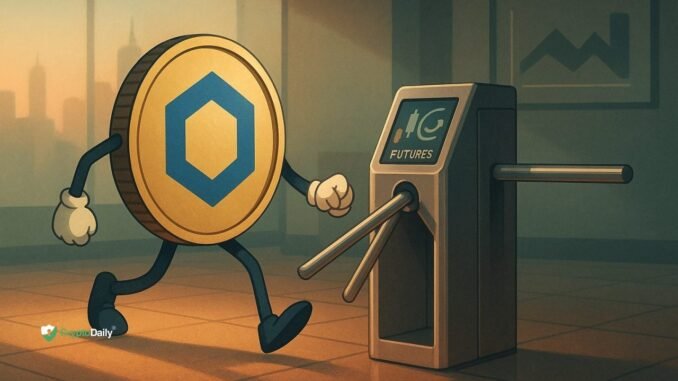

Institutional desks are increasingly evaluating crypto beyond layer-1 blockchains. One category drawing attention is oracle networks—particularly Chainlink—and the liquidity forming around LINK futures. The question isn’t just whether LINK will rise; it’s why oracle tokens could become core infrastructure exposures as on-chain finance expands.
This article helps you evaluate the thesis behind oracle tokens, understand how LINK futures work in practice, and build a process for risk-managing exposure. You’ll learn what institutions monitor, how to compare spot and derivatives, and where the hidden pitfalls tend to show up.
| Aspect | What to Know |
|---|---|
| What are LINK futures? | Exchange-traded derivatives referencing the price of LINK, typically cash-settled perpetuals or dated futures that allow leverage, hedging, and basis trading. |
| Why oracles matter | Oracles connect blockchains to real-world data and off-chain systems, enabling DeFi, tokenized assets, and cross-chain messaging to function reliably. |
| Institutional hook | Oracle tokens are tied to network usage from data delivery and interoperability services (e.g., Chainlink Price Feeds, CCIP), an infrastructure-centric thesis. |
| Primary risks | Market volatility, leverage and liquidation risk, smart-contract and oracle design risk, venue/custody risk, regulatory uncertainty, and token supply dynamics. |
| Where they trade | Major centralized exchanges list LINK perpetuals; availability, margin currencies, and liquidity differ by venue and jurisdiction. |
| Metrics to watch | Open interest and funding for futures; for fundamentals: protocol integrations, network service usage, node performance, and enterprise pilots. |
| Compliance considerations | Counterparty risk, KYC/AML policies, derivatives approvals, and mandate suitability are critical before trading futures. |
Core Concepts of Oracle Tokens and LINK Futures
Oracles provide authenticated data, computation, and cross-chain messaging to smart contracts. Chainlink is the leading oracle network by adoption, supporting services like Price Feeds, Proof of Reserve, Verifiable Randomness, Data Streams, Functions, and the Cross-Chain Interoperability Protocol (CCIP). The investment idea is that as on-chain finance grows—DeFi, tokenized assets, payments—demand for secure data and messaging increases, potentially benefiting the oracle network’s token economy.
Futures on LINK give market participants a way to take directional exposure, hedge spot holdings, or implement basis and relative-value strategies without owning or moving the underlying asset. Perpetual futures (perps) mimic a futures position without expiry by using a funding rate that periodically anchors the contract price to spot. Dated futures expire and settle on a calendar schedule, allowing classic cash-and-carry trades around the term basis.
For institutions, the LINK futures market can be an entry point to oracle exposure with risk controls: position sizing, pre-defined liquidation thresholds, and the ability to short. However, this comes with the usual derivatives caveats: slippage, funding variability, cross-venue basis differences, and the need for robust collateral and counterparty frameworks.
Key terms at a glance
- Oracle: Middleware that securely brings off-chain data or computation to on-chain applications.
- LINK: The native token of Chainlink, used for economic alignment in the network and to pay for services in certain configurations.
- Perpetual futures: Derivatives without expiry that use a funding rate to tether contract prices to spot.
- Basis/Funding: Basis is the difference between futures and spot; perps use funding payments to nudge the basis toward zero.
- CCIP: Chainlink’s Cross-Chain Interoperability Protocol for secure messaging and token transfers across heterogeneous chains.
- Proof of Reserve: On-chain attestations that off-chain assets or collateral exist, updated by oracles for transparency.
Step-by-Step Playbook
- Define the thesis: Clarify whether you want directional exposure to LINK, a hedge against spot holdings, or a relative-value strategy tied to oracle adoption.
- Select the venue: Choose an exchange with sufficient liquidity, robust risk engine, supported collateral, and compliance coverage for your jurisdiction.
- Map collateral and leverage: Decide margin type (USD stablecoin, coin-margined) and maximum leverage that fits your drawdown tolerance and liquidation thresholds.
- Establish risk guards: Set pre-trade limits, circuit breakers, and mandatory stop levels. Determine how funding costs or basis carry fit your P&L assumptions.
- Monitor fundamentals: Track oracle-network usage (integrations, service uptimes, enterprise pilots), alongside futures metrics like open interest, funding, and depth.
- Plan for adverse scenarios: Backtest stress cases such as funding spikes, liquidity gaps, or exchange downtime. Pre-plan unwind workflows and alternative venues.
- Document governance: Align with internal policies on derivatives, counterparty risk, and valuation. Ensure audit trails for margin calls and reconciliations.
- Review quarterly: Reassess the thesis with updated data on network demand (e.g., CCIP usage, Proof of Reserve expansions) and adjust sizing accordingly.
How LINK Futures Fit Into Institutional Portfolios
Institutions typically approach LINK futures through three lenses: tactical exposure, hedging, and basis or relative value. Tactical traders lean on perps for short-term momentum or mean-reversion. Long-only allocators may hedge spot LINK with short futures to manage beta during event risk. Relative-value desks look at funding or calendar spreads and even pair trades versus other infrastructure tokens.
Because oracles sit at the intersection of DeFi, tokenization, and cross-chain connectivity, some portfolio managers treat LINK less as a “coin bet” and more like a position in middleware. The underlying drivers—growth in on-chain volumes, demand for secure data delivery, and cross-chain settlement—are distinct from the throughput narratives common to layer-1s.
| Exposure Method | Pros | Cons | Best For |
|---|---|---|---|
| Spot LINK | No funding costs; can be custodied; enables staking when available | Requires secure custody; harder to short; operational movement on-chain | Long-only allocators; strategic exposure |
| Perpetual Futures | Continuous exposure; easy long/short; capital-efficient | Funding can erode P&L; liquidation risk; venue dependency | Tactical traders; hedgers needing flexibility |
| Dated Futures | Defined expiry; classic basis trades; funding risk replaced by term basis | Roll management; potential lower liquidity vs perps | Carry strategies; calendar spread traders |
| Options (where available) | Asymmetric payoff; volatility strategies | Greeks management; potential thin liquidity | Vol desks; structured-product teams |

Oracle Tokens vs Layer-1 Bets: Different Drivers
Layer-1 tokens often trade on narratives like throughput, developer activity, or fee capture within a base chain’s economy. Oracle tokens, by contrast, are about trust-minimized connectivity and verified data. Their demand side may correlate more with application volumes across multiple chains and with real-world asset (RWA) tokenization than with a single chain’s blockspace market.
Chainlink’s services include widely used Price Feeds in DeFi, CCIP for cross-chain messaging, Proof of Reserve for off-chain collateral attestations, and newer data products aimed at low-latency use cases. Publicly reported experiments by industry utilities—such as SWIFT testing blockchain interoperability and the DTCC exploring on-chain data dissemination for fund information—have highlighted practical pathways for connecting traditional finance to public chains. While experiments do not guarantee production adoption, they indicate what enterprise-grade requirements look like: robust security, auditability, and standardization.
These distinctions shape how institutions size and value oracle exposure. They may track enterprise pilots, uptime and performance of oracle networks, and the breadth of protocol integrations across ecosystems. In other words, adoption signals matter as much as market beta.
Pro tip: Separate the “crypto market” beta from the “infrastructure adoption” thesis in your risk model. Linking position size to measurable service usage can help avoid overexposure to pure sentiment cycles.
What Signals Institutions Watch in Oracle Networks
Institutions tend to formalize a scorecard that mixes market microstructure with network fundamentals and enterprise traction. The objective is to avoid relying solely on price action.
- Network reliability: Historical uptime for key services (e.g., Price Feeds), response times during volatility, and resilience to data anomalies.
- Economic alignment: How incentives secure the network—token staking, fees paid by users, and slashing or accountability mechanisms if applicable.
- Adoption breadth: Number and diversity of protocol integrations; the presence of mission-critical integrations in DeFi and tokenization pilots.
- Enterprise pathways: Evidence of standards work and trials with financial market infrastructures. For context, public materials from SWIFT and DTCC have discussed experiments involving Chainlink components.
- Market structure: Futures open interest, perp funding dynamics, depth across venues, and borrow availability for hedging.
- Security posture: Audits, bug bounties, and how oracle networks mitigate manipulation (e.g., multiple data sources, threshold signatures, trusted execution where applicable).
Some funds also monitor Chainlink ecosystem updates via the official documentation and blog to track product maturation and roadmap clarity. The goal is to translate technical progress—like CCIP adoption or enhancements to Proof of Reserve—into a forward-looking view of service demand.
Pitfalls & Red Flags
- Funding whipsaws: Perp funding rates can swing rapidly around catalysts, turning a winning directional call into a negative carry trade.
- Liquidity fragmentation: Depth varies by venue and product; slippage can be material during stress, especially for large orders or off-peak hours.
- Collateral concentration: Overreliance on a single stablecoin or a single exchange for margin amplifies counterparty and operational risk.
- Oracle-layer assumptions: Don’t assume “oracles are solved.” Evaluate data source diversity, node incentives, and failover procedures.
- Token supply dynamics: Treasury distributions, ecosystem incentives, or unlock schedules can influence float and liquidity profiles.
- Regulatory mismatches: Ensure mandates permit crypto derivatives; confirm treatment of cash-settled futures and any reporting requirements.
For ongoing analysis, insights, and market context across crypto infrastructure and institutional adoption, you can follow coverage from Crypto Daily.
Frequently Asked Questions
What exactly are Chainlink (LINK) futures?
LINK futures are derivatives that reference the price of the LINK token. The most common instruments are perpetual futures, which do not expire and use a funding rate to align with spot, and dated futures that settle on a set date. They allow leverage, short exposure, and hedging without moving the underlying token.
Where are LINK futures available?
Major centralized crypto exchanges list LINK perpetuals and, in some cases, dated futures. Availability, margin options (e.g., USD stablecoin vs coin-margined), and compliance standards vary by venue and region. Institutions typically conduct exchange due diligence and may use multiple venues to diversify counterparty risk.
Why are institutions interested in oracle tokens like LINK?
Oracle tokens underpin networks that deliver secure data and cross-chain messaging—prerequisites for DeFi, tokenized assets, and institutional blockchain use cases. The thesis is that as these services see real usage, the network’s economic model may benefit. Public experiments by industry utilities have showcased practical connectivity between traditional finance and public chains, though pilots do not guarantee production adoption.
Are LINK futures physically settled?
Settlement depends on the venue. Many LINK perpetuals are cash-settled in a margin currency such as a USD stablecoin. Some platforms also offer coin-margined products. Always verify settlement type, margin requirements, and liquidation logic before trading.
How do I hedge a spot LINK position with futures?
A simple approach is to short an equivalent notional amount of LINK via futures. Adjust for contract multipliers and consider funding costs or basis. Rebalance periodically as price and funding change, and ensure your collateral can withstand drawdowns without triggering liquidation.
Which fundamentals are most useful to track for Chainlink?
Focus on the breadth of protocol integrations, reliability of services like Price Feeds, progression of enterprise pilots, and adoption of products such as CCIP and Proof of Reserve. Supplement with market metrics—open interest, funding rates, and liquidity across venues.
What are the main risks to the oracle-token thesis?
Besides crypto-wide volatility, risks include technical failures or data anomalies in oracle delivery, slower-than-expected enterprise adoption, regulatory headwinds, token supply overhangs, and venue or custody risks when using derivatives.
Disclaimer: This article is provided for informational purposes only. It is not offered or intended to be used as legal, tax, investment, financial, or other advice.




Be the first to comment