



What to know:
- Hong Kong launches Chainlink-powered Tokenized Securities Framework.
- FORMS HK, Cyberport, Apex Group, and CSpro join the initiative.
- Framework supports compliant tokenization and cross-chain settlement.
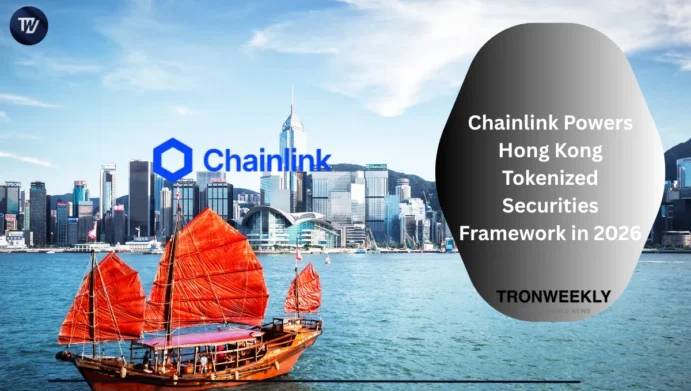
Hong Kong has launched a new Tokenized Securities Framework (TSF) that uses Chainlink infrastructure to support the issuance, distribution and settlement of tokenized securities within a regulated market structure. The initiative brings together FORMS HK, Cyberport, Apex Group and CSpro as Hong Kong continues building institutional infrastructure for digital assets.
Chainlink Framework Targets 3 Key Stages of Tokenized Securities
The TSF is designed to standardize the full lifecycle of tokenized securities, covering issuance, distribution, settlement, asset servicing and ongoing operations.
The framework initially adopts the ERC-3643 token standard, allowing compliance requirements to be embedded into tokenized assets rather than handled entirely through separate processes. This could help issuers manage permissioned access while maintaining alignment with Hong Kong’s regulatory requirements.

Chainlink plays two important infrastructure roles in the framework. Its Cross-Chain Interoperability Protocol (CCIP) is intended to support secure movement of assets and messages across blockchains, while the Automated Compliance Engine (ACE) provides identity management and policy enforcement capabilities.
Chainlink describes ACE as infrastructure for enforcing KYC, AML and jurisdictional requirements across digital-asset ecosystems.
Also Read: Chainlink (LINK) Price Could Rally to $12 if Bulls Defend Critical Support
Hong Kong Adds 4 Institutional Partners to Tokenization Push
The initiative includes Cyberport, FORMS HK, Apex Group and CSpro. Cyberport and FORMS HK previously established Blockchain Valley@Cyberport to support blockchain, digital-asset and real-world-asset development in Hong Kong, with FORMS HK committing up to HK$100 million over three years toward investment, research and market development.
Apex Group brings institutional asset-servicing capabilities to the framework, while CSpro provides regulated securities-market expertise. The combination is significant because tokenization requires more than blockchain infrastructure: issuers also need regulated distribution, custody, settlement, compliance and servicing.
The TSF therefore targets the market infrastructure surrounding tokenized securities rather than simply creating another token issuance platform.
Chainlink Connects Tokenized Assets Across 2 Market Systems
One of the central challenges for tokenized securities is fragmentation between blockchains and traditional financial infrastructure. An asset issued on one blockchain can face limited liquidity or utility if it cannot securely interact with other networks and regulated financial systems.
Chainlink’s CCIP is designed to address this interoperability problem by allowing tokenized assets and messages to move across different blockchain environments.
The framework also targets delivery-versus-payment (DvP), linking tokenized securities with digital money infrastructure such as tokenized deposits and bank-based settlement mechanisms.
This is important for institutions because settlement must connect the digital asset with the corresponding payment leg in a controlled manner. Chainlink has previously highlighted similar Hong Kong use cases involving CCIP and ACE under the Hong Kong Monetary Authority’s e-HKD program.
Chainlink TSF Builds on Hong Kong’s 2026 Rules
The launch comes as Hong Kong continues developing a regulated approach to tokenized financial products. The Securities and Futures Commission revised its tokenization guidance in April 2026, while also establishing requirements for secondary trading of certain SFC-authorized tokenized investment products on licensed virtual-asset trading platforms.
For Chainlink, the development expands its role beyond blockchain data infrastructure into compliance and institutional market connectivity. Chainlink’s existing tokenization architecture combines CCIP with ACE to support cross-chain movement and policy enforcement, addressing two of the major barriers to institutional adoption.
The next test will be whether the TSF can translate this infrastructure into actual issuance, distribution and settlement activity at scale within Hong Kong’s regulated market.
Also Read: Chainlink Price Holds Above $8 as BitGo Migrates $7.7B WBTC to CCIP



Be the first to comment