

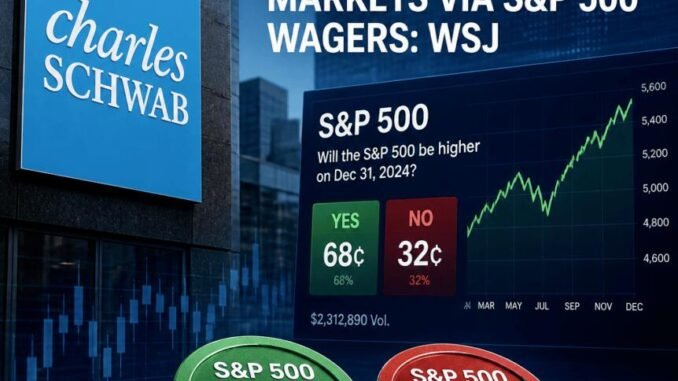

Charles Schwab is reportedly preparing to step into prediction markets, with plans to let customers place straightforward yes-or-no wagers tied to whether the S&P 500 closes above or below a selected price level. If the announcement holds, it would be one of the biggest mainstream finance players yet to formally offer event-style contracts to retail investors.
According to a Friday Wall Street Journal report, the firm is considering options contracts built around S&P 500 performance. The rollout is expected to happen in a matter of months through a partnership with Cboe Global Markets, potentially marking Schwab’s first entry into the prediction market category.
Key takeaways
- Schwab is reportedly planning yes-or-no options contracts based on whether the S&P 500 closes above or below a chosen price.
- The move is expected to be delivered via a partnership with Cboe Global Markets, according to the Wall Street Journal.
- Prediction platforms like Kalshi and Polymarket already offer similar S&P 500 contracts, creating direct competitive pressure.
- US regulators and lawmakers continue to scrutinize prediction markets, including disputes over classification and jurisdiction.
Schwab’s reported wager on the S&P 500
The reported Schwab product would focus on a narrow type of bet: a simple “yes” or “no” outcome tied to the S&P 500 index finishing above or below a target level. Unlike prediction venues that list a wide range of event outcomes—from political developments and sports results to weather and corporate-related milestones—this proposal is said to center on a single, market-linked question.
Earlier examples show how common such “index range” contracts have become. Platforms like Kalshi and Polymarket already provide S&P 500 event contracts, including structures built around the index’s closing level.

For Schwab, the significance is less about adding a new speculative category and more about packaging a format that has gained momentum among retail participants into a product framework familiar to traditional brokerage customers—options-style contracts for mainstream equity exposure.
How prediction markets could intersect with brokerage infrastructure
Prediction markets have expanded well beyond crypto-native audiences, but the most controversial parts of the ecosystem often involve how the products are structured and regulated. If Schwab’s approach is delivered through options contracts in coordination with Cboe, it could suggest a path that aims to fit event trading within established market mechanics rather than operating as a standalone betting platform.
That matters because Schwab is not new to expanding into digital asset-adjacent services. In May, the firm announced the launch of spot Bitcoin and Ether trading for certain retail clients, deepening its participation in crypto-related markets. It also reported record performance for its first quarter of 2026, including net income of $2.5 billion, per Schwab’s earnings release.
While digital assets and prediction markets differ in mechanics and regulatory frameworks, both are increasingly converging on retail demand for “market-like” ways to express views. The reported Schwab plan—anchored on a major benchmark index—could be viewed as a further test of whether prediction-style trading can grow inside institutions that already manage retail trading activity.
Why the timing is sensitive: regulation and ongoing litigation
Even as prediction markets have gained attention, they remain under legal and political pressure in the US. The scrutiny is not limited to any single platform: multiple entities, including Kalshi and Polymarket, have faced challenges tied to how their event contracts are regulated, as well as disputes connected to state oversight.
Lawmakers and state authorities have raised concerns about potential conflicts of interest—especially the idea that elected officials might profit from trading on nonpublic information. There have also been broader questions about whether prediction markets should be allowed to offer event contracts related to sports, an area where some state gaming authorities have challenged platforms’ authority.
At the federal level, the US Commodity Futures Trading Commission (CFTC) under Chair Michael Selig has argued that event contracts in prediction markets can qualify as “swaps,” implying the agency holds exclusive jurisdiction for regulation and enforcement. The resulting regulatory boundary has been a recurring theme in enforcement actions and court cases involving Kalshi, Polymarket, and the CFTC, alongside additional challenges brought by state regulators.
For Schwab, that backdrop makes the reported partnership approach especially important. A mainstream entrant will likely be expected to navigate not just product design, but also the classification of the contracts it sells and the oversight regime under which the business is operating.
Crypto exchanges also eye prediction markets
The Schwab news arrives at a moment when prediction markets are already part of the broader conversation in crypto. Cryptocurrency exchanges have explored prediction offerings, and earlier reporting highlighted that firms such as Coinbase had moved closer to bringing prediction market products to users.
In the same ecosystem, forecasts have suggested that prediction markets could reach very large annual volumes by the end of the decade, driven by retail interest in event trading. Even if those forecasts are aspirational, the common thread is that platforms are competing for the same user behavior: willingness to take positions on uncertain outcomes and pay for exposure to those bets.
If Schwab’s contract structure narrows the focus to index close outcomes, it may also be attempting to differentiate on simplicity and familiarity—offering a more “finance-native” way to place uncertainty around a benchmark—while avoiding some of the event categories that have drawn the most regulatory and reputational attention.
For traders and investors, the key question to watch next is how Schwab’s product will be structured and supervised: whether it truly fits within established brokerage and exchange oversight, and whether ongoing court and regulatory disputes around prediction markets affect its timeline or eventual rollout details. The outcome will likely shape how quickly prediction-style contracts can move from niche platforms into mainstream financial channels.


Be the first to comment