

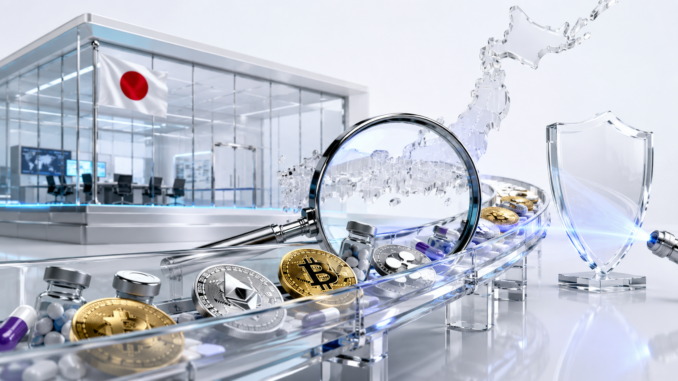
A Nikkei Asia investigation has put a Japan-based corporate trail at the center of suspected crypto-fraud activity tied to a Chinese fentanyl-precursor network.
The case centers on Firsky KK, a company registered in Nagoya, and its connections to Hubei Amarvel Biotech, the Wuhan chemical supplier whose executives were convicted in the U.S. over fentanyl-precursor importation and money laundering offenses. The Japan route had already been under scrutiny because investigators traced a web of companies, websites, sales identities, and shipment claims through Firsky and Amarvel. The latest reporting shifts the focus from shipping cover alone to whether the same Japan-facing structure also helped support crypto-related fraud.
U.S. prosecutors have already tied Amarvel’s business to crypto payments. Wang Qingzhou, also known as Bruce, and Chen Yiyi, also known as Chiron, were sentenced to 25 and 15 years in prison for fentanyl-precursor importation and money laundering offenses. The case involved ton-quantity precursor sales from China to the U.S., with prosecutors saying the company agreed to sell roughly 210 kilograms of fentanyl precursors in exchange for cryptocurrency.
The crypto-fraud suspicion now attached to the Japan base is therefore not a loose reference to digital payments. It sits on top of an existing criminal record that already included precursor sales, cryptocurrency payment rails, domain seizures, website infrastructure, and money-laundering convictions.
Firsky Trail Connects Nagoya To Amarvel
A previous Nikkei investigation identified Fengzhi Xia as the Japan-based figure around Firsky, with U.S. court materials referring to a “boss in Japan.” Firsky was registered in Nagoya’s Nishi Ward, while its China-facing materials presented the business as a Japanese-owned supplier.
The corporate trail became harder to treat as coincidence after open-source researchers tied Firsky and Amarvel through domains, archived ads, phone numbers, sales identities, images, and product listings. Bellingcat’s investigation with Nikkei found that Chen registered domains connected to Amarvel, Firsky, and Wuhan Wingroup, while a seized chemical-sales site was connected to an email using the Firsky Japan domain.
The same investigation found Firsky-branded material advertising products that overlapped with Amarvel, including references to stealth shipping and chemical listings that pointed back to the same sales network. Nikkei also reported that Firsky’s Japan entity was later liquidated in July 2024, while the broader Amarvel-linked network continued to show signs of activity in China.
That makes the Japan base important for two reasons. It allegedly gave the network a cleaner commercial front in a country not widely associated with fentanyl precursor exports, and it created another jurisdictional layer between Chinese suppliers, U.S.-directed shipments, online storefronts, and digital-payment activity.
Crypto Payments Fit The Precursor Trade Pattern
The Amarvel case is one of the clearest examples of how crypto can appear inside synthetic-drug supply chains. The June 2023 U.S. indictment said Wang operated a cryptocurrency wallet that accepted payment for Amarvel’s fentanyl-precursor sales, and prosecutors later said websites and cryptocurrency accounts totaling about $900,000 in digital funds were seized in connection with the scheme.
The wider enforcement pattern is similar. The DEA has said China-based chemical companies often use encrypted communications and accept cryptocurrency payments because those methods reduce detection risk. That same pressure has shown up in cases involving cartel crypto use, where investigators have focused on precursor purchases, cross-border routing, stablecoins, and Chinese money-laundering networks.
The suspected fraud side adds another risk layer. A chemical-supplier network can use websites, cloned corporate identities, false shipping claims, and crypto wallets for more than one purpose: selling controlled or precursor chemicals, collecting payments, moving proceeds, or running scams around buyers who never receive goods. That is why domain records, payment handles, exchange accounts, seized wallets, and corporate registration data matter as much as the physical shipping route.
Crypto compliance pressure has also widened around these patterns. Regulators increasingly treat cross-border virtual-asset businesses as exposed to illicit finance, including in Europe, where Luxembourg recently classified crypto companies as high risk for money laundering.
U.S. Convictions Keep The Case Anchored
Wang and Chen were not convicted of every charge prosecutors brought. A Manhattan jury found them guilty of conspiring to import fentanyl precursors and conspiring to launder money, while they were acquitted of the top fentanyl-manufacturing conspiracy charge. That distinction matters because the confirmed legal outcome is precursor importation and laundering, not a final finding that they manufactured fentanyl themselves.
The evidence still placed the network inside a high-risk supply chain. Prosecutors said Amarvel discussed ton-quantity precursor shipments, used deceptive packaging, shifted routes to avoid U.S. checks, and continued discussing larger orders after being told the chemicals would be used to produce fentanyl.
The Japan thread now gives the case a second front. Firsky’s Nagoya registration, Xia’s alleged role as the Japan-based figure, domain links to Amarvel, and the new suspected crypto-fraud inquiry all point to the same operational question: whether a Japan-facing corporate shell helped the network move beyond chemical sales into digital-payment fraud and laundering.
The confirmed status is that Amarvel’s two executives have been sentenced in the U.S., Firsky’s Japan company was identified and later liquidated, and Nikkei’s latest investigation has placed suspected crypto-fraud activity inside the Japan-linked branch of the same cross-border network.



Be the first to comment