


What to know:
- The CLARITY Act passed committee and heads to a full House vote, seen as a key test for U.S. crypto market reform.
- The bill defines whether digital assets are securities or commodities and outlines registration and disclosure rules.
- Clearer rules could drive institutional adoption and innovation in tokenization and stablecoins, but questions remain on conflicts.

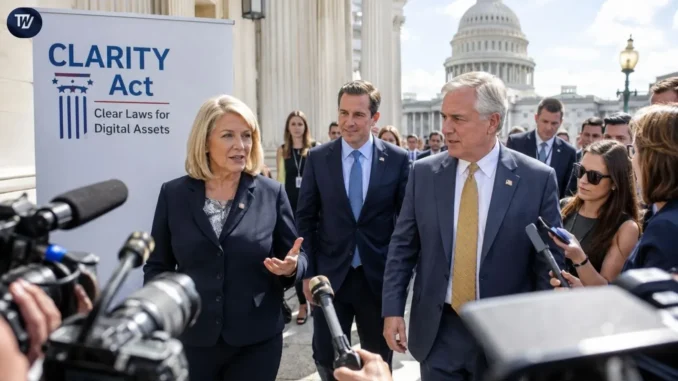
This week, US digital asset regulation took a step forward when Senator Cynthia Lummis said, “The CLARITY Act has passed the committee stage. The floor is next. We have come too far to now turn back at the 5-yard line.” This message underscores the importance of the bill as it heads towards a full House vote. For the crypto, blockchain, and Web3 industries, the bill is a major test to see whether Congress is willing to overhaul the structure of the crypto market.
Defining Regulatory Jurisdiction
One of the main goals of the CLARITY Act is to identify regulatory jurisdiction between the SEC and CFTC. Initially, the bill offers a way of figuring out whether a digital asset is a security or a commodity. It also describes the different registration requirements for crypto exchanges, brokers, and custodians, as well as disclosure obligations for token issuers.

Source: Freedom For All Americans

Through these measures, the bill aims to clarify the legal environment for developers of blockchain, DeFi protocols, and digital asset intermediaries in the US.
Also Read: Galaxy Research Warns CLARITY Act Could Face Major Delays in 2026
Potential Industry Opportunities
By providing a more understandable regulatory structure under the CLARITY Act, institutional adoption could be really boosted as banks, asset managers, and payment firms might get a clearer view of the compliance boundaries. Having detailed rules might also lead to innovations in tokenization, stablecoins, and smart contracts, besides harmonizing US policy with the digital asset systems existing internationally. Startups and infrastructure providers would be given a more certain direction with product launches, audits, and investor protection measures.
Also Read: CLARITY Act: Bold Boost for Crypto Future 2026
Ongoing Challenges and Debate
Still, some stakeholders feel that certain provisions in the CLARITY Act might be at odds with securities laws or create difficulties for decentralized networks. Besides that, there are still some questions about the timeframes for rulemaking, the extent of enforcement, and how staking, mining, and self-custody will be treated. Industry associations keep advocating for the use of technology-neutral language so as not to unintentionally limit blockchain scalability and open-source development.
Also Read: CLARITY Act Faces Senate Delays Before Key August Crypto Regulation Deadline


Be the first to comment